
Water Treatment Solutions for Schools & Universities in Pakistan
Schools, colleges and universities need a dependable supply of clean drinking water for students, teachers, administrative staff and visitors. With hundreds or even thousands of people using water every day, a small water-quality problem can quickly become a major concern.
For educational institutions, the right solution is not simply installing a water filter. The system should be designed around the source-water quality, number of users, daily consumption, required production capacity and available space.
Hydrous Water Technology provides customized water treatment solutions for schools and universities in Pakistan, including RO plants, filtration systems, UV disinfection, water softeners, cartridge filtration and complete drinking-water treatment systems.
Water filtration projects are already being implemented in Pakistani educational institutions. For example, PCRWR reports filtration and RO systems installed at schools in several cities, including Lahore, Bahawalpur, Sargodha, Sialkot, Gujranwala, Multan, Faisalabad and Sahiwal.
In Lahore, UET reported the installation of 25 RO filtration plants and water coolers across its main campus, including hostels and mosque facilities, to provide drinking water for students, faculty and staff.
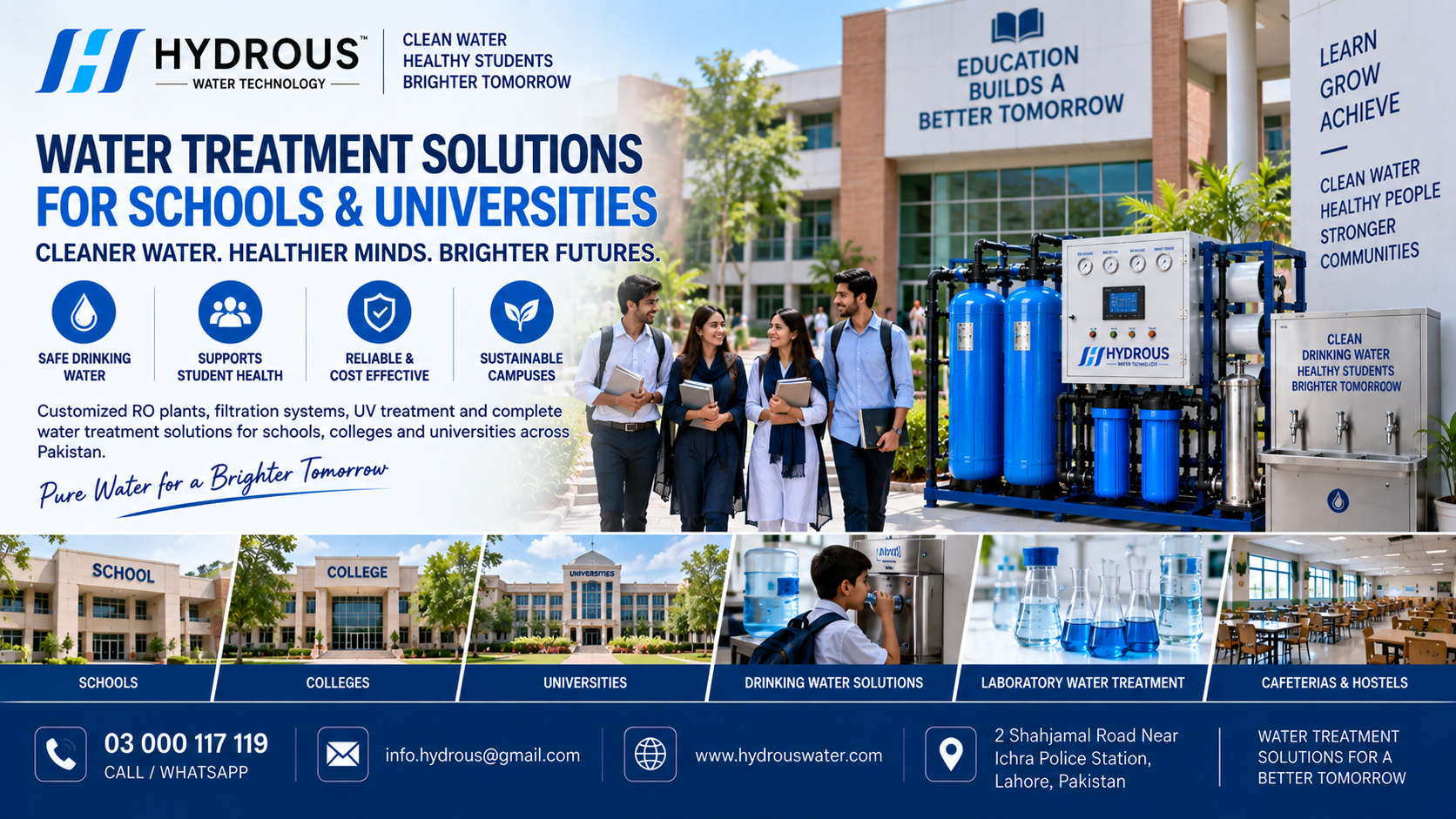
RO plants and water filtration solutions for schools, colleges and universities in Pakistan.
Why Schools Need Reliable Water Treatment
Educational institutions can have a large and constantly changing population.
Water may be required for:
- Drinking
- Water coolers
- Cafeterias
- Kitchens
- Laboratories
- Washrooms
- Hostels
- Mosques
- Sports facilities
- Cleaning
- Gardening
The water-quality requirement can be different for each application.
For example, drinking water requires appropriate treatment and monitoring, while water used for gardening may have completely different requirements.
A properly designed water-treatment system helps an institution manage these requirements more effectively.
School Water Filtration Systems
A school water filtration system can be designed according to the quality of the available water.
A typical drinking-water system may include:
Raw Water → Sediment Filtration → Activated Carbon → RO → UV → Final Filtration → Storage → Drinking Water
However, not every school requires all these stages.
The correct configuration depends on the raw-water analysis.
Some schools may require a simple filtration and disinfection system, while others may require an RO plant because of high TDS, hardness or other dissolved contaminants.
School RO Plant
A school RO plant is commonly used where the incoming water contains high levels of dissolved salts or other contaminants that require membrane treatment.
A typical commercial school RO system can include:
- Feed-water pump
- Sand/media filter
- Activated carbon filter
- Water softener where required
- Cartridge filter
- RO membrane system
- High-pressure pump
- UV sterilization
- Product-water storage
- Drinking-water dispensing system
The plant capacity should be based on actual water consumption rather than simply choosing the largest available RO plant.
University Water Filtration System
Universities can have considerably higher water requirements because they may include:
- Academic buildings
- Hostels
- Laboratories
- Cafeterias
- Staff areas
- Libraries
- Sports facilities
- Mosques
- Research centers
For a large campus, a centralized water treatment system may be more practical than installing small systems throughout the entire institution.
A centralized system can produce treated water and distribute it to selected buildings or drinking-water points.
Alternatively, separate RO systems can be installed in high-demand locations.
The best option depends on the campus layout, water source, consumption and budget.
Drinking Water Treatment for Schools
Drinking-water systems should be designed specifically for human consumption.
The treatment process may include:
Sediment Filtration
Removes suspended particles and turbidity.
Activated Carbon
Helps reduce chlorine, taste and odor and certain organic compounds.
Reverse Osmosis
Reduces dissolved salts and a broad range of dissolved contaminants.
UV Disinfection
Can be used as an additional microbiological control stage.
Final Filtration
Provides additional protection before the treated water reaches the point of use.
The actual treatment stages should be selected after analyzing the source water.
Water Quality Testing for Educational Institutions
Before installing a school or university filtration plant, testing the source water is highly recommended.
Depending on the source and intended application, testing may include:
- pH
- TDS
- Conductivity
- Turbidity
- Total hardness
- Calcium
- Magnesium
- Chloride
- Sulphate
- Iron
- Manganese
- Nitrate
- Fluoride
- Arsenic
- Microbiological parameters
PCRWR provides water-quality testing and analysis services and operates water-quality laboratories in different locations across Pakistan.
Water testing is particularly important because the same RO or filtration configuration may not be suitable for every school.
Water Treatment for School Hostels
University and college hostels can have substantial water demand.
Students may require water throughout the day for:
- Drinking
- Cooking
- Washing
- Cleaning
- Bathrooms
- Prayer facilities
For drinking-water applications, separate treated-water points can be installed near:
- Hostel blocks
- Dining areas
- Common rooms
- Cafeterias
Large campuses can also use centralized treated-water storage and distribution.
UET Lahore’s recent installation of RO plants across its hostels demonstrates how campus-wide drinking-water infrastructure can be distributed across multiple buildings.
Water Filtration for University Laboratories
Universities may have chemistry, biology, environmental science, engineering and medical laboratories.
Laboratory water requirements can be different from normal drinking-water requirements.
A laboratory may require:
- RO water
- DI water
- Deionized water
- High-purity water
- UV-treated water
- Specialized laboratory purification
Therefore, a university may need two separate water-treatment strategies:
Drinking Water System
for students, staff and visitors.
Laboratory Water Purification System
for research, testing and laboratory applications.
This distinction is important because drinking-water treatment and high-purity laboratory water are not the same thing.
Water Treatment for Colleges
Colleges can use commercial filtration systems according to their student population.
A smaller college may require a compact RO plant with a storage tank and drinking-water coolers.
A larger college may require:
Raw Water → Pretreatment → RO → UV → Storage → Multiple Drinking Points
Capacity should be calculated using:
- Number of students
- Staff strength
- Daily operating hours
- Drinking-water demand
- Seasonal demand
- Existing water infrastructure
Water Filtration for School Cafeterias
Cafeterias require water for:
- Drinking
- Cooking
- Food preparation
- Washing
- Cleaning
Where treated water is used for food preparation, the treatment system should be designed according to the quality requirements of the application.
Separate treated-water lines can be considered for drinking and food-preparation areas.
Water Treatment for Educational Campuses
Large educational campuses can benefit from a centralized water-treatment strategy.
A campus may have:
Bore Water / Municipal Water
↓
Pretreatment
↓
RO / Filtration
↓
Treated Water Storage
↓
Distribution
↓
Hostels | Academic Blocks | Cafeterias | Laboratories | Mosques
This approach can simplify monitoring and maintenance.
However, where buildings are widely separated, decentralized systems may be more practical.
How Much RO Capacity Does a School Need?
There is no single RO capacity suitable for every school.
For example, if an institution estimates that it needs 4,000 litres of drinking water per day and the RO plant operates for 8 hours:
4,000 ÷ 8 = 500 litres per hour
A system around 500 LPH could theoretically produce that daily volume under the stated operating schedule.
However, actual system sizing should also consider:
- Peak demand
- Recovery
- Storage
- Operating hours
- Membrane performance
- Maintenance downtime
- Seasonal variation
This is why the plant should be sized after understanding the institution’s actual requirements.
Common RO Plant Capacities for Schools
Depending on the institution, systems may include:
- 250 LPH
- 500 LPH
- 1000 LPH
- 2000 LPH
- 2500 LPH
- 4000 LPH
- 5000 LPH
- 10,000 LPH
- Customized higher-capacity systems
PCRWR’s school-water program includes examples of 500 LPH, 1000 LPH and 2500 LPH systems, as well as other filtration configurations, demonstrating that system capacity can vary significantly between educational facilities.
School Water Filtration Plant with UV
UV can be included as an additional disinfection stage.
A possible arrangement is:
RO → UV → Storage → Drinking Points
or, depending on the application:
Filtration → UV → Storage → Drinking Points
The correct position of UV depends on the treatment process and system design.
UV does not replace appropriate physical and chemical treatment where those treatments are needed.
Arsenic Removal for Schools
Some groundwater sources can contain arsenic.
If arsenic is detected in the source water, the treatment system should be specifically designed for arsenic removal.
Possible treatment approaches depend on:
- Arsenic concentration
- Arsenic form
- pH
- Iron concentration
- Flow rate
- Required treated-water quality
PCRWR documents school installations that include arsenic-removal technology, illustrating the importance of designing treatment around the actual source-water problem.
Do not assume that a standard domestic RO filter is automatically an appropriate arsenic-removal solution. Proper water analysis and system design are essential.
Water Treatment for Schools with Bore Water
Many educational institutions may rely on groundwater.
Bore water can contain:
- High TDS
- Hardness
- Iron
- Manganese
- Fluoride
- Arsenic
- Turbidity
- Microbiological contamination
The treatment process should therefore start with a water-quality analysis.
A possible treatment arrangement could be:
Bore → Raw Water Tank → Media Filter → Carbon Filter → Softener → Cartridge Filter → RO → UV → Treated Water Tank
This is only an example; the actual system should be based on laboratory results.
Water Storage for Schools
Treated-water storage is important where demand varies throughout the day.
For example, students may consume much more water during:
- Break times
- Lunch
- Summer months
- Sports activities
A storage tank allows the treatment system to produce water at a controlled rate while providing a reserve for peak demand.
Tank capacity should be selected according to:
- Plant capacity
- Daily consumption
- Peak demand
- Available space
- Distribution arrangement
Drinking Water Coolers and Dispensing Points
A water-treatment plant is only one part of the complete drinking-water system.
Educational institutions may also require:
- Water coolers
- Drinking fountains
- Bottle-filling stations
- Stainless-steel dispensing points
- Treated-water storage
- Distribution piping
These points should be positioned where students and staff can easily access treated water.
Water Treatment Maintenance for Schools
A school RO plant should have a proper maintenance schedule.
Daily / Routine Checks
Operators can monitor:
- Feed pressure
- Product flow
- TDS
- Pump operation
- Leakage
- Storage level
Filter Maintenance
Sediment and cartridge filters should be replaced according to loading and operating conditions.
RO Membrane Maintenance
Membrane performance should be monitored through:
- Permeate flow
- Feed pressure
- Conductivity/TDS
- Salt rejection
- Differential pressure
UV Maintenance
UV lamps and associated components should be maintained according to manufacturer recommendations.
Tank Cleaning
Treated-water storage tanks should be inspected and cleaned as part of an appropriate maintenance program.
Benefits of a Proper School Water Treatment System
A well-designed system can provide educational institutions with:
Reliable Drinking Water
A properly maintained treatment system can provide a consistent supply of treated water.
Better Water Quality Management
Regular monitoring provides greater visibility into water quality.
Protection of Students and Staff
Appropriate treatment and maintenance can help reduce water-quality risks.
Lower Long-Term Maintenance Problems
Correct pretreatment can protect RO membranes, pumps and downstream equipment.
Scalable Infrastructure
A system can be expanded as student enrollment and campus requirements grow.
Better Campus Facilities
Reliable drinking-water infrastructure is an important part of modern campus facilities.
Water Treatment Solutions for Universities in Pakistan
Hydrous Water Technology can design customized water-treatment systems for:
- Schools
- Colleges
- Universities
- Boarding schools
- Technical institutes
- Medical colleges
- Engineering universities
- Research institutions
- Training centers
- Educational campuses
Solutions can include:
- Commercial RO plants
- School RO plants
- University RO plants
- Drinking-water filtration plants
- Multimedia filtration
- Activated carbon filtration
- Water softeners
- UV systems
- Cartridge filtration
- DI water systems
- Laboratory water purification
- Water storage systems
- Water coolers and dispensing systems
- RO membranes
- Pumps
- Dosing systems
- Water-treatment chemicals
- Installation and commissioning
- Maintenance services
Why Choose Hydrous Water Technology?
Hydrous Water Technology focuses on application-based water-treatment design rather than selling the same system to every customer.
Our process can include:
Water Analysis → Requirement Assessment → System Design → Equipment Selection → Installation → Commissioning → Maintenance
For educational institutions, we can consider the number of users, water source, daily consumption, campus layout and available space before recommending a suitable system.
Educational institutions in Pakistan are already investing in water-quality infrastructure. UET Lahore, for example, has recently expanded RO-based drinking-water facilities across its campus, while PCRWR has documented filtration and RO installations at schools in multiple Pakistani cities.
Get a School or University Water Treatment System
If you are planning a new water filtration plant for a school, college or university, send us:
- Water analysis report
- Number of students
- Number of staff
- Water source
- Daily water requirement
- Required RO capacity
- Number of drinking points
- Existing filtration system
- Available installation area
- Location of the institution
Our team can then recommend an appropriate water-treatment configuration.
Frequently Asked Questions
What type of water filter is best for a school?
It depends on the source-water quality. A school may require sediment and carbon filtration, RO, UV or a combination of technologies. Water analysis should be completed before selecting the system.
Is RO necessary for school drinking water?
Not always. If dissolved salts and other contaminants are low, a suitable filtration and disinfection system may be sufficient. RO is considered when the source-water chemistry requires membrane treatment.
What size RO plant does a school need?
The required capacity depends on the number of students and staff, daily drinking-water consumption, operating hours and peak demand. Common systems range from a few hundred LPH to several thousand LPH.
Can one RO plant supply an entire university?
Yes. A centralized system can supply multiple buildings when the production, storage and distribution system are correctly designed. For very large or distributed campuses, several decentralized systems may be more practical.
Can school RO plants be installed with water coolers?
Yes. RO plants can be integrated with treated-water storage and drinking-water coolers or dispensing stations.
Do schools need water testing before installing an RO plant?
Yes. Water testing helps determine whether the institution needs filtration, softening, RO, UV, arsenic removal or another treatment technology.
Can you provide water treatment systems for schools outside Lahore?
Yes. Hydrous Water Technology serves customers across Pakistan and can provide customized water-treatment solutions based on the project’s location and requirements.