
Plastic & Polymer Industry Water Treatment Solutions in Pakistan
Water is an important utility in plastic and polymer manufacturing. Depending on the production process, water may be used for equipment cooling, temperature control, washing, cleaning, process operations and general factory utilities.
Plastic manufacturing facilities can include injection molding, extrusion, blow molding, PET production, plastic packaging, polymer processing and other specialized operations. Each process can have different water-quality and wastewater-treatment requirements.
Poor-quality water can contribute to scale, corrosion, fouling and reduced cooling efficiency. Wastewater may also contain suspended solids, oils, chemicals, additives and other process-related contaminants.
Hydrous Water Technology provides customized plastic and polymer industry water treatment solutions in Pakistan, including industrial RO plants, filtration systems, water softeners, cooling-water treatment, ETP systems, chemical dosing and water-recycling solutions.
The appropriate treatment process should be selected according to raw-water analysis, process requirements, wastewater characteristics and the required treated-water quality.
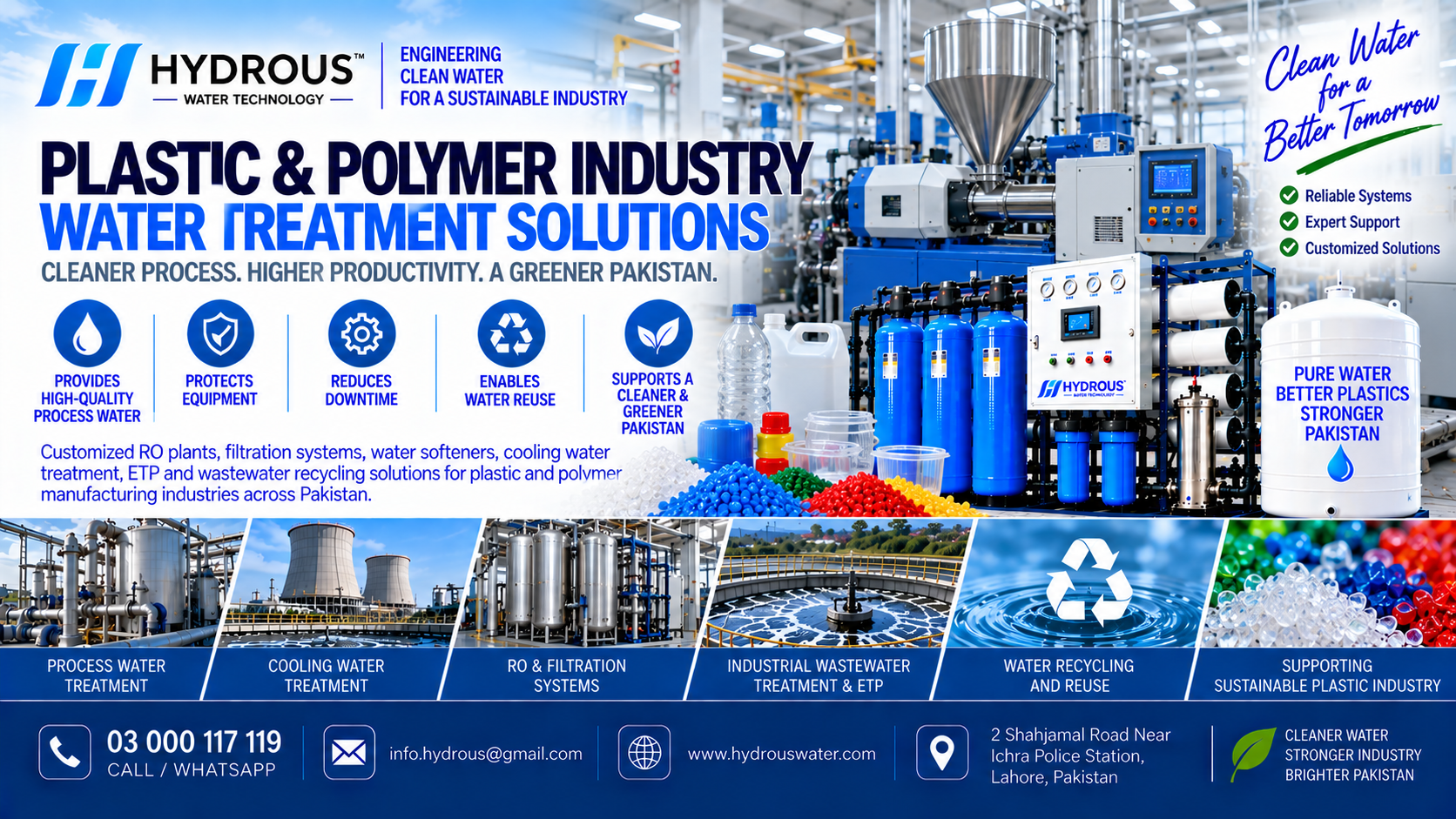
Industrial RO, cooling-water, filtration and wastewater treatment solutions for plastic and polymer industries in Pakistan.
Water Treatment for Plastic Manufacturing
Plastic and polymer factories can require treated water for several applications, including:
- Mold cooling
- Extrusion cooling
- Chiller systems
- Cooling towers
- Equipment cleaning
- Process applications
- Boiler systems
- General utilities
- Washing operations
The water-quality requirement depends on the application.
Cooling systems, for example, may require control of hardness and suspended solids, while boiler systems can require significantly stricter control of dissolved minerals.
Why Water Treatment Is Important in the Plastic Industry
Unsuitable water quality can create operational problems such as:
- Scale formation
- Corrosion
- Fouling
- Blockages
- Reduced heat-transfer efficiency
- Chiller performance problems
- Cooling-system maintenance
- RO membrane fouling
- Increased chemical consumption
A properly designed treatment system can help maintain more consistent water quality and protect equipment.
Industrial RO Plant for Plastic Factories
An industrial RO plant for plastic manufacturing can be used where lower-TDS water is required for process or utility applications.
A typical system may include:
Raw Water Tank → Feed Pump → Multimedia Filter → Activated Carbon Filter → Softener → Cartridge Filter → High-Pressure Pump → RO → Product Water Tank
RO water can potentially be used for:
- Process applications
- Equipment washing
- Boiler-feedwater pretreatment
- Selected cooling applications
- Cleaning
- General utilities
RO capacity should be calculated according to actual water demand, operating hours and required production volume.
Cooling Water Treatment for Plastic Industry
Cooling is one of the most important water-related applications in plastic manufacturing.
Injection molding machines, extrusion equipment, molds and other machinery may use chilled or circulating water for temperature control.
Poor-quality cooling water can contribute to:
- Scale
- Corrosion
- Fouling
- Reduced heat transfer
- Blocked cooling passages
- Increased maintenance
A cooling-water treatment program may include:
- Filtration
- Water softening
- Scale control
- Corrosion control
- Biocide treatment
- pH monitoring
- Blowdown management
The treatment program should be selected according to the cooling-system design and water chemistry.
Chiller Water Treatment for Plastic Manufacturing
Many plastic factories operate chillers for process cooling.
Water quality can affect heat exchangers and cooling circuits.
Depending on the system, treatment may include:
- Side-stream filtration
- Softening
- Chemical dosing
- Corrosion control
- Scale control
- Regular water-quality monitoring
Maintaining appropriate water chemistry can help reduce deposits and fouling in heat-transfer equipment.
Water Softener for Plastic Factories
Hard water contains calcium and magnesium that can form scale in cooling systems and other equipment.
A water softener can reduce hardness through ion exchange.
A common pretreatment configuration can be:
Multimedia Filter → Activated Carbon → Water Softener → Cartridge Filter → RO
Softening requirements should be confirmed through laboratory water analysis.
Filtration Systems for Plastic Industry
Filtration can provide important protection for industrial equipment and downstream treatment systems.
Multimedia Filter
Reduces suspended particles and turbidity.
Sand Filter
Provides physical filtration of particulate matter.
Activated Carbon Filter
Can remove chlorine and adsorb selected organic compounds.
Cartridge Filter
Provides fine filtration and protects RO membranes.
Ultrafiltration
Can be considered where fine suspended solids, colloids and turbidity need additional control.
The correct filtration system depends on the source-water quality and application.
Ultrafiltration for Polymer Manufacturing
UF can be useful as a pretreatment technology where conventional filtration does not provide sufficient control of suspended or colloidal material.
A possible arrangement is:
Raw Water → Pretreatment → UF → RO
UF can help provide more consistent feedwater to downstream RO systems.
Plastic Industry Wastewater Treatment
Wastewater from plastic manufacturing varies according to the production process.
Some facilities generate relatively low volumes of process wastewater, while others may have wastewater from:
- Equipment washing
- Floor cleaning
- Cooling-system blowdown
- Chemical processes
- Printing
- Surface treatment
- Plastic recycling
- Resin or polymer processing
Potential contaminants can include:
- Suspended solids
- Oil and grease
- Organic matter
- Chemicals
- Additives
- Detergents
- High TDS
- Process-specific contaminants
Wastewater should be tested before selecting the final treatment system.
Plastic Industry ETP
An ETP for plastic manufacturing may combine physical, chemical and advanced treatment processes.
A conceptual arrangement can be:
Collection → Screening → Equalization → pH Adjustment → Coagulation & Flocculation → Clarification → Filtration → Final Treatment
Depending on the wastewater, equipment may include:
- Collection tank
- Equalization tank
- Chemical dosing system
- pH correction
- Flash mixer
- Flocculation tank
- Clarifier
- Multimedia filter
- Activated carbon filter
- Cartridge filtration
- Sludge dewatering
The final design should be based on wastewater analysis.
Plastic Recycling Wastewater Treatment
Plastic recycling facilities can have different wastewater characteristics from conventional plastic manufacturing.
Wastewater may originate from:
- Washing lines
- Plastic shredding
- Material cleaning
- Separation processes
- Equipment washing
These streams may contain:
- Suspended solids
- Dirt
- Plastic particles
- Oils
- Detergents
- Organic material
A suitable treatment system may include screening, equalization, sedimentation, filtration and additional treatment where required.
Polymer Industry Wastewater Treatment
Polymer-processing facilities can generate wastewater associated with cleaning, cooling and process operations.
Depending on the polymer and manufacturing process, wastewater may contain:
- Suspended solids
- Dissolved solids
- Organic compounds
- Oils
- Additives
- Chemicals
Treatment technology should be selected after identifying the actual contaminants.
Chemical Dosing for Plastic Industry Water Treatment
Chemical dosing systems can be used in both water and wastewater treatment.
Applications may include:
- pH correction
- Coagulation
- Flocculation
- RO antiscalant
- Scale control
- Corrosion control
- Biocide dosing
- Disinfection
A dosing system can include:
- Chemical tank
- Metering pump
- Injection point
- Calibration arrangement
- Level monitoring
- Control system
Chemical selection should be based on water chemistry and treatment requirements.
Boiler Water Treatment for Plastic Factories
Some large plastic and polymer manufacturing facilities use boilers or steam systems.
Boiler-feedwater may require treatment to control:
- Hardness
- TDS
- Conductivity
- Silica
- Alkalinity
- Corrosion-related parameters
A possible treatment arrangement is:
Filtration → Softener → RO → Chemical Dosing → Boiler
The final design should be based on boiler specifications and feedwater analysis.
Plastic Industry Water Recycling
Water recycling can help reduce freshwater consumption where suitable treated water is available.
A potential recycling arrangement is:
Wastewater → ETP → Clarification → Filtration → UF → RO → Reuse Tank
Depending on the final water quality, recycled water may potentially be used for:
- Cooling
- Equipment washing
- Floor washing
- Utility applications
- Dust control
- Selected process applications
The reuse application determines the required treatment level.
RO Reject and Concentrate Management
RO systems generate a concentrate stream containing higher levels of dissolved salts.
A water-treatment strategy should consider the management of this stream.
Possible approaches include:
- Controlled discharge
- Further treatment
- Recovery systems
- Additional RO stages
- Evaporation
- Recycling where technically feasible
The appropriate solution depends on water chemistry, local requirements and project economics.
Zero Liquid Discharge for Plastic Industry
Where wastewater discharge needs to be minimized significantly, a facility may consider a Zero Liquid Discharge (ZLD) system.
A potential configuration can include:
ETP → UF → RO → Concentrate Management → Evaporation / Crystallization
ZLD systems are specialized and can involve substantial capital and energy requirements.
A technical and economic feasibility assessment should be completed before selecting this approach.
Water Quality Testing for Plastic Factories
Water analysis is essential before designing a treatment system.
Raw Water Testing
Depending on the source:
- pH
- TDS
- Conductivity
- Turbidity
- Hardness
- Alkalinity
- Chloride
- Sulfate
- Iron
- Manganese
- Silica
Cooling Water Testing
Possible parameters include:
- pH
- Conductivity
- TDS
- Hardness
- Alkalinity
- Corrosion indicators
- Microbiological parameters where relevant
Wastewater Testing
Depending on the process:
- pH
- TSS
- TDS
- COD
- BOD
- Oil and grease
- Turbidity
- Chemical-specific parameters
- Other process-specific contaminants
Representative samples should be tested before finalizing the treatment design.
How to Design a Plastic Industry Water Treatment Plant
1. Understand the Manufacturing Process
Identify water-consuming processes and wastewater-generating operations.
2. Calculate Water Consumption
Determine average and peak water demand.
3. Analyze Raw Water
Obtain a complete laboratory analysis.
4. Identify Treatment Requirements
Determine whether the facility requires:
- Filtered water
- Soft water
- RO water
- Cooling water
- Boiler-feedwater
- Recycled water
5. Analyze Wastewater
Identify contaminants and wastewater flow.
6. Select Treatment Technologies
Choose appropriate combinations of:
- Filtration
- Softening
- UF
- RO
- Chemical treatment
- ETP
7. Evaluate Recycling
Identify practical opportunities to recover and reuse treated water.
8. Design Automation
Depending on the project, consider:
- Flow meters
- Pressure gauges
- pH sensors
- Conductivity meters
- Level sensors
- Automatic valves
- PLC control
9. Establish Maintenance Requirements
Plan for:
- Filter replacement
- Membrane cleaning
- Chemical dosing
- Instrument calibration
- Softener regeneration
- Preventive maintenance
Benefits of Proper Water Treatment in Plastic Manufacturing
Protect Cooling Equipment
Water treatment can help reduce scale and fouling in cooling circuits.
Improve Heat Transfer
Better water quality can help maintain heat-transfer performance.
Protect RO Membranes
Appropriate pretreatment can reduce membrane fouling.
Improve Process Water Quality
Treatment can provide water suitable for specific industrial requirements.
Improve Wastewater Management
An appropriately designed ETP can treat contaminated process wastewater.
Support Water Recycling
Treated water can potentially be reused for suitable applications.
Reduce Water-Related Maintenance
Better control of water chemistry can help reduce certain scale, corrosion and fouling problems.
Sustainable Water Management in the Plastic Industry
Plastic manufacturers can improve water efficiency by managing the entire water cycle.
A practical approach is:
Reduce → Treat → Recover → Reuse
This can include:
- Reducing unnecessary water consumption
- Optimizing cooling systems
- Improving filtration
- Treating wastewater
- Recovering suitable water
- Reusing treated water
- Monitoring water quality
- Controlling water losses
Water-recycling projects should be evaluated based on technical feasibility and the required quality of reuse water.
Plastic & Polymer Industry Water Treatment Solutions in Pakistan
Hydrous Water Technology provides customized water and wastewater treatment solutions for plastic and polymer manufacturing facilities in Pakistan.
Our solutions include:
- Industrial RO plants
- Commercial RO plants
- Multimedia filters
- Sand filtration
- Activated carbon filters
- Water softeners
- Ultrafiltration systems
- Industrial ETPs
- Wastewater treatment
- Cooling-water treatment
- Chiller-water treatment
- Boiler-water treatment
- Chemical dosing systems
- Water recycling
- RO antiscalant systems
- Membrane cleaning solutions
- Installation and commissioning
- Preventive maintenance
Every project is evaluated according to the customer’s water quality, manufacturing process, capacity and treatment objectives.
Why Choose Hydrous Water Technology?
Hydrous Water Technology provides commercial and industrial water-treatment solutions in Pakistan.
For plastic and polymer projects, we consider:
- Raw-water quality
- Manufacturing process
- Water consumption
- Cooling requirements
- Wastewater characteristics
- Required capacity
- Required treated-water quality
- Existing equipment
- Available installation space
- Water-recycling opportunities
- Maintenance requirements
This project-specific approach helps ensure that the proposed treatment system is suitable for the actual operating conditions.
Get a Plastic Industry Water Treatment Solution
Planning an industrial RO plant, cooling-water treatment system, plastic factory ETP or wastewater recycling project?
Share the following information with our team:
- Raw-water analysis
- Wastewater analysis
- Daily water consumption
- Wastewater flow
- Production capacity
- Manufacturing process
- Cooling-system details
- Existing treatment system
- Required treated-water quality
- Project location
- Available installation area
This information can help determine the appropriate treatment technology and system capacity.
Hydrous Water Technology
Call / WhatsApp: 03 000 117 119
Email: info.hydrous@gmail.com
Website: hydrouswater.com
Address: 2 Shahjamal Road Near Ichra Police Station, Lahore, Pakistan
Frequently Asked Questions
What water treatment does the plastic industry require?
Plastic factories may require filtration, softening, RO, cooling-water treatment, boiler-water treatment and wastewater treatment depending on their manufacturing processes.
Is an RO plant suitable for plastic factories?
Yes. Industrial RO can provide lower-TDS water for suitable process and utility applications and can also be used as pretreatment for other purification systems.
Why is cooling-water treatment important in plastic manufacturing?
Cooling systems are commonly used for molding, extrusion and other equipment. Scale, corrosion and fouling can reduce cooling efficiency, making suitable water treatment important.
Does plastic recycling require wastewater treatment?
Plastic recycling facilities can generate wastewater from washing and cleaning operations. Treatment requirements depend on the wastewater’s actual contaminants and flow.
Can plastic factory wastewater be recycled?
Yes. After appropriate treatment, wastewater can potentially be reused for suitable industrial applications such as cooling, washing or utilities.
What is an ETP for the plastic industry?
An ETP is an Effluent Treatment Plant designed to treat industrial wastewater. Depending on the wastewater, it may include equalization, pH adjustment, chemical treatment, clarification and filtration.
Does Hydrous provide plastic industry water treatment in Pakistan?
Yes. Hydrous Water Technology provides industrial RO, filtration, cooling-water treatment, ETP, wastewater treatment, chemical dosing and water-recycling solutions for plastic and polymer industries in Pakistan.