
Leather & Tannery Industry Water Treatment Solutions in Pakistan
The leather and tanning industry uses water throughout several stages of hide and skin processing, including soaking, liming, washing, tanning, dyeing and finishing. These processes can generate wastewater containing suspended solids, organic matter, salts, sulfides, dyes and chromium compounds.
For this reason, an effective tannery wastewater treatment system requires more than a single filtration process. Depending on the wastewater characteristics and treatment objective, a tannery may require a combination of screening, equalization, chemical treatment, biological treatment, filtration, membrane treatment and other advanced processes.
Hydrous Water Technology provides customized leather and tannery industry water treatment solutions in Pakistan, including industrial RO plants, filtration systems, water softeners, chemical dosing systems, ETPs, wastewater treatment and water-recycling solutions.
Every tannery project should be designed according to actual wastewater analysis, production capacity, water consumption and the required treated-water quality.
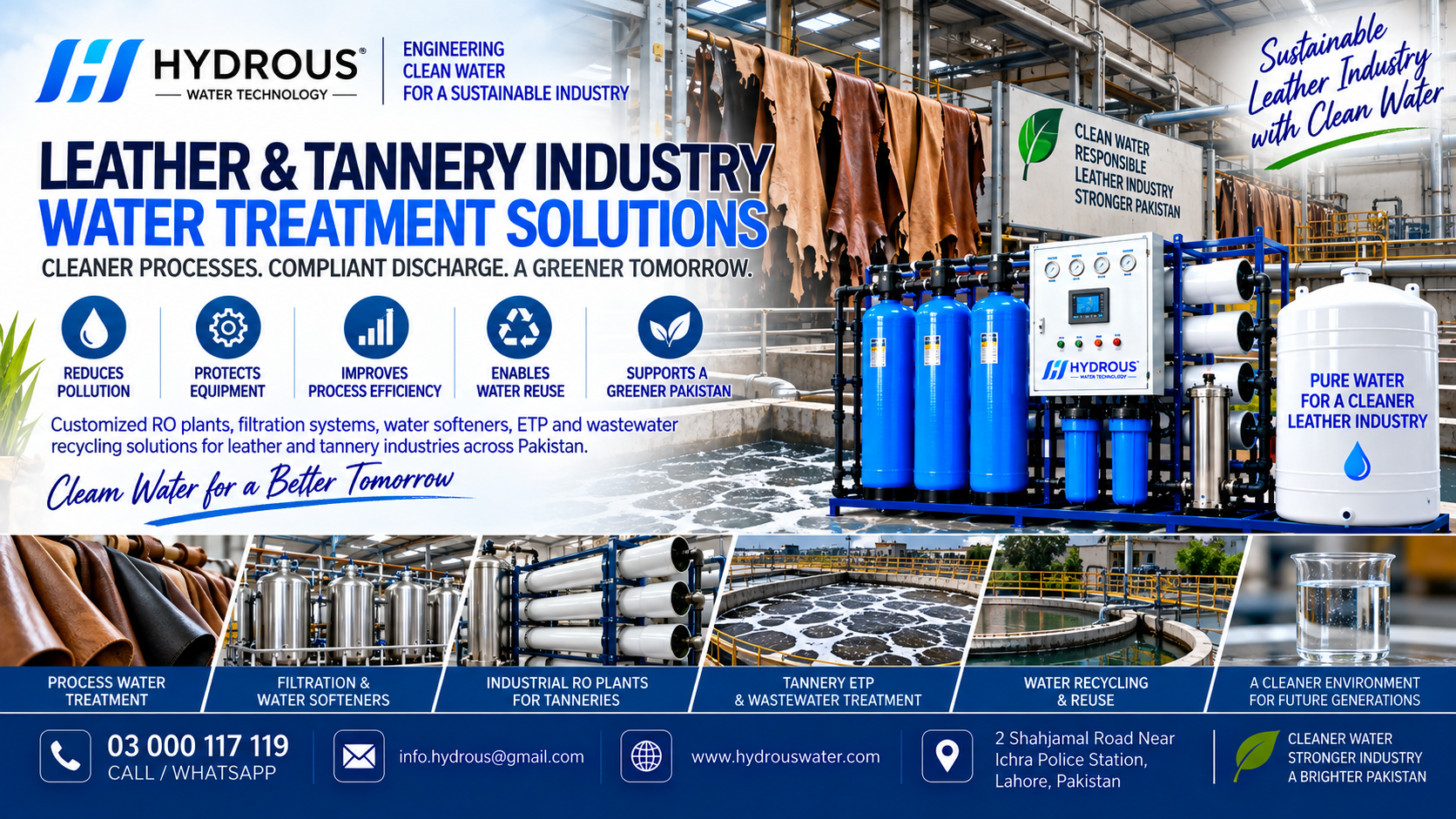
Industrial RO, ETP, chromium treatment and wastewater recycling solutions for leather and tannery industries in Pakistan.
Why Water Treatment Is Important in the Leather Industry
Leather processing can generate wastewater with a complex mixture of contaminants. Published research identifies parameters and contaminants including COD, BOD, TSS, TDS, sulfides, chlorides, salts, dyes and chromium in tannery wastewater.
Poorly treated wastewater can create problems for:
- Surface water
- Soil
- Local drainage systems
- Industrial wastewater networks
- Nearby ecosystems
- Water-reuse programs
Chromium is a particularly important consideration in many chrome-tanning processes. Research on tannery effluent treatment has therefore examined chemical precipitation, adsorption, biological processes, membranes, electrochemical treatment and other technologies for chromium removal.
Leather Industry Water Treatment Applications
A leather factory may require several different water-treatment systems.
Process Water Treatment
Provides suitable-quality water for manufacturing and cleaning processes.
Industrial RO Plant
Reduces dissolved salts and TDS where lower-mineral water is required.
Water Softener
Reduces hardness before sensitive equipment or process applications.
Filtration System
Removes suspended solids and other contaminants from incoming water.
Tannery ETP
Treats wastewater generated by leather processing.
Chromium Treatment
Provides targeted treatment where chromium is present in wastewater.
Wastewater Recycling
Allows suitably treated wastewater to be reused for selected applications.
Tannery Wastewater Treatment Plant
A tannery wastewater treatment plant should be designed around the actual characteristics of the effluent.
A conceptual treatment train may look like:
Collection → Screening → Equalization → pH Adjustment → Coagulation & Flocculation → Primary Clarification → Biological Treatment → Secondary Clarification → Tertiary Filtration → Final Treatment
Additional treatment may be required depending on the wastewater.
Potential technologies include:
- DAF
- MBBR
- SBR
- Activated sludge
- MBR
- Activated carbon
- UF
- RO
- Ozone
- Advanced oxidation
- Electrochemical treatment
Research reviews indicate that integrated or combined treatment processes are generally more promising than relying on a single treatment technology for complex tannery wastewater.
Chromium Removal from Tannery Wastewater
Chromium removal is one of the most important considerations for many chrome-tanning operations.
Treatment options can include:
Chemical Precipitation
Chemicals are used to convert dissolved chromium into a form that can be separated from the wastewater.
Coagulation and Flocculation
These processes can help remove suspended material and chromium-containing solids.
Adsorption
Selected adsorbents can be used for additional contaminant removal.
Membrane Treatment
UF, NF and RO can be incorporated into appropriate treatment systems.
Electrochemical Treatment
Electrocoagulation and related electrochemical technologies have also been investigated for tannery effluent treatment.
The appropriate process depends on chromium concentration, wastewater chemistry, flow rate and the required final water quality.
Sulfide Treatment in Tannery Wastewater
Sulfides can enter wastewater during certain leather-processing operations.
They require careful management because wastewater chemistry can change significantly with pH and process conditions.
A treatment system may use:
- Equalization
- pH control
- Chemical oxidation
- Chemical precipitation
- Biological treatment
- Appropriate ventilation and safety controls
The exact treatment process should be established through wastewater characterization and pilot or jar testing where appropriate.
Tannery Wastewater Filtration
Filtration is an important part of wastewater treatment.
Depending on the system, filtration can include:
Multimedia Filtration
Used to reduce suspended solids and turbidity.
Sand Filtration
Can provide additional physical removal of particulate matter.
Activated Carbon
Can provide adsorption of selected organic compounds and colour.
Cartridge Filtration
Provides fine filtration before sensitive downstream equipment.
Membrane Filtration
UF, NF and RO can be used where higher-level treatment or water recovery is required.
Biological Treatment for Tannery Wastewater
Biological treatment can help reduce biodegradable organic matter.
Possible technologies include:
- Activated sludge
- MBBR
- SBR
- MBR
- Anaerobic treatment
- Aerobic treatment
However, tannery wastewater may contain chromium, sulfides, salinity and other compounds that influence biological treatment performance. Reviews therefore support combining physicochemical and biological treatment where appropriate.
A possible arrangement is:
Physicochemical Pretreatment → Biological Treatment → Clarification → Tertiary Treatment
MBBR for Leather Industry Wastewater
A Moving Bed Biofilm Reactor (MBBR) can be considered as part of a biological treatment stage.
MBBR systems use carrier media to support microbial growth and can be incorporated into compact industrial wastewater-treatment plants.
The system can be considered for reducing biodegradable organic loading after appropriate pretreatment.
The actual reactor size should be calculated from:
- Flow
- COD
- BOD
- Organic loading
- Temperature
- Required removal
- Hydraulic retention time
SBR for Tannery ETP
A Sequencing Batch Reactor (SBR) performs biological treatment in controlled cycles.
An SBR can combine:
- Fill
- React
- Settle
- Decant
within a single reactor.
It can be considered where a compact biological treatment arrangement is suitable.
The selection between SBR, MBBR, MBR and conventional activated sludge should be based on wastewater characteristics, available space, operating requirements and treated-water objectives.
Industrial RO Plant for Leather Industry
An industrial RO plant for leather factories can be used to produce lower-TDS water for applications where dissolved salts need to be controlled.
A typical pretreatment arrangement may include:
Raw Water → Multimedia Filter → Activated Carbon → Softener → Cartridge Filter → High-Pressure Pump → RO
The RO permeate can then be stored in a treated-water tank.
Where wastewater recycling is required, additional pretreatment may be necessary before the RO system.
RO for Tannery Wastewater Recycling
RO can be considered as a tertiary treatment or water-recovery stage after suitable wastewater treatment.
A possible arrangement is:
Tannery Wastewater → ETP → UF → RO → Recycled Water Tank
The objective may be to recover water for selected non-critical or process applications.
However, membrane fouling, scaling, salinity and concentrate management must be considered. Tannery wastewater is particularly complex, and membrane systems generally require effective pretreatment.
Water Softener for Leather Factories
Hard water can cause scaling in:
- RO systems
- Boilers
- Heat exchangers
- Process equipment
- Hot-water systems
A water softener can reduce calcium and magnesium hardness before downstream applications.
A possible arrangement is:
Multimedia Filter → Activated Carbon → Softener → Cartridge Filter → RO
Softening does not replace RO because it does not remove the majority of dissolved salts.
Chemical Dosing in Tannery Water Treatment
Chemical dosing can be required at different stages of tannery water and wastewater treatment.
Applications may include:
- pH correction
- Coagulation
- Flocculation
- Chromium precipitation
- RO antiscalant
- Disinfection
- Oxidation
- Boiler-water treatment
- Cooling-water treatment
A dosing system may include:
- Chemical storage tank
- Dosing pump
- Injection point
- Calibration system
- Mixing arrangement
- Control panel
Chemical selection should be based on water chemistry and treatment objectives.
Tannery ETP Sludge Management
Wastewater treatment can generate sludge containing concentrated contaminants removed from the wastewater.
For tannery ETPs, sludge management is particularly important where chromium or other hazardous constituents are concentrated in the solids.
Research identifies chromium-containing treatment sludge and other treatment by-products as important management challenges.
A complete ETP project should therefore consider:
- Sludge production
- Sludge dewatering
- Storage
- Handling
- Testing
- Final disposal or approved management route
Water Recycling in the Leather Industry
Water recycling can help reduce freshwater demand where the required quality can be achieved economically.
A recycling system may include:
ETP → Tertiary Filtration → UF → RO → Storage → Reuse
Potential reuse applications can include:
- Equipment washing
- Floor cleaning
- Utility applications
- Cooling
- Selected process applications
The reuse application should be selected only after defining the required water quality.
Leather Industry Water Quality Monitoring
Regular water testing helps maintain treatment performance.
Raw Water Parameters
Depending on the source:
- pH
- TDS
- Conductivity
- Hardness
- Alkalinity
- Turbidity
- Iron
- Manganese
- Chlorine
- Other site-specific parameters
Tannery Wastewater Parameters
Depending on the process:
- pH
- TSS
- TDS
- BOD
- COD
- Sulfides
- Sulfates
- Chlorides
- Chromium
- Colour
- Oil and grease
- Other site-specific contaminants
The exact laboratory testing program should be established according to the factory’s processes and discharge or reuse requirements.
How to Design a Tannery ETP
A professional tannery wastewater project should follow a systematic process.
Step 1 — Understand the Production Process
Identify:
- Soaking
- Liming
- Unhairing
- Deliming
- Pickling
- Tanning
- Dyeing
- Finishing
Step 2 — Measure Wastewater Flow
Determine average and peak wastewater generation.
Step 3 — Conduct Wastewater Analysis
Test representative samples.
Step 4 — Separate Wastewater Streams Where Practical
Separate high-strength or specific streams where process design makes this beneficial.
Step 5 — Perform Treatability Testing
Jar testing and other treatability work can help determine suitable chemical treatment.
Step 6 — Design Primary Treatment
This may include screening, equalization, pH control and clarification.
Step 7 — Design Biological Treatment
Select MBBR, SBR, MBR or another suitable technology.
Step 8 — Design Tertiary Treatment
Use filtration, activated carbon, membranes or advanced treatment as required.
Step 9 — Plan Sludge Handling
Include dewatering and appropriate disposal or management.
Step 10 — Consider Water Reuse
Where technically and economically practical, assess treated-water reuse.
Tannery ETP Capacity Calculation
ETP capacity should be based on actual wastewater generation.
For example, if a tannery generates:
500 m³/day
and operates its ETP for 20 hours per day:
500 ÷ 20 = 25 m³/hour
The hydraulic design would therefore start around 25 m³/hour, before considering equalization, peak flows and design safety factors.
The final ETP capacity should be established from actual flow measurements rather than simply selecting a standard plant.
Automation for Tannery ETP
Automation can improve consistency and operational control.
Possible features include:
- Automatic level control
- pH monitoring
- Flow monitoring
- Chemical dosing control
- Pump protection
- Automatic filter backwashing
- Blower control
- ORP monitoring where applicable
- Alarm systems
- PLC control panels
For larger facilities, a centralized PLC/SCADA system can be considered.
Benefits of a Proper Tannery Water Treatment System
A properly engineered system can help a leather-processing facility:
Improve Wastewater Quality
Reduce targeted pollutants before discharge or reuse.
Control Chromium
Provide dedicated treatment where chromium is present.
Reduce Suspended Solids
Primary and tertiary filtration can improve treated-water clarity.
Reduce Organic Loading
Biological treatment can reduce biodegradable organic matter.
Protect Equipment
Proper process-water treatment can reduce scaling and fouling.
Support Water Reuse
Advanced treatment can create opportunities for recycling suitable wastewater streams.
Improve Operational Control
Automation and regular monitoring help operators identify changes in treatment performance.
Sustainable Water Management for Tanneries
Modern tannery water management should go beyond end-of-pipe treatment.
A better approach is:
Reduce → Separate → Treat → Recover → Reuse
This can include:
- Reducing unnecessary water consumption
- Improving process efficiency
- Separating specific wastewater streams
- Recovering selected chemicals where practical
- Optimizing ETP operation
- Treating wastewater appropriately
- Recovering water through membrane systems
- Managing sludge responsibly
Recent research increasingly focuses on integrated treatment, water recovery and resource recovery rather than treating tannery wastewater only as a disposal problem.
Leather & Tannery Water Treatment in Pakistan
Pakistan has an established leather-processing sector, and Sialkot is an important centre for leather manufacturing and tanning. Research on Sialkot has specifically examined tannery wastewater-treatment challenges and treatment approaches.
For Pakistani tanneries, treatment design should account for:
- Local water quality
- Production process
- Wastewater flow
- Seasonal variations
- Chemical usage
- Required discharge quality
- Available land
- Electricity availability
- Operating and maintenance requirements
A system designed specifically for the individual tannery will generally be more practical than a generic ETP design.
Why Choose Hydrous Water Technology?
Hydrous Water Technology provides customized industrial water and wastewater-treatment solutions in Pakistan.
Our solutions for leather and tannery facilities can include:
- Industrial RO plants
- Commercial RO plants
- Multimedia filters
- Activated carbon filters
- Water softeners
- UF systems
- RO membrane systems
- Chemical dosing systems
- Tannery ETP systems
- Industrial wastewater treatment
- Chromium-treatment solutions
- Wastewater filtration
- Water-recycling systems
- RO antiscalants
- Membrane cleaning chemicals
- Boiler-water treatment
- Cooling-water treatment
- Installation and commissioning
- Preventive maintenance
We recommend starting every tannery wastewater project with flow measurement and laboratory analysis before finalizing the treatment technology.
Get a Leather & Tannery Water Treatment Solution
If you are planning an ETP, RO plant or wastewater-recycling project for a leather factory, provide:
- Raw-water analysis
- Wastewater analysis
- Daily water consumption
- Daily wastewater flow
- Leather-processing capacity
- Existing ETP details
- Chromium concentration
- COD and BOD
- TSS and TDS
- Required treated-water quality
- Available installation area
- Project location
Based on this information, the treatment process and equipment can be properly sized.
Frequently Asked Questions
What wastewater treatment is required for a tannery?
Depending on the leather-processing operations, a tannery may require screening, equalization, pH control, coagulation, clarification, biological treatment, filtration and advanced treatment such as membranes.
Why is chromium important in tannery wastewater?
Chromium can be present in wastewater from chrome tanning. Dedicated treatment may therefore be required to control chromium concentrations.
Can tannery wastewater be recycled?
Yes, appropriately treated wastewater can potentially be recovered for selected applications. Membrane-based treatment is one of the technologies being investigated for tannery-water reclamation.
Is RO suitable for tannery wastewater?
RO can be suitable as a tertiary water-recovery stage, but it normally requires effective upstream treatment to control suspended solids, organic fouling and scaling.
What is the difference between a tannery ETP and an RO plant?
An ETP primarily treats industrial wastewater, while an RO plant uses membrane separation to reduce dissolved salts and other contaminants. They can be used together in a water-recycling system.
Can one standard ETP be used for every tannery?
No. Tannery wastewater varies according to leather type, production process, chemicals, water consumption and operating conditions. Treatment should therefore be based on actual wastewater analysis.
Does Hydrous provide tannery ETP solutions in Pakistan?
Yes. Hydrous Water Technology provides customized industrial wastewater-treatment, ETP, RO, filtration, chemical-dosing and water-recycling solutions for industrial applications in Pakistan.