
Sugar Industry Water Treatment Solutions in Pakistan
Water plays an important role in sugar manufacturing and the operation of sugar mills. From process water and boiler feedwater to cooling systems, equipment washing and wastewater management, a reliable water-treatment system can support efficient plant operations.
Sugar mills also deal with wastewater streams that can contain suspended solids, organic matter, high BOD and COD, colour and other process-related contaminants. The characteristics of the wastewater can vary according to the production process, raw material, chemicals and operating conditions.
Hydrous Water Technology provides customized sugar industry water treatment solutions in Pakistan, including industrial RO plants, multimedia filtration, activated carbon filtration, water softeners, boiler-water treatment, cooling-water treatment, chemical dosing, ETP systems and water-recycling solutions.
Our approach is based on the actual water analysis, process requirements, plant capacity and required treated-water quality.
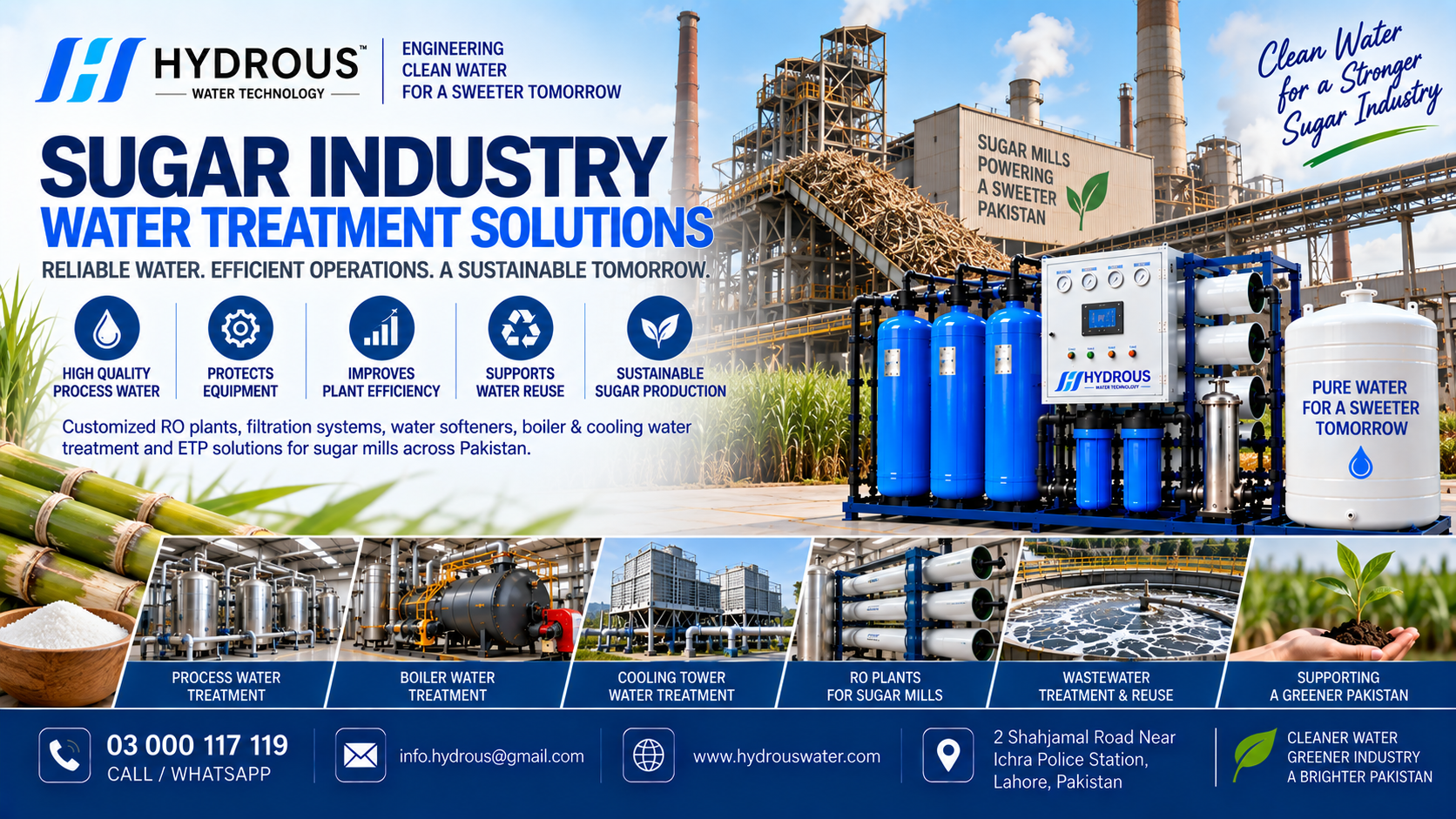
Industrial RO, filtration, boiler, cooling-water and wastewater treatment solutions for sugar mills in Pakistan.
Why Water Treatment Is Important in Sugar Mills
Sugar manufacturing involves several water-intensive operations and utility systems.
Poor-quality water can contribute to:
- Scale formation
- Corrosion
- Fouling
- Suspended-solids problems
- Boiler deposits
- Cooling-system problems
- RO membrane fouling
- Higher maintenance requirements
- Reduced equipment efficiency
Not every application requires the same water quality.
For example, boiler feedwater may require much better control of hardness and dissolved salts than water used for general floor washing.
A properly designed water-treatment strategy therefore separates water requirements according to their application.
Water Treatment Applications in the Sugar Industry
A sugar mill may require treated water for:
Process Water
Used in different stages of sugar production.
Boiler Feedwater
Used for steam generation and utility operations.
Cooling Water
Used for condensers, heat exchangers and cooling systems.
Equipment Cleaning
Used for cleaning machinery and production areas.
RO / Purified Water
Used where reduced TDS or specific water quality is required.
Drinking Water
Provided for workers, staff and visitors.
Wastewater Treatment
Used to treat industrial effluent before discharge or possible reuse.
Industrial RO Plant for Sugar Mills
An industrial RO plant for sugar mills can be used when the raw-water TDS or dissolved mineral content is unsuitable for the intended application.
A typical RO system may include:
Raw Water Tank → Feed Pump → Multimedia Filter → Activated Carbon Filter → Water Softener → Cartridge Filter → High-Pressure Pump → RO Membranes → Product Water Tank
The final configuration depends on the raw-water laboratory analysis.
RO can be particularly useful where lower-TDS water is required for selected process or utility applications.
For high-purity applications, additional treatment such as demineralization or polishing may be required after RO.
Sugar Mill Water Filtration System
Pretreatment is an important part of a reliable industrial water-treatment system.
Depending on raw-water conditions, a sugar factory may use:
Multimedia Filter
Designed to reduce suspended solids and turbidity.
Activated Carbon Filter
Used where chlorine, organic compounds, taste or odour require control.
Water Softener
Used to reduce hardness where scale control is required.
Cartridge Filter
Provides finer filtration before sensitive downstream equipment.
Bag Filter
Can be considered for selected industrial filtration applications.
The correct filtration arrangement should be determined from the raw-water analysis rather than using the same design for every sugar mill.
Boiler Water Treatment for Sugar Mills
Boilers are an important part of many sugar-mill utility systems.
Boiler feedwater containing excessive hardness or other undesirable contaminants can contribute to deposits and operational problems.
A possible treatment arrangement is:
Raw Water → Multimedia Filter → Activated Carbon Filter → Softener → RO → Chemical Dosing → Boiler
Depending on boiler pressure and water-quality requirements, a DM or other polishing system may also be necessary.
The final specification should be matched with the boiler manufacturer’s requirements and operating conditions.
Cooling Water Treatment for Sugar Industry
Sugar mills use cooling systems for different equipment and process applications.
Cooling water can become concentrated with dissolved minerals as water evaporates. Without proper control, this can contribute to:
- Scaling
- Corrosion
- Fouling
- Biological growth
- Reduced heat-transfer efficiency
A cooling-water treatment program may include:
- Filtration
- Blowdown management
- Scale-control chemicals
- Corrosion inhibitors
- Biocides
- Dispersants
- Water-quality monitoring
The appropriate treatment depends on cooling-system design and water chemistry.
Sugar Mill Wastewater Treatment
Sugar-mill wastewater can vary considerably depending on the production process and sources of wastewater within the facility.
Potential wastewater characteristics may include:
- High BOD
- High COD
- Suspended solids
- Organic matter
- Colour
- Variable pH
- Process residues
- Dissolved solids
Because wastewater characteristics differ between plants, an ETP should be designed after representative wastewater sampling and laboratory analysis.
Effluent Treatment Plant for Sugar Mills
A conceptual sugar-mill ETP may include:
Collection → Screening → Equalization → pH Adjustment → Primary Treatment → Biological Treatment → Clarification → Filtration → Final Treatment
Depending on the required treated-water quality, additional processes may include:
- Coagulation
- Flocculation
- DAF
- MBBR
- SBR
- MBR
- Activated carbon
- UF
- RO
- Disinfection
The final process should be selected according to the actual wastewater characteristics and discharge or reuse requirements.
Biological Wastewater Treatment for Sugar Factories
Sugar-industry wastewater can contain significant biodegradable organic matter.
Biological treatment can therefore be an important part of an ETP.
Depending on the application, treatment technologies can include:
- Aerobic treatment
- Anaerobic treatment
- Activated sludge
- MBBR
- SBR
- MBR
Anaerobic treatment may also be considered for selected high-organic-load wastewater streams.
The appropriate technology depends on wastewater strength, available space, energy requirements, sludge management and the desired final water quality.
pH Control in Sugar Mill Wastewater
Wastewater pH may vary according to the processes and chemicals used at the facility.
An automated pH-control system can monitor wastewater continuously and dose acid or alkali when required.
A typical arrangement can include:
Equalization Tank → pH Sensor → Controller → Dosing Pump → Chemical Injection → Mixing
Online pH monitoring can provide better control than manual dosing alone.
Sugar Mill Water Recycling
Water recycling can be considered where treated water can meet the requirements of the intended reuse application.
Potential reuse areas include:
- Equipment washing
- Cooling systems
- Utility applications
- Floor washing
- Gardening
- Selected process applications
A recycling system may use:
Wastewater Treatment → Filtration → UF / RO → Treated Water Storage → Reuse
The final treatment level depends on the intended application.
Improving Water Efficiency in Sugar Mills
A water-management program can help identify where water is being consumed unnecessarily.
Sugar mills can consider:
- Water metering
- Leak detection
- Process-water optimization
- Cooling-water optimization
- Condensate recovery
- Treated-water reuse
- RO recovery optimization
- Chemical-dosing optimization
- Regular equipment maintenance
Instead of treating all water to the highest quality, the plant can use fit-for-purpose water for different applications.
Water Softener for Sugar Industry
Hard water can create scaling problems in boilers, heat exchangers and other equipment.
A water softener exchanges hardness ions and can be used as part of a pretreatment system.
For example:
Multimedia Filter → Carbon Filter → Softener → Cartridge Filter → RO
However, a softener does not replace RO.
A softener primarily targets hardness, while RO reduces a much broader range of dissolved contaminants.
Chemical Dosing Systems for Sugar Mills
Chemical dosing can be used throughout sugar-mill water and wastewater systems.
Typical applications include:
- RO antiscalant dosing
- pH adjustment
- Coagulation
- Flocculation
- Boiler-water treatment
- Cooling-water treatment
- Disinfection
A dosing system can include:
- Chemical storage tank
- Dosing pump
- Injection assembly
- Mixer
- Calibration system
- Controller
Automatic dosing can improve consistency and reduce unnecessary chemical consumption when properly configured.
RO Membrane Protection in Sugar Mills
RO membranes require suitable pretreatment to operate reliably.
Poor pretreatment can lead to:
- Scaling
- Suspended-solids fouling
- Organic fouling
- Increased pressure
- Reduced permeate flow
- Increased cleaning frequency
Important RO operating parameters include:
- Feed pressure
- Permeate flow
- Reject flow
- Feed conductivity
- Product conductivity
- Salt rejection
- Differential pressure
Monitoring these parameters helps identify changes in system performance.
How to Design a Sugar Mill Water Treatment System
A successful project starts with understanding the complete water requirement.
Step 1 — Analyze the Raw Water
Obtain a representative laboratory report.
Step 2 — Identify Water Sources
Determine whether the mill uses:
- Bore water
- Canal or surface water
- Municipal water
- Tanker water
- Recycled water
Step 3 — Identify Applications
Determine where treated water will be used.
Step 4 — Establish Water Quality
Specify whether each application needs:
- Filtered water
- Soft water
- RO water
- Demineralized water
- Recycled water
Step 5 — Analyze Wastewater
Test wastewater from relevant production and utility streams.
Step 6 — Design the ETP
Select primary, biological and tertiary treatment according to the analysis.
Step 7 — Evaluate Reuse
Identify suitable opportunities for treated-water recycling.
Step 8 — Calculate Capacity
Consider daily consumption, peak demand, operating hours and future expansion.
Sugar Mill RO Plant Capacity
RO capacity should be calculated from actual water consumption.
For example, if a sugar mill requires 60,000 litres of RO water per day and the plant operates for 12 hours:
60,000 ÷ 12 = 5,000 LPH
An RO production capacity of approximately 5,000 LPH could therefore be an initial design reference.
The final capacity should also account for:
- Peak demand
- RO recovery
- Storage capacity
- Operating schedule
- Maintenance downtime
- Future expansion
Automation for Sugar Mill Water Treatment
Large industrial treatment plants can benefit from automated controls.
Possible automation features include:
- Automatic filter backwashing
- RO auto-start and stop
- Tank-level control
- Low-level protection
- High-pressure protection
- Conductivity monitoring
- Flow monitoring
- Pressure monitoring
- pH control
- Automatic chemical dosing
Automation can reduce manual intervention and provide more consistent system operation.
Preventive Maintenance for Sugar Mill RO Plants
Regular maintenance helps protect equipment and maintain water quality.
Operators should monitor:
- Feed pressure
- Permeate flow
- Reject flow
- Feed TDS
- Product TDS
- Conductivity
- Salt rejection
- Differential pressure
A change in these values can indicate membrane fouling, scaling, pretreatment problems or changes in feedwater quality.
Membrane cleaning should be performed according to actual operating conditions and manufacturer recommendations.
Benefits of Water Treatment in the Sugar Industry
A properly designed treatment system can help sugar mills:
Improve Process Water Quality
Provide water appropriate for different manufacturing applications.
Protect Boilers and Heat Exchangers
Reduce the risks associated with hardness and unsuitable water chemistry.
Protect RO Membranes
Effective pretreatment helps reduce fouling and scaling.
Improve Cooling-System Performance
Water chemistry control can help reduce scale, corrosion and biological problems.
Reduce Freshwater Consumption
Recycling treated water can reduce freshwater demand where technically feasible.
Improve Wastewater Management
An appropriately designed ETP can support better control of industrial wastewater.
Sustainable Water Management for Sugar Mills
Water efficiency is becoming increasingly important for industrial facilities.
A sugar mill can improve its water strategy by combining:
Measure → Reduce → Treat → Recover → Reuse
This approach can help identify water losses, improve process efficiency and create opportunities for recycling.
Water-treatment equipment should be considered as part of the overall plant water balance rather than as an isolated system.
Why Choose Hydrous Water Technology?
Hydrous Water Technology provides customized commercial and industrial water-treatment solutions in Pakistan.
Our solutions for the sugar industry can include:
- Industrial RO plants
- Commercial RO plants
- Multimedia filtration
- Activated carbon filtration
- Water softeners
- DM / demineralization plants
- Cartridge filtration
- UV systems
- Chemical dosing systems
- RO antiscalants
- Membrane cleaning chemicals
- Boiler treatment chemicals
- Cooling-tower chemicals
- ETP systems
- Industrial wastewater treatment
- Water recycling systems
- RO membrane replacement
- Installation and commissioning
- Preventive maintenance
We design systems according to raw-water quality, production requirements, required capacity and treated-water specifications.
Sugar Industry Water Treatment Services Across Pakistan
Hydrous Water Technology can provide customized solutions for:
- Sugar mills
- Sugar factories
- Sugar-processing facilities
- Industrial boiler systems
- Cooling systems
- Production utilities
- Industrial wastewater-treatment plants
Whether you need an industrial RO plant, water softener, filtration system, boiler-water treatment system or sugar-mill ETP, the correct solution begins with understanding your water and wastewater characteristics.
Get a Sugar Mill Water Treatment Solution
Planning a water-treatment project for a sugar mill?
Provide us with:
- Raw-water analysis
- Water source
- Daily water consumption
- Required RO capacity
- Required treated-water quality
- Boiler specifications
- Cooling-system details
- Wastewater analysis
- Existing ETP details
- Project location
Our technical team can use this information to recommend an appropriate treatment configuration.
Frequently Asked Questions
What water treatment does a sugar mill need?
A sugar mill may require filtration, softening, RO, boiler-water treatment, cooling-water treatment and wastewater treatment depending on its water source and processes.
Is an RO plant required for sugar mills?
RO is useful when reduced TDS or dissolved-salt levels are required. It is not necessary for every water-use point.
What is a sugar mill ETP?
An Effluent Treatment Plant treats wastewater generated by sugar-processing operations before discharge or potential reuse.
Can sugar mill wastewater be recycled?
Yes, treated wastewater can potentially be reused for appropriate applications when it meets the required water-quality specifications.
Why is boiler-water treatment important in sugar mills?
Boiler-water treatment helps control hardness and other contaminants that can contribute to deposits, scaling and corrosion.
How is RO membrane fouling controlled?
Appropriate pretreatment, correct system operation, water-chemistry control and timely membrane cleaning can help control scaling and fouling.
Does Hydrous provide water treatment for sugar mills in Pakistan?
Yes. Hydrous Water Technology provides industrial RO, filtration, softening, chemical dosing, boiler and cooling-water treatment, ETP and water-recycling solutions for industrial customers.