
Commercial Building Water Treatment Solutions in Pakistan
Clean and reliable water is an important part of every modern commercial building. Offices, shopping centers, corporate facilities, apartment complexes, business centers and other commercial properties may require treated water for drinking, kitchens, cafeterias, washrooms and general building operations.
The challenge is that not every commercial building has the same water-quality problem or the same water demand.
A small office may only need a drinking-water filtration system, while a large corporate building may require a commercial RO plant, water softener, centralized filtration system and treated-water storage.
Hydrous Water Technology provides customized commercial building water treatment solutions in Pakistan, designed around the building’s water source, daily consumption, required water quality and operating conditions.
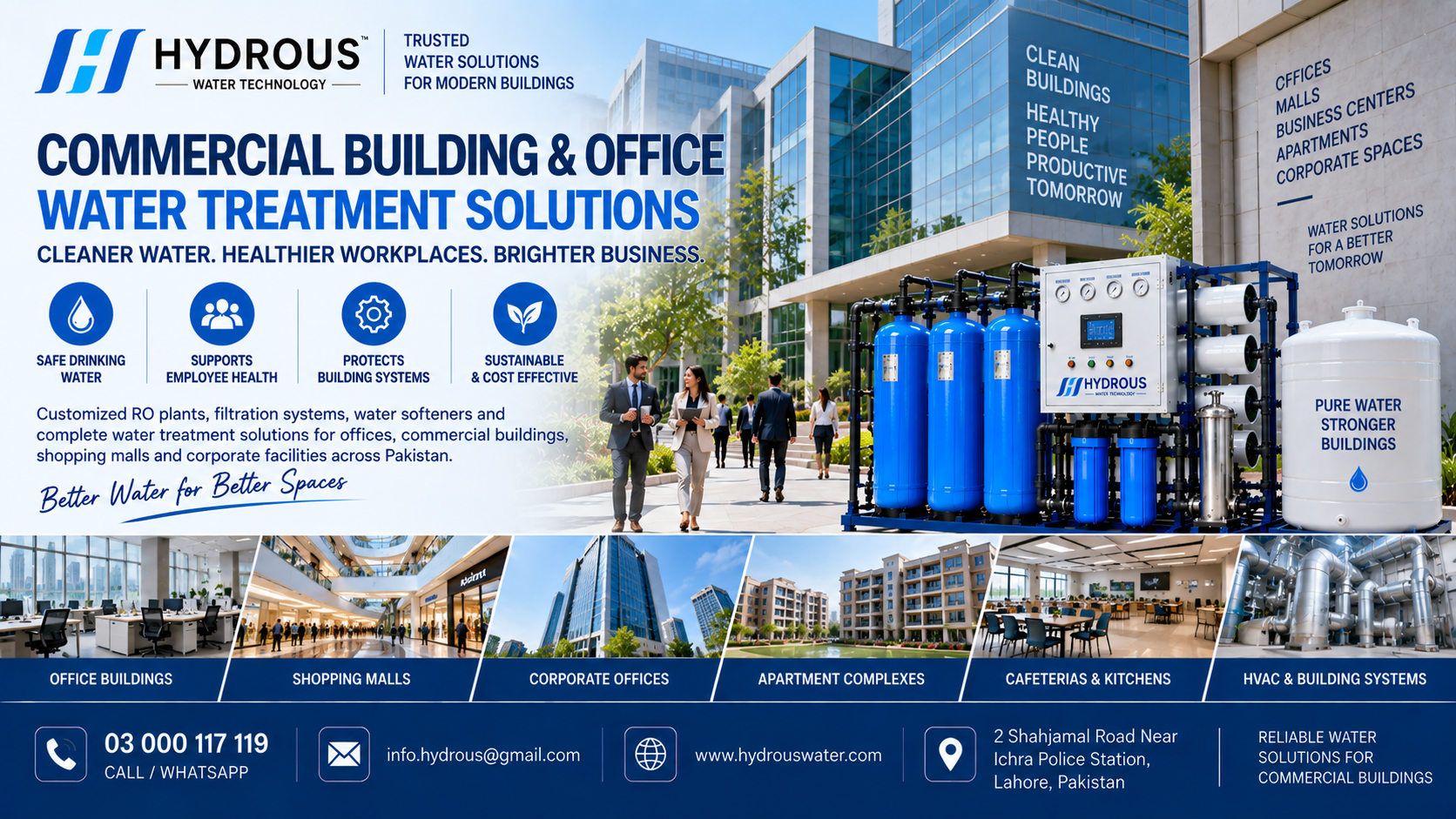
Commercial RO plants and water filtration solutions for offices and commercial buildings in Pakistan.
Why Commercial Buildings Need Water Treatment
Commercial buildings can have hundreds or thousands of people using water every day.
Water may be required for:
- Drinking
- Kitchen and cafeteria operations
- Tea and coffee areas
- Water coolers
- Washrooms
- Cleaning
- HVAC-related applications
- Landscaping
- Staff facilities
- Guest areas
Depending on the source, water may contain:
- Suspended particles
- High TDS
- Hardness
- Chlorine
- Iron
- Unpleasant taste or odor
- Microbiological contaminants
- Other dissolved substances
A suitable water-treatment system helps address the specific problems identified through water testing.
Office Water Filtration System
An office water filtration system can be relatively simple or highly customized.
For a small office, the system may include:
Sediment Filter → Activated Carbon → UV → Drinking Water
Where TDS or dissolved contaminants are high, RO may be added:
Sediment → Carbon → RO → UV → Storage → Drinking Water
The correct design depends on the incoming water quality.
There is no advantage in installing an unnecessarily complicated system if a simpler treatment process can safely meet the intended requirements.
Commercial RO Plant for Offices
A commercial RO plant can be used when the building’s water requires significant reduction of dissolved salts or other contaminants.
A typical commercial RO system may include:
- Raw-water tank
- Feed pump
- Multimedia filter
- Activated carbon filter
- Water softener, if required
- Cartridge filtration
- High-pressure pump
- RO membranes
- Control panel
- Treated-water storage
- UV system where appropriate
The plant can be sized according to the building’s expected consumption.
Common capacities can range from small commercial systems to large centralized RO plants.
Building Water Filtration System
Large buildings may require centralized water treatment.
A typical arrangement can be:
Municipal / Bore Water
↓
Raw Water Storage
↓
Pretreatment
↓
RO / Filtration
↓
Treated Water Storage
↓
Distribution
↓
Offices | Cafeteria | Drinking Points | Staff Areas
Centralized treatment can make monitoring and maintenance easier when the building has a suitable plumbing infrastructure.
Drinking Water Solutions for Corporate Offices
Corporate offices often have dedicated drinking-water requirements.
Employees and visitors may use water through:
- Water coolers
- Bottle-filling stations
- Drinking fountains
- Kitchen dispensers
- Direct drinking-water taps
A centralized RO system can feed multiple drinking points.
For smaller offices, a compact RO filtration system may be more practical.
The system should be selected according to:
- Number of employees
- Number of floors
- Daily consumption
- Peak demand
- Water source
- Available installation space
Water Treatment for Shopping Malls
Shopping malls have considerably higher water requirements than ordinary offices.
Water may be consumed by:
- Visitors
- Restaurants
- Food courts
- Employees
- Cleaning staff
- Retail outlets
- Kitchens
A mall may therefore require a centralized water-treatment system.
Depending on the application, the system can include:
- Multimedia filtration
- Activated carbon
- Water softening
- RO
- UV
- Cartridge filtration
- Treated-water storage
- Distribution system
Food courts and restaurants may have additional water-quality requirements that should be considered separately.
Water Treatment for Hotels and Commercial Properties
Hotels and commercial properties can have multiple water requirements.
Drinking water, kitchens, laundry, housekeeping and other building services may require different treatment approaches.
For drinking water, an RO-based system may be considered where raw-water quality requires it.
For hard water, a softener may be appropriate for selected applications.
This is why a whole-building water treatment strategy can be more effective than installing one system without considering the building’s different water uses.
Water Softener for Commercial Buildings
Hard water can cause scale inside:
- Pipes
- Water heaters
- Boilers
- Heat exchangers
- Kitchen equipment
- Plumbing fixtures
A water softener reduces hardness by ion exchange.
It may be considered where hardness is causing operational problems.
However, a softener does not replace an RO system where the primary problem is high TDS or salinity.
The correct treatment should be determined from the water analysis.
Bore Water Treatment for Commercial Buildings
Many commercial properties may use bore or tube-well water.
Groundwater quality can vary significantly from one location to another.
A bore-water analysis may reveal:
- High TDS
- Hardness
- Iron
- Manganese
- Chloride
- Sulphate
- Silica
- Fluoride
- Arsenic
- Turbidity
Depending on the results, treatment may include:
Media Filtration → Carbon Filtration → Softening → Cartridge Filtration → RO
Not every building needs every stage.
Water Treatment for High-Rise Buildings
High-rise buildings require special attention to water distribution.
The treatment system may need to account for:
- Building height
- Water pressure
- Storage tanks
- Pumping requirements
- Number of floors
- Peak demand
- Distribution piping
- Treated-water storage
For larger properties, a centralized treatment plant can be installed at an appropriate service area and connected to dedicated treated-water storage.
Water Treatment for Corporate Campuses
Corporate campuses can include:
- Multiple office buildings
- Staff cafeterias
- Guest areas
- Parking facilities
- Landscaping
- Prayer areas
- Recreation facilities
A centralized water-treatment plant can serve multiple buildings where the infrastructure allows.
Alternatively, individual buildings can have independent treatment systems.
The choice depends on distance, consumption, pressure requirements and the building’s existing plumbing.
Commercial Building Water Storage
Storage is an important part of a centralized water-treatment system.
A building may consume significantly more water at certain times of the day.
For example:
- Morning office hours
- Lunch breaks
- Cafeteria operating hours
- Events
- Peak summer demand
Treated-water storage can help meet short-term demand without requiring the RO plant to operate at peak capacity continuously.
Tank capacity should be calculated from actual consumption and operating requirements.
Water Quality Testing for Commercial Buildings
Water testing should be the first step before designing a commercial water-treatment system.
Depending on the application, important parameters can include:
- pH
- TDS
- Conductivity
- Turbidity
- Total hardness
- Calcium
- Magnesium
- Chloride
- Sulphate
- Alkalinity
- Iron
- Manganese
- Silica
- Fluoride
- Arsenic
- Microbiological parameters
Testing provides the information required to select appropriate treatment equipment.
It can also prevent a building owner from spending money on unnecessary treatment stages.
How to Choose a Commercial RO Plant
Choosing an RO plant based only on its LPH capacity is not enough.
Consider the following:
1. Water Source
Is the building using:
- Bore water?
- Municipal water?
- Tanker water?
- Another source?
2. Water Analysis
What contaminants need to be reduced?
3. Daily Consumption
How many litres are required each day?
4. Peak Demand
When does the building consume the most water?
5. Operating Hours
How many hours per day can the plant operate?
6. Storage Capacity
How much treated water should be stored?
7. Installation Area
How much space is available for the plant?
8. Future Expansion
Will the building’s occupancy increase?
These factors should be considered before finalizing the system capacity.
Commercial RO Plant Capacity Calculation
Suppose an office building requires approximately 5,000 litres of treated drinking water per day.
If the RO plant is planned to operate for 8 hours:
5,000 ÷ 8 = 625 LPH
A plant around this production range could be considered as a starting point, but the final capacity should account for:
- Recovery
- Peak demand
- Storage
- Maintenance
- Membrane performance
- Future growth
The actual design should therefore be completed after reviewing the building’s requirements.
Commercial Building UV Water Treatment
UV can be incorporated into a drinking-water treatment system as an additional disinfection stage.
A possible configuration is:
RO → UV → Treated Water Tank → Drinking Points
Alternatively, UV can be incorporated at another suitable point depending on the system design.
UV is generally used as part of a treatment train rather than as a replacement for filtration or RO when those processes are required.
Cartridge Filtration for Commercial Water Systems
Cartridge filters provide fine particulate filtration.
They can be installed:
- Before RO
- After pretreatment
- At point of use
- Before selected equipment
Cartridge selection depends on the application and required filtration level.
Regular replacement is important because a heavily loaded cartridge can reduce water flow and increase pressure drop.
Commercial Water Treatment Maintenance
A commercial water-treatment plant requires routine maintenance to remain reliable.
RO Maintenance
Monitor:
- Feed pressure
- Product flow
- TDS
- Conductivity
- Salt rejection
- Differential pressure
Filter Maintenance
Backwash media filters according to operating conditions.
Replace cartridge filters when loading or pressure drop indicates replacement is required.
Softener Maintenance
Check:
- Hardness leakage
- Regeneration
- Salt level
- Valve operation
Pump Maintenance
Inspect:
- Pressure
- Seals
- Bearings
- Electrical performance
- Leakage
Tank Maintenance
Inspect and clean tanks according to the building’s maintenance program.
Common Commercial Water Treatment Problems
High TDS
High TDS may indicate the need for RO or another suitable treatment process depending on the water analysis.
Hard Water
Hardness can contribute to scaling and may require softening for selected applications.
Bad Taste or Odor
Activated carbon can help address chlorine, taste and odor issues depending on the contaminant.
Turbid Water
Media or cartridge filtration may be required to reduce suspended particles.
Low RO Production
Possible causes include:
- Fouled membranes
- Low feed pressure
- Blocked filters
- Scaling
- Temperature changes
Frequent Filter Replacement
This may indicate excessive suspended solids or inadequate pretreatment.
Commercial Building Water Treatment for Cafeterias
Cafeterias and office kitchens can consume significant amounts of water.
Applications include:
- Drinking
- Cooking
- Tea
- Coffee
- Food preparation
- Washing
A dedicated treated-water supply can be considered for these areas.
Where a building contains restaurants or a large cafeteria, the water demand should be included when calculating the overall treatment capacity.
Sustainable Water Treatment for Commercial Buildings
Modern commercial buildings are increasingly interested in reducing operating costs and improving resource efficiency.
Water-treatment design can contribute through:
- Efficient RO operation
- Proper pretreatment
- Preventive maintenance
- Appropriate storage
- Reduced membrane fouling
- Water reuse where technically suitable
- Efficient pumping
However, sustainability should be considered alongside water quality, system reliability and operational cost.
Solar-Powered Water Treatment for Commercial Sites
Where suitable, solar energy can be integrated with water-treatment equipment.
Solar systems can potentially power:
- Water pumps
- Bore pumps
- RO feed pumps
- Irrigation systems
- Selected treatment equipment
The solar system should be designed according to the actual electrical load and operating schedule.
For sites with limited or unreliable grid electricity, a customized solar-powered water-treatment solution may be worth evaluating.
Water Treatment for Offices in Lahore and Across Pakistan
Hydrous Water Technology provides water-treatment solutions for commercial customers in Lahore and other cities across Pakistan.
Solutions can be designed for:
- Corporate offices
- Business centers
- Shopping malls
- Commercial plazas
- Restaurants
- Hotels
- Apartment buildings
- Educational campuses
- Healthcare facilities
- Industrial offices
- Corporate campuses
The treatment system can be customized according to the source-water analysis and required capacity.
Why Choose Hydrous Water Technology?
Hydrous Water Technology specializes in water treatment and purification systems for commercial, industrial and institutional applications.
Our solutions include:
- Commercial RO plants
- Industrial RO plants
- Water filtration systems
- Multimedia filters
- Activated carbon filters
- Water softeners
- UV systems
- Cartridge filtration
- RO membranes
- Pumps
- Dosing systems
- Water-treatment chemicals
- Antiscalants
- Membrane cleaning chemicals
- Treated-water storage
- Installation and commissioning
- Maintenance services
Our approach is based on the principle that the treatment system should match the water and the application.
Get a Commercial Building Water Treatment System
If you are planning a water-treatment system for an office, commercial plaza, shopping mall or corporate building, provide:
- Water analysis report
- Water source
- Number of occupants
- Daily water requirement
- Peak water demand
- Number of floors
- Required drinking-water points
- Available installation space
- Existing pumps and tanks
- Location of the project
This information helps determine the appropriate treatment technology and system capacity.
Frequently Asked Questions
What is a commercial building water treatment system?
It is a water-treatment system designed to provide suitable water quality for commercial properties such as offices, shopping centers, corporate buildings, hotels and commercial plazas.
Is an RO plant necessary for an office?
Not necessarily. The requirement depends on the raw-water quality. A simple filtration system may be sufficient in some offices, while high-TDS water may require RO.
What size RO plant is suitable for a commercial building?
Capacity depends on the number of users, daily consumption, operating hours, peak demand and storage capacity. Commercial systems can range from hundreds to many thousands of litres per hour.
Can one RO plant supply multiple floors?
Yes. A centralized RO plant can supply multiple floors when the storage, pumping and distribution system is correctly designed.
Should bore water be tested before installing an RO plant?
Yes. Bore-water quality can vary significantly. Testing helps determine whether the building needs filtration, softening, RO or another treatment process.
Can a water softener replace an RO plant?
No. A softener primarily addresses hardness. It does not provide the same dissolved-contaminant reduction as RO.
Do you provide commercial water treatment in Pakistan?
Yes. Hydrous Water Technology provides customized commercial and industrial water-treatment solutions in Pakistan.