
Paper & Pulp Industry Water Treatment Solutions in Pakistan
Water is an essential part of many operations in the paper and pulp industry. Paper mills may use water for pulp preparation, washing, paper formation, equipment cleaning, cooling systems, boilers and other utility applications.
At the same time, paper manufacturing can generate wastewater containing suspended fibres, organic matter, colour and other contaminants. The exact wastewater characteristics depend on the raw material, manufacturing process and chemicals used.
Research on paper and pulp wastewater has identified suspended solids, COD, BOD and colour as important treatment considerations, while studies in Pakistan have also examined paper-mill wastewater and treatment performance against local environmental requirements.
Hydrous Water Technology provides customized paper and pulp industry water treatment solutions in Pakistan, including industrial RO plants, filtration, water softening, chemical dosing, boiler-water treatment, cooling-water treatment, ETP systems and water-recycling solutions.
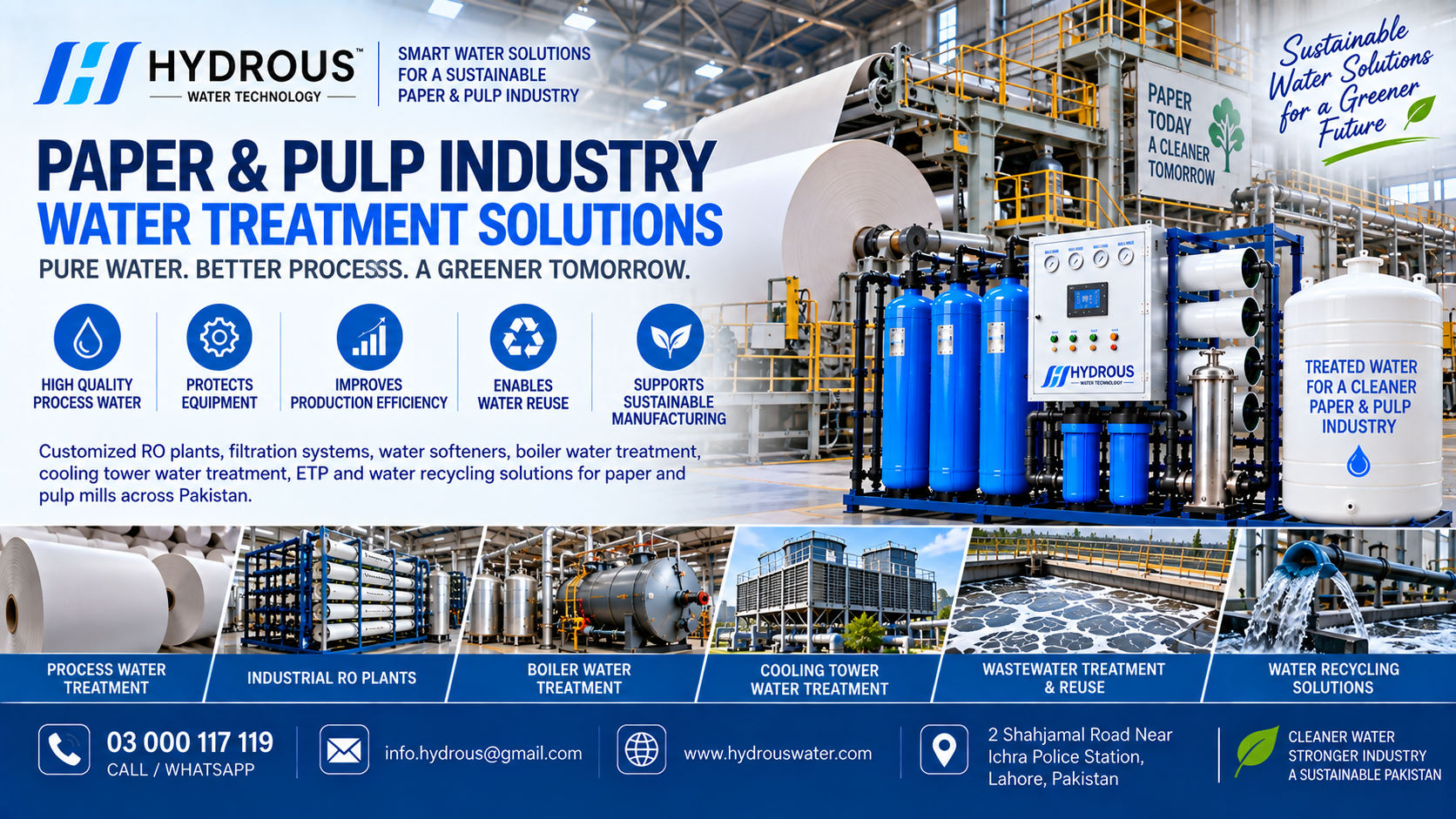
Industrial RO, filtration, boiler-water and wastewater treatment solutions for paper and pulp mills in Pakistan.
Why Water Treatment Is Important in Paper Mills
Water quality can directly affect different areas of a paper mill.
Untreated or poorly managed water may contribute to:
- Scaling
- Corrosion
- Fouling
- Suspended solids
- Equipment deposits
- Membrane fouling
- Reduced heat-transfer efficiency
- Higher maintenance requirements
The water requirement for a paper machine is also different from the requirement for a boiler, cooling tower or general cleaning.
For this reason, an efficient mill should consider different water-quality levels for different applications instead of treating all water in exactly the same way.
Water Treatment for Paper Manufacturing
A paper mill may require treated water for several applications, including:
Process Water
Used during pulp preparation, stock preparation and paper production.
Boiler Feedwater
Used to produce steam for plant operations.
Cooling Water
Used to remove heat from equipment and process systems.
Cleaning Water
Used for equipment and plant cleaning.
RO / Purified Water
Used where lower-TDS water is required.
Drinking Water
Used for employees and visitors.
Recycled Water
Treated wastewater may potentially be reused for suitable non-potable or process applications.
The final treatment design depends on the mill’s water balance and water-quality requirements.
Industrial RO Plant for Paper Mills
An industrial RO plant for a paper mill can be used when dissolved salts and TDS need to be reduced.
A typical system may include:
Raw Water Tank → Feed Pump → Multimedia Filter → Activated Carbon Filter → Softener → Cartridge Filter → High-Pressure Pump → RO Membranes → RO Product Tank
The actual configuration should be based on laboratory water analysis.
RO systems are also relevant to paper-mill utility systems. A published industrial case from a paper and board mill in Pakistan examined RO used to produce demineralized water for high-pressure boiler operation and highlighted the importance of controlling scaling and fouling.
Paper Mill Water Filtration System
Filtration is often used as pretreatment before RO or as standalone treatment for selected applications.
Depending on the raw-water quality, a paper mill may require:
Multimedia Filter
Helps reduce suspended particles and turbidity.
Activated Carbon Filter
Can be used where chlorine, certain organic compounds, taste or odour require control.
Water Softener
Reduces hardness before applications that are sensitive to scaling.
Cartridge Filter
Provides fine filtration and protects downstream equipment such as RO membranes.
Bag Filter
Can be considered for particular industrial filtration requirements.
The filtration sequence should be selected according to the actual water analysis rather than using a standard arrangement for every mill.
Boiler Water Treatment for Paper Mills
Many paper mills use steam and boiler systems as part of their utility infrastructure.
Boiler feedwater needs appropriate treatment because hardness and other dissolved contaminants can contribute to deposits and operational problems.
A possible treatment arrangement is:
Raw Water → Multimedia Filter → Carbon Filter → Softener → RO → Chemical Dosing → Boiler
For higher-pressure systems, additional demineralization or polishing may be required.
The final specification should be based on the boiler manufacturer’s requirements and operating conditions.
Cooling Tower Water Treatment for Paper Industry
Cooling systems can be an important part of a paper mill’s water and energy management.
As cooling water circulates and water evaporates, dissolved minerals can become increasingly concentrated. Poor water chemistry control may contribute to scale, corrosion, deposits and biological growth.
A cooling-water treatment program may include:
- Filtration
- Blowdown management
- Scale control
- Corrosion control
- Biocide dosing
- Dispersants
- Online monitoring
The appropriate chemical program depends on the cooling-system design and water chemistry.
Paper Mill Wastewater Treatment
Wastewater from paper and pulp manufacturing can be more complex than ordinary domestic wastewater.
Depending on the manufacturing process, wastewater may contain:
- Suspended fibres
- Fine solids
- Organic matter
- High COD
- BOD
- Colour
- Process chemicals
- Dissolved solids
Studies of paper-mill wastewater have investigated combinations of biological, coagulation and filtration processes, demonstrating why treatment needs to be matched to the characteristics of the particular effluent.
Therefore, a paper mill ETP should be designed after wastewater sampling and laboratory analysis.
Effluent Treatment Plant for Paper Mills
A conceptual paper-mill ETP may include:
Collection → Screening → Equalization → Primary Clarification → Coagulation / Flocculation → Biological Treatment → Secondary Clarification → Filtration → Final Treatment
Depending on the target water quality, additional treatment may include:
- Activated carbon
- UF
- MBR
- RO
- Disinfection
- Advanced oxidation
There is no single ETP configuration that is correct for every paper mill.
Primary Treatment of Paper Mill Wastewater
Primary treatment focuses mainly on removing larger suspended materials and settleable solids.
Possible equipment includes:
- Screens
- Collection tanks
- Equalization tanks
- Settling tanks
- Clarifiers
- DAF systems
For mills handling significant fibre loads, recovery of useful fibre and reduction of suspended solids can also be important from an operational perspective.
Biological Treatment for Paper Mill Effluent
After primary treatment, biodegradable organic matter can be treated using biological processes.
Depending on the wastewater characteristics and project requirements, options may include:
- Aerobic treatment
- Anaerobic treatment
- Activated sludge
- SBR
- MBBR
- MBR
The choice depends on wastewater composition, available space, energy requirements and the required treated-water quality.
Colour Removal in Paper Mill Wastewater
Colour can be an important consideration in some paper and pulp wastewater streams.
The treatment approach depends on the source of the colour and the overall wastewater chemistry.
Potential technologies include:
- Coagulation
- Activated carbon
- Oxidation
- Membrane treatment
- Biological treatment
A jar test and laboratory evaluation can help determine which treatment is most appropriate.
Paper Mill Water Recycling and Reuse
Water recycling can help reduce freshwater requirements when treated water can meet the quality needed for reuse.
Possible reuse applications include:
- Equipment washing
- Cooling systems
- Utility applications
- Floor washing
- Pulp preparation
- Selected paper-machine applications
Research has demonstrated the potential for membrane-based treatment and other processes to recover water for reuse in paper manufacturing. One study reported an integrated MBR, membrane filtration and RO system that produced water suitable for reuse in paper production.
The reuse system should always be designed around the required water quality and the mill’s process chemistry.
Closing the Water Loop in Paper Mills
A modern water-management strategy can go beyond simply treating wastewater before discharge.
The mill can identify opportunities to:
Reduce → Recover → Treat → Reuse
For example:
Paper Machine Effluent → Primary Treatment → Biological Treatment → UF/MBR → RO → Reuse
The exact configuration will depend on the wastewater quality and the desired reuse application.
Water-reuse studies in paper manufacturing have shown that suitable treatment can provide a more reliable source of process water while reducing the freshwater footprint.
RO Membrane Fouling in Paper Mill Applications
RO performance depends heavily on pretreatment.
Poor pretreatment can cause:
- Scaling
- Organic fouling
- Suspended-solids fouling
- Increased pressure
- Reduced permeate flow
- Increased cleaning frequency
A Pakistan-based study of RO operation at a paper and board mill specifically examined scaling and fouling and found that controlling feed-water chemistry was important for maintaining membrane performance.
This is why an RO system should not be considered separately from its pretreatment system.
Antiscalant for Paper Mill RO Plants
Where appropriate, antiscalant dosing can help control mineral scaling in RO systems.
However, the chemical selection and dosage should be based on:
- Feedwater analysis
- Membrane type
- Recovery
- Temperature
- pH
- Hardness
- Alkalinity
- Silica
- Other scaling ions
Hydrous Water Technology supplies RO water-treatment chemicals, including antiscalant solutions, for suitable industrial applications.
Water Softener for Paper Mills
Hardness can cause scale in boilers, heat exchangers and other equipment.
A water softener can be used where hardness reduction is required.
However:
Water Softener ≠ RO Plant
A softener primarily targets hardness, while RO removes a much broader range of dissolved contaminants.
The two systems may therefore be used together:
Filtration → Softener → RO
when required by the application.
Paper Mill Chemical Dosing Systems
Chemical dosing can be used in several parts of a paper mill’s water-treatment system.
Applications may include:
- pH adjustment
- Coagulation
- Flocculation
- Cooling-water treatment
- Boiler-water treatment
- RO antiscalant dosing
- Disinfection
A dosing system may include:
- Chemical tank
- Dosing pump
- Mixer
- Calibration arrangement
- Injection point
- Controller
Automated dosing can help maintain more consistent treatment conditions.
Paper Mill Water Quality Monitoring
Regular monitoring helps identify changes before they become major operational problems.
Depending on the application, important parameters may include:
- pH
- TDS
- Conductivity
- Turbidity
- Hardness
- Chlorine
- Silica
- COD
- BOD
- TSS
- Colour
- Flow
- Pressure
RO systems should also be monitored for permeate flow, reject flow, pressure and salt rejection.
How to Design a Paper Mill Water Treatment System
A successful project should start with the mill’s actual water requirements.
Step 1 — Identify Water Sources
Determine whether water comes from:
- Bore water
- Municipal supply
- Surface water
- Tankers
- Recycled water
Step 2 — Test Raw Water
Obtain a complete laboratory analysis.
Step 3 — Map Water Consumption
Identify where water is used throughout the mill.
Step 4 — Separate Water Qualities
Determine which applications require:
- Filtered water
- Soft water
- RO water
- Demineralized water
- Recycled water
Step 5 — Characterize Wastewater
Test wastewater for parameters relevant to the process and treatment objective.
Step 6 — Design the ETP
Select primary, biological and tertiary treatment as required.
Step 7 — Evaluate Water Reuse
Identify treated streams that can potentially be reused.
Step 8 — Size Storage and Equipment
Calculate daily, hourly and peak requirements.
Paper Mill RO Plant Capacity
RO capacity should be based on actual consumption rather than selecting a standard size.
For example, if a paper mill requires 50,000 litres of RO water per day and the RO plant operates for 10 hours:
50,000 ÷ 10 = 5,000 LPH
A production capacity of approximately 5,000 LPH could therefore be an initial reference.
The final design should consider:
- Peak demand
- RO recovery
- Storage
- Operating hours
- Maintenance requirements
- Future expansion
Automation of Paper Mill Water Treatment
Industrial water-treatment systems can be automated to reduce manual operation.
Possible controls include:
- Automatic filter backwashing
- RO auto-start/stop
- Tank-level control
- Low-level protection
- High-pressure protection
- Conductivity monitoring
- Flow monitoring
- Pressure monitoring
- pH control
- Chemical dosing control
Automation can be particularly useful for large mills operating continuously.
Preventive Maintenance for Paper Mill RO Plants
Regular maintenance helps maintain RO performance.
Operators should monitor:
- Feed pressure
- Permeate pressure
- Reject flow
- Permeate flow
- Feed conductivity
- Product conductivity
- Salt rejection
- Differential pressure
Changes in these parameters can indicate fouling, scaling, membrane damage or pretreatment problems.
Regular membrane cleaning should be performed when operating data indicates that cleaning is necessary.
Benefits of Water Treatment for the Paper Industry
A properly designed system can help paper manufacturers:
Improve Process-Water Quality
Provide water suitable for specific production requirements.
Protect Equipment
Reduce problems associated with scale, solids and unsuitable water chemistry.
Improve Boiler Performance
Proper feedwater treatment can help control deposits and corrosion risks.
Protect RO Membranes
Good pretreatment can reduce fouling and scaling.
Reduce Freshwater Consumption
Recycling treated water can reduce dependence on fresh sources where technically feasible.
Improve Wastewater Management
A properly designed ETP can help control wastewater pollutants before discharge or reuse.
Sustainable Water Management in Paper Mills
Paper manufacturers can improve water efficiency through:
- Water metering
- Leak detection
- Process-water optimization
- Fibre recovery
- Cooling-water management
- RO recovery optimization
- Wastewater recycling
- Treated-water reuse
- Condensate recovery
- Efficient chemical dosing
The objective is not simply to treat more water, but to use water more efficiently throughout the mill.
Why Choose Hydrous Water Technology?
Hydrous Water Technology provides customized water-treatment solutions for commercial and industrial customers across Pakistan.
Our paper and pulp industry solutions can include:
- Industrial RO plants
- Commercial RO plants
- Multimedia filters
- Activated carbon filters
- Water softeners
- DM / demineralization plants
- Cartridge filtration
- UV systems
- Chemical dosing systems
- RO antiscalants
- Membrane cleaning chemicals
- Boiler treatment chemicals
- Cooling-tower chemicals
- ETP systems
- Industrial wastewater treatment
- Water recycling systems
- RO membrane replacement
- Installation and commissioning
- Preventive maintenance
Every project should be designed according to water analysis, process requirements, capacity and treated-water quality.
Paper & Pulp Industry Water Treatment Services Across Pakistan
Hydrous Water Technology can provide customized solutions for:
- Paper mills
- Pulp mills
- Paperboard manufacturers
- Tissue-paper manufacturers
- Packaging-paper factories
- Printing-paper manufacturers
- Recycled-paper plants
- Industrial utility systems
Whether you need an RO plant, filtration system, softener, boiler-water treatment, ETP or water-recycling system, the treatment process should be matched to your actual requirements.
Get a Paper Mill Water Treatment Solution
Planning a water-treatment project for a paper or pulp mill?
Provide:
- Raw-water analysis
- Water source
- Daily water consumption
- Required RO capacity
- Process-water quality requirement
- Boiler details
- Cooling-system details
- Wastewater analysis
- Existing ETP details
- Project location
This information can be used to develop a suitable treatment concept and equipment specification.
Frequently Asked Questions
What water treatment does a paper mill need?
It depends on the mill’s water source and manufacturing process. Common systems include filtration, softening, RO, boiler-water treatment, cooling-water treatment and wastewater treatment.
Is RO required for paper mills?
RO is useful where lower-TDS water is required, particularly for certain process or boiler applications. It is not automatically required for every water-use point.
What is a paper mill ETP?
An Effluent Treatment Plant treats wastewater generated by paper manufacturing before discharge or potential reuse.
Can paper mill wastewater be reused?
Yes, treated wastewater can potentially be reused for selected applications when it meets the required water-quality specification. Membrane-based treatment has been studied for process-water recovery in paper mills.
Why does a paper mill need a boiler-water treatment system?
Proper boiler feedwater treatment helps control hardness and other contaminants that can contribute to deposits and corrosion.
How can paper mills reduce RO membrane fouling?
Good pretreatment, appropriate recovery, water chemistry control and timely membrane cleaning can help manage scaling and fouling. A Pakistan paper-and-board mill study specifically highlighted scaling and fouling control as important to RO operation.
Does Hydrous provide paper mill water treatment solutions?
Yes. Hydrous Water Technology provides industrial RO, filtration, softening, chemical dosing, ETP, wastewater-treatment and water-recycling solutions for industrial customers in Pakistan.