
Cement Industry Water Treatment Solutions in Pakistan
Water plays an important role in the operation and maintenance of cement manufacturing facilities. Although cement production is not simply a water-intensive process, cement plants require reliable water for cooling systems, equipment cleaning, laboratories, utilities, employee facilities and other industrial applications.
The quality of this water can vary significantly depending on whether the plant uses bore water, municipal water, tanker supply or another source.
High hardness, TDS, suspended solids, iron, silica and other contaminants can create problems for particular applications. This is why a cement factory may require a combination of filtration, softening, reverse osmosis, chemical dosing and wastewater-treatment systems.
Hydrous Water Technology provides customized cement industry water treatment solutions in Pakistan, designed around the source-water analysis, required capacity and intended application.
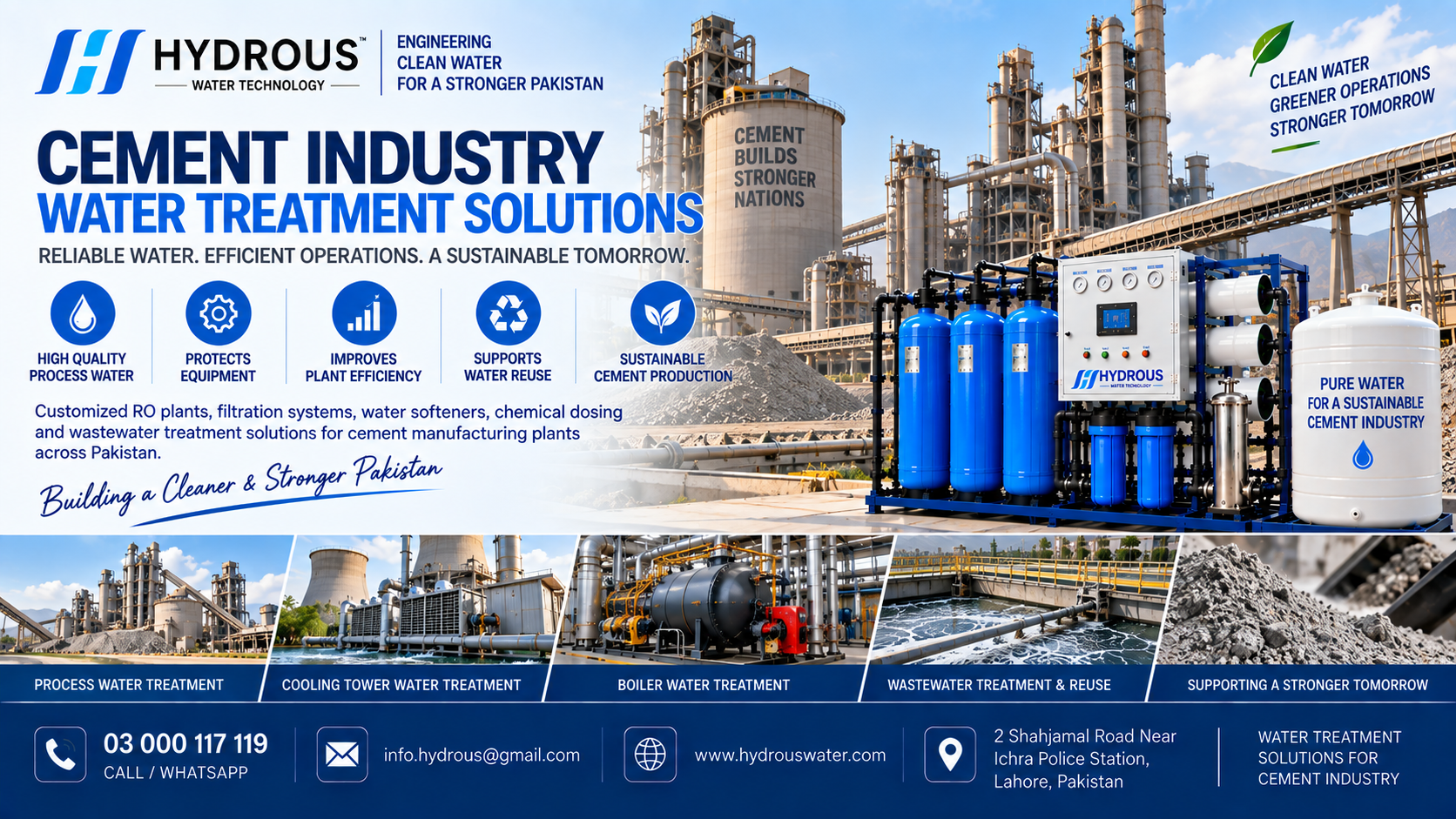
Industrial RO, filtration, cooling-water and wastewater treatment solutions for cement plants in Pakistan.
Why Water Treatment Is Important in Cement Plants
Cement manufacturing facilities operate large industrial equipment, cooling systems and utility infrastructure.
Poor-quality water can contribute to:
- Scaling
- Corrosion
- Fouling
- Blockages
- Reduced heat-transfer efficiency
- Increased equipment maintenance
- Higher chemical consumption
- Unstable process-water quality
The treatment requirement is different for every facility. A cement plant using relatively good-quality municipal water may require only filtration and softening for some applications, while a plant using high-TDS groundwater may require a complete RO system.
The most economical approach is therefore to test the water first and design the treatment around the actual problem.
Water Treatment for Cement Manufacturing Plants
A cement manufacturing facility may have several separate water requirements.
These can include:
Process and Utility Water
Water used for general plant operations and industrial utilities.
Cooling Water
Used for equipment, machinery and heat-transfer systems.
RO Water
Required where lower-TDS water is needed for a particular application.
Drinking Water
Provided for employees, visitors and administrative areas.
Cleaning Water
Used for equipment, floors and plant maintenance.
Wastewater
Generated from cleaning, utilities and other activities depending on the plant’s processes.
Each application should be evaluated separately before selecting treatment equipment.
Industrial RO Plant for Cement Industry
An industrial RO plant for a cement factory can be used when dissolved salts and high TDS need to be reduced.
A typical treatment arrangement may include:
Raw Water Tank → Feed Pump → Multimedia Filter → Activated Carbon Filter → Softener → Cartridge Filter → High-Pressure Pump → RO Membranes → Product Water Tank
The actual design can change depending on the raw-water analysis.
For example, if the source is bore water with high hardness and TDS, pretreatment may be more extensive than a system supplied by relatively clean municipal water.
Cement Factory Water Filtration System
Filtration is commonly used as pretreatment before RO or as standalone treatment for suitable applications.
Possible filtration technologies include:
- Multimedia filters
- Sand filters
- Activated carbon filters
- Cartridge filters
- Bag filters
- Micron filtration
Multimedia filtration can help reduce suspended particles, while activated carbon can be used where chlorine, organic compounds or certain taste and odor issues need to be addressed.
The selection should be based on water analysis rather than simply installing every available filter.
Water Softener for Cement Plants
Hard water can create scale in:
- Cooling equipment
- Heat exchangers
- Hot-water systems
- Washing equipment
- Utility systems
A water softener exchanges hardness ions and can help reduce hardness-related scaling where the application requires it.
It is important to understand that a softener does not function as an RO system and does not remove the majority of dissolved salts.
If the main problem is high TDS, an RO plant may be required.
Cooling Tower Water Treatment in Cement Plants
Many large industrial facilities use cooling systems that require proper water management.
As cooling water circulates, evaporation can increase the concentration of dissolved minerals.
Without suitable control, this may contribute to:
- Scale formation
- Corrosion
- Deposits
- Biological growth
- Reduced heat-transfer performance
A cooling-water treatment program can include:
- Filtration
- Blowdown management
- Scale-control chemicals
- Corrosion inhibitors
- Biocides
- Dispersants
- Chemical dosing
The treatment program should be selected according to the cooling-system design and water chemistry.
Cooling Tower Chemicals for Cement Industry
Chemical dosing can be an important part of industrial cooling-water management.
Depending on the application, a chemical program may include:
Antiscalant / Scale Control
Used where mineral scaling is a concern.
Corrosion Control
Helps protect suitable metal surfaces from corrosion.
Biocide
Used to control biological growth where required.
Dispersant
May help control suspended particles and deposits in suitable systems.
Hydrous Water Technology supplies industrial water-treatment chemicals and dosing systems that can be incorporated into an overall water-management program.
Boiler Water Treatment for Cement Plants
Some cement facilities may have boilers, steam systems or other hot-water applications.
Where boilers are installed, feedwater quality should be controlled according to the boiler manufacturer’s specifications.
Treatment can potentially include:
Filtration → Softening → RO → Chemical Dosing
Higher-pressure systems may require additional demineralization or polishing.
Boiler-water treatment can help control problems associated with hardness, dissolved minerals, corrosion and deposits.
Cement Plant Water Recycling
Water conservation can be particularly valuable at large industrial sites.
Depending on the application, cement plants can evaluate opportunities for:
- Cooling-water reuse
- Treated wastewater reuse
- Filter-backwash recovery
- RO reject management
- Rainwater harvesting
- Process-water recycling
- Improved cooling-tower blowdown control
Not every wastewater stream is suitable for direct reuse. The water must first be treated to a quality appropriate for the intended application.
Cement Plant Wastewater Treatment
Wastewater characteristics can vary depending on the activities carried out at a cement facility.
Potential wastewater sources include:
- Equipment washing
- Floor cleaning
- Cooling-system blowdown
- RO reject
- Filter backwash
- Laboratory activities
- Vehicle washing
- Domestic sewage
Industrial and domestic wastewater should be assessed separately where their characteristics differ.
Possible treatment processes include:
- Screening
- Equalization
- Settling
- Coagulation
- Flocculation
- Clarification
- Media filtration
- Carbon filtration
- RO
- Disinfection
The appropriate process should be selected after wastewater testing.
Dust Suppression and Water Management
Water can sometimes be used for dust suppression in industrial areas.
However, using high-quality RO water for applications that do not require it can unnecessarily increase operating costs.
A better approach is to identify which water-quality level is actually required for each application.
For example:
RO Water → High-quality applications
Filtered Water → Suitable utility applications
Recycled Treated Water → Approved non-potable applications
This type of water segregation can help optimize operating costs.
Bore Water Treatment for Cement Factories
Many industrial sites use groundwater as their primary water source.
Bore water can contain elevated levels of:
- TDS
- Hardness
- Iron
- Manganese
- Chloride
- Sulphate
- Silica
- Suspended solids
A typical bore-water treatment system may be:
Bore Water → Multimedia Filter → Activated Carbon → Softener → Cartridge Filter → RO
However, this should only be considered a conceptual arrangement.
A proper laboratory water analysis is essential before final equipment selection.
Water Treatment for Cement Plant Laboratories
Cement laboratories may require cleaner water for specific testing and analytical activities.
Depending on the testing requirements, laboratories may need:
- RO water
- Deionized water
- Distilled water
- Low-conductivity water
The required water quality should be confirmed from the laboratory equipment and test-method requirements.
For high-purity laboratory applications, RO alone may not be sufficient.
Water Treatment for Cement Plant Staff Facilities
Cement factories also require potable water for:
- Employees
- Offices
- Canteens
- Washrooms
- Visitors
A separate drinking-water system may include:
Sediment Filtration → Carbon Filtration → RO → UV / Disinfection → Storage
The exact configuration depends on the source-water quality and applicable drinking-water requirements.
Water Treatment for Cement Plant Equipment
Industrial equipment can be sensitive to water quality.
Depending on the equipment, untreated water may contribute to deposits or corrosion.
Water treatment can therefore be used to protect:
- Cooling equipment
- Heat exchangers
- Boilers
- Pumps
- Washing systems
- Process equipment
- Utility systems
The correct treatment is determined by the equipment manufacturer’s requirements and the water chemistry.
How to Design a Cement Plant Water Treatment System
A proper design should begin with the site’s actual water balance.
Step 1 — Identify the Water Source
Determine whether the facility uses:
- Bore water
- Municipal water
- Tanker water
- Surface water
- Recycled water
Step 2 — Perform Water Analysis
Test the source water for relevant physical, chemical and microbiological parameters.
Step 3 — Identify Applications
Separate the requirements for:
- Cooling
- RO water
- Boiler feed
- Drinking water
- Washing
- Other utilities
Step 4 — Calculate Water Demand
Determine:
- Daily consumption
- Hourly consumption
- Peak demand
- Operating hours
- Future expansion
Step 5 — Select Treatment
Possible technologies include:
Filtration → Softening → RO → UV → Chemical Dosing → Wastewater Treatment
Not every project needs all these stages.
Step 6 — Design Storage
Raw-water and treated-water storage should be sized according to the site’s operating requirements.
Step 7 — Installation & Commissioning
After installation, the system should be tested for flow, pressure and treated-water quality.
Cement Industry RO Plant Capacity
There is no standard RO capacity for every cement factory.
For example, if a plant requires 30,000 litres of RO water per day and the RO system operates for 10 hours:
30,000 ÷ 10 = 3,000 LPH
An RO plant producing approximately 3,000 LPH could therefore be considered as an initial production-rate reference.
The final capacity should also account for:
- RO recovery
- Peak demand
- Storage
- Operating schedule
- Maintenance downtime
- Future expansion
For a commercial quotation, the complete water requirement should be calculated before finalizing capacity.
Automation of Cement Plant Water Treatment
Larger water-treatment systems can be automated to simplify operation.
Depending on the project, automation can include:
- Automatic filter backwashing
- RO auto-start/stop
- High-pressure protection
- Low-water protection
- Tank-level control
- Conductivity monitoring
- Flow monitoring
- Pressure monitoring
- Chemical dosing control
Automation can reduce manual intervention and help maintain consistent system operation.
Preventive Maintenance of Cement Plant RO Systems
Regular maintenance is important for industrial RO plants.
Operators should monitor:
- Feed pressure
- Permeate pressure
- Permeate flow
- Reject flow
- Feed TDS
- Product-water TDS
- Salt rejection
- Cartridge-filter pressure drop
Changes in these parameters can indicate membrane fouling, scaling, pretreatment problems or changes in feedwater quality.
Regular membrane cleaning and preventive maintenance can help maintain system performance.
Benefits of Proper Water Treatment in Cement Industry
A properly designed water-treatment system can help cement plants:
Protect Industrial Equipment
Proper treatment can reduce problems associated with scale, suspended solids and unsuitable water chemistry.
Maintain Water Quality
Different processes can receive water appropriate for their requirements.
Reduce Maintenance
Good pretreatment can protect RO membranes and downstream equipment.
Improve Cooling-System Performance
Water chemistry control can help manage scaling, corrosion and biological fouling.
Reduce Freshwater Consumption
Recycling and reuse can be considered where technically feasible.
Improve Operational Reliability
A properly maintained water-treatment system provides a more consistent water supply to critical applications.
Sustainable Water Management in Cement Plants
Cement manufacturers can consider a broader water-management strategy rather than focusing only on water purification.
Useful measures can include:
- Water metering
- Leak detection
- Cooling-water optimization
- Treated wastewater reuse
- RO recovery optimization
- Rainwater collection
- Filter-backwash management
- Efficient chemical dosing
- Water-quality monitoring
The objective should be to reduce unnecessary water consumption while maintaining the quality required for each application.
Why Choose Hydrous Water Technology?
Hydrous Water Technology provides customized water-treatment systems for industrial and commercial customers in Pakistan.
Our solutions for cement plants can include:
- Industrial RO plants
- Commercial RO plants
- Multimedia filters
- Activated carbon filters
- Water softeners
- Cartridge filtration
- UV systems
- Chemical dosing systems
- Cooling-tower treatment
- Boiler-water treatment
- RO antiscalants
- Membrane cleaning chemicals
- Industrial wastewater treatment
- Water recycling systems
- RO membrane replacement
- Installation and commissioning
- Preventive maintenance
Our approach is based on raw-water analysis, required capacity, application and operating conditions.
Cement Industry Water Treatment Services Across Pakistan
Hydrous Water Technology can provide customized water-treatment solutions for:
- Cement manufacturing plants
- Cement factories
- Grinding units
- Cement storage facilities
- Industrial utility systems
- Cement plant workshops
- Associated industrial facilities
Whether you require a new RO plant, filtration system, water softener, cooling-water treatment program or wastewater solution, the system should be designed around your specific requirements.
Get a Cement Plant Water Treatment Solution
Planning a water-treatment system for a cement factory?
Provide us with:
- Raw-water analysis
- Water source
- Daily water requirement
- Required RO capacity
- Cooling-system details
- Boiler details, if applicable
- Existing treatment equipment
- Treated-water quality requirement
- Wastewater analysis, if available
- Project location
This information allows a suitable treatment configuration and capacity to be developed for the project.
Frequently Asked Questions
What type of water treatment does a cement plant need?
It depends on the water source and application. Cement plants may require filtration, softening, RO, chemical dosing, cooling-water treatment, boiler-water treatment or wastewater treatment.
Is an RO plant required in every cement factory?
No. RO is required when the application and water chemistry justify dissolved-solids reduction. Water analysis should be performed before deciding.
Can bore water be used in a cement plant?
Yes, but its suitability depends on the water chemistry and intended application. Treatment may be required for hardness, TDS, iron, silica or other contaminants.
Why is cooling-tower water treatment important?
Proper water management can help control scale, corrosion, suspended solids and biological growth in cooling systems.
Can cement plants recycle wastewater?
Potentially. The feasibility depends on wastewater quality and the quality required for the intended reuse application.
What is the best RO capacity for a cement factory?
There is no single standard capacity. The RO plant should be sized according to actual daily and peak water requirements, operating hours, recovery and storage.
Does Hydrous provide cement plant water treatment systems?
Yes. Hydrous Water Technology provides customized industrial RO, filtration, softening, chemical dosing and wastewater-treatment solutions for industrial facilities in Pakistan.