
Steel & Metal Industry Water Treatment Solutions in Pakistan
Steel and metal manufacturing requires water for several important industrial processes. Water can be used for cooling, equipment cleaning, steam generation, process operations, dust control and other utility applications.
At the same time, steel mills and metal-processing facilities can generate wastewater containing suspended solids, oils, metals, chemicals, high temperatures and other process-specific contaminants.
A properly designed steel and metal industry water treatment solution can help facilities maintain suitable water quality, protect equipment and improve wastewater management.
Hydrous Water Technology provides customized industrial water-treatment solutions for steel mills, metal-processing facilities and related industrial operations in Pakistan. Our solutions include industrial RO plants, filtration systems, water softeners, cooling-water treatment, boiler-water treatment, ETP systems, chemical dosing and water-recycling solutions.
Every project should be designed according to the actual water analysis, process requirements, wastewater characteristics and required treated-water quality.
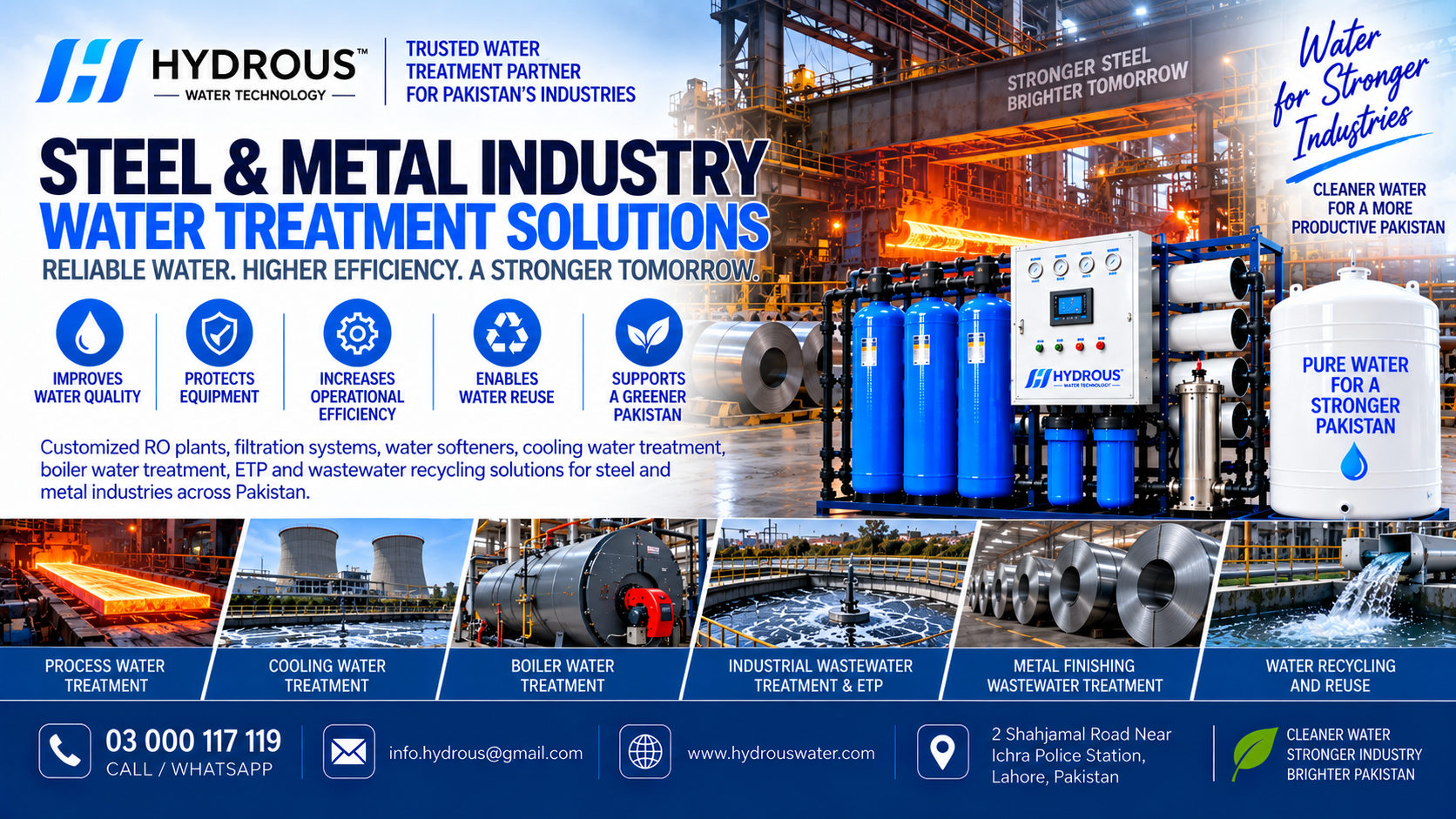
Industrial RO, cooling-water treatment, wastewater treatment and recycling solutions for steel and metal industries in Pakistan.
Water Treatment for the Steel Industry
Water is an essential utility in many steel-production operations.
Typical applications can include:
- Cooling systems
- Furnace cooling
- Rolling-mill operations
- Equipment cooling
- Process water
- Boiler systems
- Steam generation
- Equipment washing
- Dust suppression
- General utilities
The quality requirements can differ considerably between applications.
For example, cooling water may require scale and corrosion control, while boiler feedwater may require much lower hardness and dissolved-solids levels.
Why Water Treatment Is Important in Steel Mills
Poor-quality industrial water can contribute to:
- Scaling
- Corrosion
- Fouling
- Blockages
- Reduced heat-transfer efficiency
- Equipment maintenance
- RO membrane fouling
- Increased chemical consumption
Wastewater can also contain suspended solids, oils and metals that require appropriate treatment before discharge or reuse.
A well-designed water-treatment strategy can therefore support both production efficiency and environmental management.
Steel Mill Water Treatment Applications
Hydrous Water Technology can design water-treatment systems for applications such as:
- Steel mills
- Steel rolling mills
- Foundries
- Metal-processing plants
- Fabrication facilities
- Metal finishing operations
- Galvanizing facilities
- Industrial workshops
- Engineering plants
- Steel-production utilities
Treatment technology is selected according to the specific process rather than using the same system for every facility.
Industrial RO Plant for Steel Industry
An industrial RO plant for steel mills can provide lower-TDS water for applications where dissolved minerals need to be controlled.
A typical RO pretreatment system may include:
Raw Water → Multimedia Filter → Activated Carbon Filter → Water Softener → Cartridge Filter → High-Pressure Pump → RO → Treated Water Tank
RO can be considered for:
- Process water
- Boiler-feedwater pretreatment
- Utility water
- Equipment washing
- Laboratory applications
- Selected water-recycling projects
RO capacity should be calculated from actual water consumption and production requirements.
Cooling Water Treatment for Steel Mills
Cooling systems are particularly important in steel manufacturing.
Equipment may require continuous cooling to manage operating temperatures.
Poor cooling-water quality can cause:
- Scale formation
- Corrosion
- Fouling
- Reduced heat transfer
- Blockages
- Increased maintenance
A cooling-water treatment program may include:
- Filtration
- Blowdown control
- Scale inhibition
- Corrosion control
- Biocide treatment
- pH monitoring
- Chemical dosing
The treatment program should be based on cooling-system design and water chemistry.
Boiler Water Treatment for Steel Industry
Where steel and metal facilities operate boilers or steam systems, suitable boiler-feedwater is essential.
A possible treatment arrangement is:
Raw Water → Multimedia Filtration → Softener → RO → Chemical Dosing → Boiler
Depending on the boiler system, additional polishing may be required.
Important monitoring parameters can include:
- Hardness
- Conductivity
- TDS
- pH
- Alkalinity
- Silica
- Dissolved oxygen
Proper feedwater treatment can help reduce the risk of scale and corrosion inside the boiler system.
Steel Mill Wastewater Treatment
Steel-manufacturing wastewater can vary according to the process.
Potential contaminants may include:
- Suspended solids
- Oil and grease
- Iron
- Other metals
- High or low pH
- Dissolved salts
- Process chemicals
- Heat
- Other site-specific contaminants
A conceptual treatment system may include:
Collection → Screening → Equalization → Oil Separation → pH Adjustment → Coagulation & Flocculation → Clarification → Filtration → Final Treatment
Additional technologies can be incorporated where required.
Steel Industry ETP
An ETP for the steel industry may combine physical and chemical treatment with appropriate tertiary processes.
Possible equipment includes:
- Bar screen
- Equalization tank
- Oil separator
- Chemical dosing system
- Flash mixer
- Flocculation tank
- Clarifier
- Multimedia filter
- Activated carbon filter
- Cartridge filter
- Sludge dewatering system
The final design depends on wastewater flow and laboratory analysis.
Oil and Grease Removal
Oil and grease can enter wastewater from machinery, rolling operations, hydraulic systems and maintenance activities.
Suitable treatment can include:
Oil-Water Separator
Used to remove free oil from wastewater.
Coalescing Separator
Can improve separation of dispersed oil droplets.
DAF
Dissolved Air Flotation can be considered for removing fine oil droplets and suspended solids.
Chemical Treatment
Coagulation and flocculation may improve removal where appropriate.
Removing oil before downstream treatment can help reduce fouling and improve treatment performance.
Metal Removal from Industrial Wastewater
Metal-processing wastewater may contain metals depending on the raw materials and manufacturing process.
Potential contaminants may include:
- Iron
- Zinc
- Copper
- Nickel
- Chromium
- Other process-specific metals
Treatment may involve:
- pH adjustment
- Chemical precipitation
- Coagulation
- Flocculation
- Clarification
- Filtration
- Adsorption
- Membrane treatment
The actual process should be selected only after identifying the metals and their concentrations.
Metal Finishing Wastewater Treatment
Metal finishing operations can generate wastewater from:
- Pickling
- Degreasing
- Plating
- Surface preparation
- Washing
- Chemical treatment
Depending on the process, wastewater may contain metals, acids, alkalis, oils or other chemicals.
Separate treatment streams may sometimes be beneficial because different wastewater streams can have significantly different characteristics.
Filtration Systems for Steel Mills
Filtration plays an important role in industrial water treatment.
Multimedia Filters
Used to reduce suspended solids and turbidity.
Sand Filters
Provide physical removal of particulate matter.
Activated Carbon Filters
Can provide adsorption for selected contaminants.
Cartridge Filters
Provide fine filtration and can protect RO membranes.
Ultrafiltration
Can provide a membrane barrier for suspended solids and colloidal material.
The correct filtration technology depends on the water quality and application.
Water Softener for Steel Plants
Hard water can create scaling problems in industrial equipment.
A water softener reduces hardness caused mainly by calcium and magnesium.
It can be used as pretreatment for:
- RO systems
- Boilers
- Heat exchangers
- Cooling systems
- Process equipment
A common configuration is:
Multimedia Filter → Activated Carbon → Softener → Cartridge Filter → RO
Softening should be selected according to the water analysis and downstream requirements.
Ultrafiltration for Steel Industry
UF can be considered where fine suspended solids, colloids and turbidity need to be reduced before downstream treatment.
A possible arrangement is:
Pretreatment → UF → RO
UF can help protect downstream RO membranes when the feedwater contains significant suspended or colloidal material.
Steel Industry Water Recycling
Water recycling can help industrial facilities reduce freshwater consumption.
A possible recycling system is:
Wastewater → ETP → Clarification → Filtration → UF → RO → Reuse Tank
Depending on the treated-water quality, recycled water may potentially be used for:
- Cooling
- Equipment washing
- Dust suppression
- Utility applications
- Process applications
- Other suitable industrial purposes
The final reuse application must determine the required water quality.
Zero Liquid Discharge Considerations
Some industrial facilities may investigate Zero Liquid Discharge (ZLD) where wastewater discharge needs to be minimized significantly.
A potential ZLD strategy can involve:
ETP → UF → RO → Concentrate Treatment → Evaporation / Crystallization
ZLD systems are highly project-specific and can involve significant capital and operating costs.
A feasibility assessment should be performed before selecting ZLD.
Chemical Dosing Systems
Chemical dosing may be required throughout steel-industry water treatment.
Applications include:
- Coagulation
- Flocculation
- pH correction
- RO antiscalant
- Corrosion inhibition
- Scale control
- Biocide dosing
- Wastewater treatment
A dosing system can include:
- Chemical tank
- Dosing pump
- Injection point
- Calibration system
- Level monitoring
- Control system
Chemical selection should be based on water chemistry and treatment objectives.
Steel Mill Sludge Management
ETP processes such as clarification and chemical precipitation generate sludge.
A complete wastewater-treatment system should therefore include a suitable sludge-management strategy.
Possible equipment includes:
- Sludge collection tank
- Sludge thickener
- Filter press
- Sludge dewatering system
- Sludge storage
Sludge should be characterized and managed according to its composition and applicable disposal requirements.
Water Quality Monitoring for Steel Plants
Regular testing is important for maintaining treatment performance.
Raw Water Testing
Depending on the source:
- pH
- TDS
- Conductivity
- Turbidity
- Hardness
- Alkalinity
- Iron
- Manganese
- Chloride
- Sulfate
RO Monitoring
- Feed pressure
- Permeate flow
- Conductivity
- TDS
- Recovery
- Salt rejection
Wastewater Testing
Depending on the process:
- pH
- COD
- BOD
- TSS
- TDS
- Oil and grease
- Iron
- Zinc
- Chromium
- Nickel
- Copper
- Other site-specific contaminants
A laboratory testing program should be developed according to the facility’s process and discharge/reuse requirements.
How to Design a Steel Industry Water Treatment Plant
Step 1 — Understand the Production Process
Identify the major water-consuming processes.
Step 2 — Determine Water Demand
Measure average and peak water consumption.
Step 3 — Analyze Raw Water
Obtain representative laboratory results.
Step 4 — Characterize Wastewater
Test wastewater from relevant process streams.
Step 5 — Identify Treatment Objectives
Determine whether the water is required for:
- Process use
- Cooling
- Boiler feed
- Cleaning
- Utility use
- Wastewater discharge
- Recycling
Step 6 — Select Pretreatment
Choose filtration, softening and other pretreatment according to the analysis.
Step 7 — Select Advanced Treatment
Where necessary, consider:
- UF
- RO
- Activated carbon
- Additional polishing
Step 8 — Design ETP
Select oil separation, chemical treatment, clarification and filtration as required.
Step 9 — Evaluate Water Recycling
Identify suitable applications for treated-water reuse.
Step 10 — Add Monitoring and Automation
Consider:
- Flow meters
- Pressure monitoring
- pH sensors
- Conductivity meters
- Level sensors
- Automatic valves
- PLC control
Benefits of Proper Steel Industry Water Treatment
A properly engineered water-treatment system can help:
Protect Equipment
Reduce the risks associated with scale, corrosion and fouling.
Improve Cooling Performance
Maintain suitable cooling-water chemistry.
Support Boiler Operation
Provide appropriately treated boiler-feedwater.
Improve Process Water Quality
Reduce suspended solids, hardness and dissolved contaminants where required.
Improve Wastewater Management
Provide appropriate treatment for industrial wastewater.
Support Water Recycling
Recover treated water for suitable applications.
Reduce Maintenance Problems
Better water chemistry can help reduce certain water-related equipment problems.
Sustainable Water Management in Steel Manufacturing
Water efficiency should be considered alongside wastewater treatment.
A practical strategy can follow:
Reduce → Treat → Recover → Reuse
This may include:
- Optimizing water consumption
- Reducing unnecessary losses
- Improving cooling-water management
- Treating wastewater
- Recovering suitable water
- Reusing treated water
- Monitoring water quality
- Managing sludge appropriately
Water recycling should be evaluated according to technical feasibility and economics.
Steel & Metal Industry Water Treatment Solutions in Pakistan
Hydrous Water Technology provides customized industrial water-treatment solutions for steel and metal-processing facilities throughout Pakistan.
Our solutions can include:
- Industrial RO plants
- Commercial RO plants
- Multimedia filtration
- Activated carbon filtration
- Water softeners
- UF systems
- Industrial ETPs
- Wastewater treatment
- Oil-water separation
- Chemical dosing systems
- Boiler-water treatment
- Cooling-water treatment
- Water recycling
- RO antiscalant systems
- Membrane cleaning solutions
- Installation and commissioning
- Preventive maintenance
Our systems are designed according to the customer’s water analysis, process requirements and required capacity.
Why Choose Hydrous Water Technology?
Hydrous Water Technology specializes in commercial and industrial water-treatment solutions in Pakistan.
We don’t recommend one standard system for every steel or metal-processing facility. Treatment requirements depend on:
- Raw-water quality
- Production process
- Wastewater characteristics
- Water consumption
- Required capacity
- Required treated-water quality
- Available space
- Equipment requirements
- Water-reuse objectives
This project-specific approach helps develop a practical treatment system for the facility.
Get a Steel & Metal Water Treatment Solution
Planning an industrial RO plant, cooling-water system, boiler-water treatment plant or ETP?
Provide us with:
- Raw-water analysis
- Wastewater analysis
- Daily water consumption
- Wastewater flow
- Production capacity
- Process details
- Cooling-system details
- Boiler details
- Wastewater laboratory results
- Required treated-water quality
- Project location
- Available installation area
This information allows the treatment system to be evaluated and sized appropriately.
Hydrous Water Technology
Call / WhatsApp: 03 000 117 119
Email: info.hydrous@gmail.com
Website: hydrouswater.com
Address: 2 Shahjamal Road Near Ichra Police Station, Lahore, Pakistan
Frequently Asked Questions
What water treatment does the steel industry require?
Steel facilities can require filtration, softening, RO, cooling-water treatment, boiler-water treatment, wastewater treatment and water recycling depending on their processes.
Is RO suitable for steel mills?
Yes. Industrial RO can provide lower-TDS water for suitable applications, provided the feedwater is appropriately pretreated.
How is steel mill wastewater treated?
Treatment can include screening, equalization, oil separation, pH adjustment, coagulation, flocculation, clarification and filtration. Additional treatment may be required depending on the wastewater.
How are metals removed from steel-industry wastewater?
Depending on the metal and concentration, treatment may involve chemical precipitation, coagulation, clarification, adsorption or membrane treatment.
Why is cooling-water treatment important in steel plants?
Cooling systems can be affected by scale, corrosion and fouling. Proper water chemistry and chemical control can help maintain cooling-system performance.
Can steel mill wastewater be recycled?
Yes, appropriately treated wastewater can potentially be reused for selected applications. The treatment process should be designed according to the required reuse-water quality.
Does Hydrous provide steel industry ETP solutions in Pakistan?
Yes. Hydrous Water Technology provides customized ETP, industrial RO, filtration, chemical dosing, wastewater treatment and water-recycling solutions for industrial customers in Pakistan.