
Oil & Gas Industry Water Treatment Solutions in Pakistan
Water is used throughout the oil and gas industry for a wide range of applications, including process operations, equipment cleaning, cooling systems, boilers, utilities and other industrial activities.
At the same time, oil and gas operations can generate wastewater containing hydrocarbons, suspended solids, dissolved salts, chemicals and other contaminants. The treatment requirement can vary considerably depending on the type of facility and the specific process generating the wastewater.
Hydrous Water Technology provides customized oil & gas industry water treatment solutions in Pakistan, including industrial RO plants, filtration systems, water softeners, wastewater treatment, ETP systems, chemical dosing, boiler-water treatment, cooling-water treatment and water-recycling solutions.
Our systems are designed according to the raw-water quality, wastewater characteristics, required capacity, intended application and treated-water requirements.
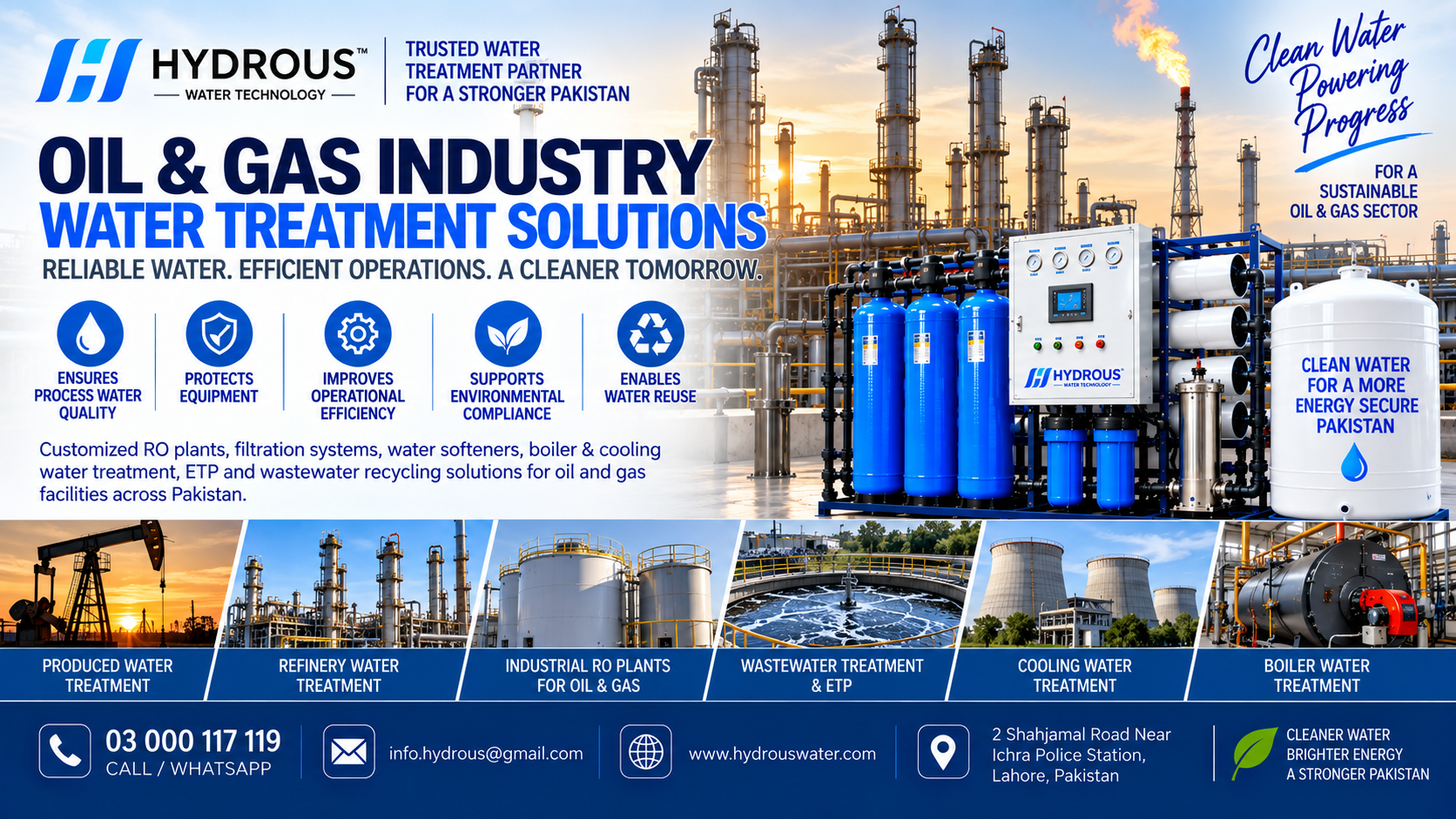
Industrial RO, wastewater treatment, filtration and water recycling solutions for the oil and gas industry in Pakistan.
Why Water Treatment Is Important in the Oil & Gas Industry
Oil and gas facilities can have demanding water-quality requirements.
Poor-quality water can contribute to:
- Scaling
- Corrosion
- Fouling
- Equipment damage
- Reduced heat-transfer efficiency
- Membrane fouling
- Increased maintenance
- Wastewater-management problems
At the same time, industrial wastewater must be appropriately treated before discharge or reuse.
A properly designed water-treatment system can therefore help an oil and gas facility improve process reliability, equipment protection, water quality and water management.
Oil & Gas Water Treatment Applications
Different oil and gas facilities require different treatment systems.
Hydrous Water Technology can design solutions for applications such as:
- Oil and gas processing facilities
- Refineries
- Petrochemical-related facilities
- Fuel storage facilities
- Industrial workshops
- Oil terminals
- Gas-processing facilities
- Industrial utility systems
- Boiler systems
- Cooling-water systems
- Wastewater-treatment facilities
The treatment technology should always be selected according to the specific process and water analysis.
Industrial RO Plant for Oil & Gas Industry
An industrial RO plant can be used where lower-TDS water is required for industrial applications.
A typical RO pretreatment system may include:
Raw Water → Multimedia Filter → Activated Carbon → Water Softener → Cartridge Filter → High-Pressure Pump → RO Membranes → Treated Water
RO can reduce dissolved salts and other dissolved contaminants from suitable feedwater.
Applications may include:
- Process water
- Utility water
- Boiler-feedwater pretreatment
- Equipment washing
- Laboratory applications
- General industrial water
The final RO design should be based on feedwater analysis and required permeate quality.
Oil Refinery Water Treatment
Refineries and related industrial facilities may require several water-treatment systems operating together.
A refinery water-treatment strategy can include:
Raw-Water Treatment
Filtration and conditioning before industrial use.
RO Water Treatment
Reduction of dissolved salts and TDS.
Boiler Feedwater Treatment
Protection of boilers and steam-generation equipment.
Cooling-Water Treatment
Control of scale, corrosion and biological growth.
Wastewater Treatment
Treatment of process and utility wastewater.
Water Recycling
Recovery of treated water for suitable applications.
A refinery therefore may require an integrated water-management approach rather than a single treatment plant.
Oil & Gas Wastewater Treatment
Industrial wastewater from oil and gas operations can contain different types of contaminants depending on the source.
Potential contaminants include:
- Oil and grease
- Suspended solids
- Dissolved solids
- Hydrocarbons
- COD
- BOD
- Chemicals
- Salts
- Metals
- Process-specific contaminants
The first step in designing an appropriate system is to understand the wastewater characteristics.
A representative laboratory analysis should normally be obtained before finalizing the ETP design.
Oil & Gas ETP
An oil and gas ETP can be designed using multiple treatment stages.
A conceptual treatment process may include:
Collection → Screening → Oil Separation → Equalization → pH Adjustment → Coagulation & Flocculation → Clarification → Biological Treatment → Filtration → Final Treatment
Depending on the wastewater, additional treatment may include:
- Dissolved Air Flotation (DAF)
- Activated carbon
- MBBR
- SBR
- MBR
- Ultrafiltration
- Reverse osmosis
- Advanced oxidation
- Disinfection
The final configuration should be based on wastewater analysis and the required treated-water quality.
Oil and Grease Removal
Oil and grease can be an important consideration in wastewater generated by oil and gas operations.
A suitable pretreatment system can include:
Oil-Water Separator
Separates free oil from wastewater through physical separation.
Coalescing Separator
Can improve the separation of dispersed oil droplets.
DAF System
Dissolved Air Flotation can be considered where fine oil droplets and suspended solids require additional removal.
Chemical Treatment
Coagulation and flocculation may be used where appropriate to improve separation.
Effective oil removal before downstream biological or membrane treatment can help reduce fouling and improve overall treatment performance.
Produced Water Treatment
Produced water is wastewater associated with oil and gas production.
Its composition can vary significantly depending on:
- Geological formation
- Production method
- Field age
- Oil characteristics
- Chemicals used
- Water-to-oil ratio
Depending on the application, produced-water treatment may involve:
Oil Separation → Filtration → Chemical Treatment → Membrane Treatment → Polishing
Advanced treatment may include UF, NF or RO where appropriate.
The treatment objective could be discharge, reinjection or selected reuse, depending on the facility and applicable requirements.
Water Filtration for Oil & Gas Facilities
Filtration is commonly used in industrial water-treatment systems.
Multimedia Filtration
Reduces suspended solids and turbidity.
Activated Carbon Filtration
Can help reduce chlorine and selected organic compounds.
Bag or Cartridge Filtration
Provides fine particulate protection for downstream equipment.
Ultrafiltration
Provides membrane-based removal of fine suspended material and colloidal contaminants.
RO
Provides dissolved-solids reduction after suitable pretreatment.
A multi-stage system can therefore provide progressively higher water quality.
Boiler Water Treatment for Oil & Gas
Boilers and steam systems require suitable feedwater to minimize scale and corrosion.
A possible boiler-feedwater treatment system is:
Raw Water → Filtration → Softening → RO → Chemical Dosing → Boiler
Depending on the boiler and operating conditions, additional treatment may be required.
Important monitoring parameters can include:
- pH
- Conductivity
- Hardness
- TDS
- Alkalinity
- Silica
- Dissolved oxygen
- Boiler-water chemistry
Proper treatment can help protect heat-transfer surfaces and improve boiler operating efficiency.
Cooling Water Treatment for Refineries
Cooling towers and industrial cooling systems continuously circulate water.
Evaporation can increase the concentration of dissolved minerals, while poor biological control can contribute to fouling and microbiological growth.
A cooling-water treatment program can include:
- Filtration
- Blowdown control
- Scale control
- Corrosion control
- Biocide treatment
- pH control
- Chemical dosing
- Regular water testing
The treatment program should be designed according to the cooling-system configuration and water chemistry.
Chemical Dosing Systems
Chemical dosing is an important component of many oil and gas water-treatment systems.
Applications can include:
- RO antiscalant dosing
- Coagulant dosing
- Flocculant dosing
- pH correction
- Corrosion inhibition
- Scale control
- Biocide dosing
- Dechlorination
- Wastewater treatment
A typical dosing system can include:
- Chemical tank
- Dosing pump
- Calibration arrangement
- Injection assembly
- Mixing system
- Control panel
Chemical selection should be based on laboratory analysis and the treatment objective.
Oil & Gas Water Recycling
Water recycling can help reduce freshwater consumption where suitable treatment and reuse applications are available.
A possible recycling system is:
Wastewater → ETP → Tertiary Filtration → UF → RO → Recycled Water Tank
Recycled water may potentially be used for selected:
- Utility applications
- Cooling systems
- Cleaning
- Equipment washing
- Irrigation where appropriate
- Other non-critical applications
The reuse application must be evaluated carefully to ensure that treated water meets the required quality.
Advanced Membrane Treatment
Membrane technologies can be integrated into oil and gas water-treatment systems.
UF — Ultrafiltration
Suitable for reducing suspended solids, colloids and larger contaminants.
NF — Nanofiltration
Can provide selective removal of dissolved contaminants and hardness.
RO — Reverse Osmosis
Used for significant dissolved-solids reduction.
A possible treatment sequence is:
Pretreatment → UF → RO → Polishing
Membrane selection depends on feedwater quality, recovery requirements and final water specifications.
Wastewater Treatment and Sludge Management
ETP systems generate sludge as contaminants are removed from wastewater.
An industrial wastewater project should therefore consider:
- Sludge quantity
- Sludge thickening
- Sludge dewatering
- Filter press
- Centrifuge where appropriate
- Sludge storage
- Testing
- Approved disposal or management
Sludge characteristics depend on the wastewater and treatment chemicals used.
Oil & Gas Water Treatment Monitoring
Regular monitoring helps operators understand system performance.
Raw Water Monitoring
Depending on the source:
- pH
- TDS
- Conductivity
- Turbidity
- Hardness
- Alkalinity
- Iron
- Manganese
- Chlorine
RO Monitoring
- Feed pressure
- Permeate pressure
- Flow
- Conductivity
- TDS
- Recovery
- Salt rejection
Wastewater Monitoring
Depending on the process:
- pH
- COD
- BOD
- TSS
- TDS
- Oil and grease
- Hydrocarbons
- Chlorides
- Sulfates
- Metals
Testing requirements should be established according to the facility’s process and applicable discharge or reuse requirements.
How to Design an Oil & Gas Water Treatment System
Step 1 — Identify the Application
Determine whether the water is required for:
- Process use
- Boiler feed
- Cooling
- Cleaning
- Utility use
- Reuse
Step 2 — Analyze the Raw Water
Obtain a complete laboratory water analysis.
Step 3 — Analyze Wastewater
Where an ETP is required, test representative wastewater samples.
Step 4 — Determine Capacity
Calculate daily and peak water requirements.
Step 5 — Select Pretreatment
Choose filtration, softening, carbon treatment and other pretreatment based on water chemistry.
Step 6 — Select Purification Technology
This could include:
RO → Double-Pass RO → UF → Polishing
depending on requirements.
Step 7 — Design Wastewater Treatment
Select oil separation, DAF, biological and tertiary treatment as appropriate.
Step 8 — Plan Water Recycling
Identify practical reuse opportunities.
Step 9 — Add Automation
Install appropriate flow, pressure, pH, conductivity and level monitoring.
Step 10 — Establish Maintenance
Create preventive-maintenance and water-quality monitoring schedules.
Benefits of Proper Water Treatment for Oil & Gas Facilities
A properly engineered system can help:
Protect Equipment
Reduce scaling, fouling and corrosion risks.
Improve Water Quality
Provide water appropriate for specific industrial applications.
Improve RO Performance
Proper pretreatment can help protect membranes from fouling and scaling.
Support Boiler Operation
Suitable feedwater can help protect steam-generation equipment.
Improve Cooling-System Control
Water-treatment programs can help manage scale, corrosion and biological growth.
Improve Wastewater Management
An appropriately designed ETP can reduce targeted wastewater contaminants.
Support Water Reuse
Advanced treatment can make selected water-recycling projects technically feasible.
Oil & Gas Water Treatment Solutions Across Pakistan
Hydrous Water Technology provides customized industrial water-treatment solutions for facilities throughout Pakistan.
Our solutions can include:
- Industrial RO plants
- Commercial RO plants
- Multimedia filtration
- Activated carbon filtration
- Water softeners
- UF systems
- Industrial wastewater treatment
- Oil-water separation
- ETP systems
- Chemical dosing
- Boiler-water treatment
- Cooling-water treatment
- RO antiscalant systems
- Membrane cleaning
- Water recycling
- Installation and commissioning
- Preventive maintenance
Our engineers can evaluate the application and recommend a treatment process based on the available water analysis and project requirements.
Why Choose Hydrous Water Technology?
Hydrous Water Technology specializes in commercial and industrial water treatment solutions in Pakistan.
We focus on designing practical systems rather than using the same treatment configuration for every project.
For oil and gas applications, our approach considers:
- Raw-water quality
- Wastewater characteristics
- Required capacity
- Process requirements
- Equipment protection
- Water-reuse opportunities
- Operating conditions
- Maintenance requirements
This helps develop a treatment system suited to the actual facility.
Get an Oil & Gas Water Treatment Solution
Planning an RO plant, ETP or wastewater-recycling system?
Send us:
- Raw-water analysis
- Wastewater analysis
- Daily water consumption
- Wastewater flow
- Required RO capacity
- Process details
- Boiler capacity, if applicable
- Cooling-system details
- Oil and grease concentration
- COD/BOD/TSS/TDS results
- Required treated-water quality
- Project location
Our team can use this information to develop an appropriate treatment concept and equipment specification.
Frequently Asked Questions
What water treatment does the oil and gas industry require?
Requirements vary by facility. Common systems include filtration, softening, RO, boiler-water treatment, cooling-water treatment, oil separation, ETP and wastewater recycling.
Can RO be used in oil and gas facilities?
Yes. Industrial RO can be used where lower-TDS water is required, provided the feedwater is appropriately pretreated.
What is produced water?
Produced water is water brought to the surface during oil and gas production. Its composition varies considerably and may require specialized treatment.
How is oil removed from industrial wastewater?
Free oil can be separated using oil-water separators, while dispersed oil and suspended solids may require technologies such as DAF and chemical treatment.
Can refinery wastewater be recycled?
Potentially, yes. After appropriate treatment, wastewater can be considered for selected reuse applications depending on the required water quality.
Why is boiler-water treatment important?
Proper boiler-feedwater treatment helps control hardness, dissolved solids, corrosion and scale that can affect boiler performance.
Does Hydrous provide oil and gas ETP solutions in Pakistan?
Yes. Hydrous Water Technology provides customized industrial wastewater-treatment, ETP, RO, filtration, chemical-dosing and water-recycling solutions.