
Power Industry Water Treatment Solutions in Pakistan
Water is one of the most important utilities in power generation. Whether a facility is a thermal power plant, captive power plant, biomass plant, industrial power facility or other energy installation, water quality can directly affect equipment performance, operating reliability and maintenance requirements.
Power plants may use water for boiler feed, steam generation, cooling towers, heat exchangers, equipment cleaning, service water and other plant utilities. Different applications require different levels of water quality.
Hydrous Water Technology provides customized power industry water treatment solutions in Pakistan, including industrial RO plants, multimedia filtration, water softeners, demineralization systems, chemical dosing, boiler-water treatment, cooling-tower treatment and wastewater-treatment solutions.
The right system starts with understanding the water source, plant process, required water quality and operating conditions.
Power plants commonly require high-quality boiler feedwater and carefully managed cooling systems; industry sources in Pakistan also identify RO, DM/polishing systems and chemical treatment as important parts of power-plant water management.
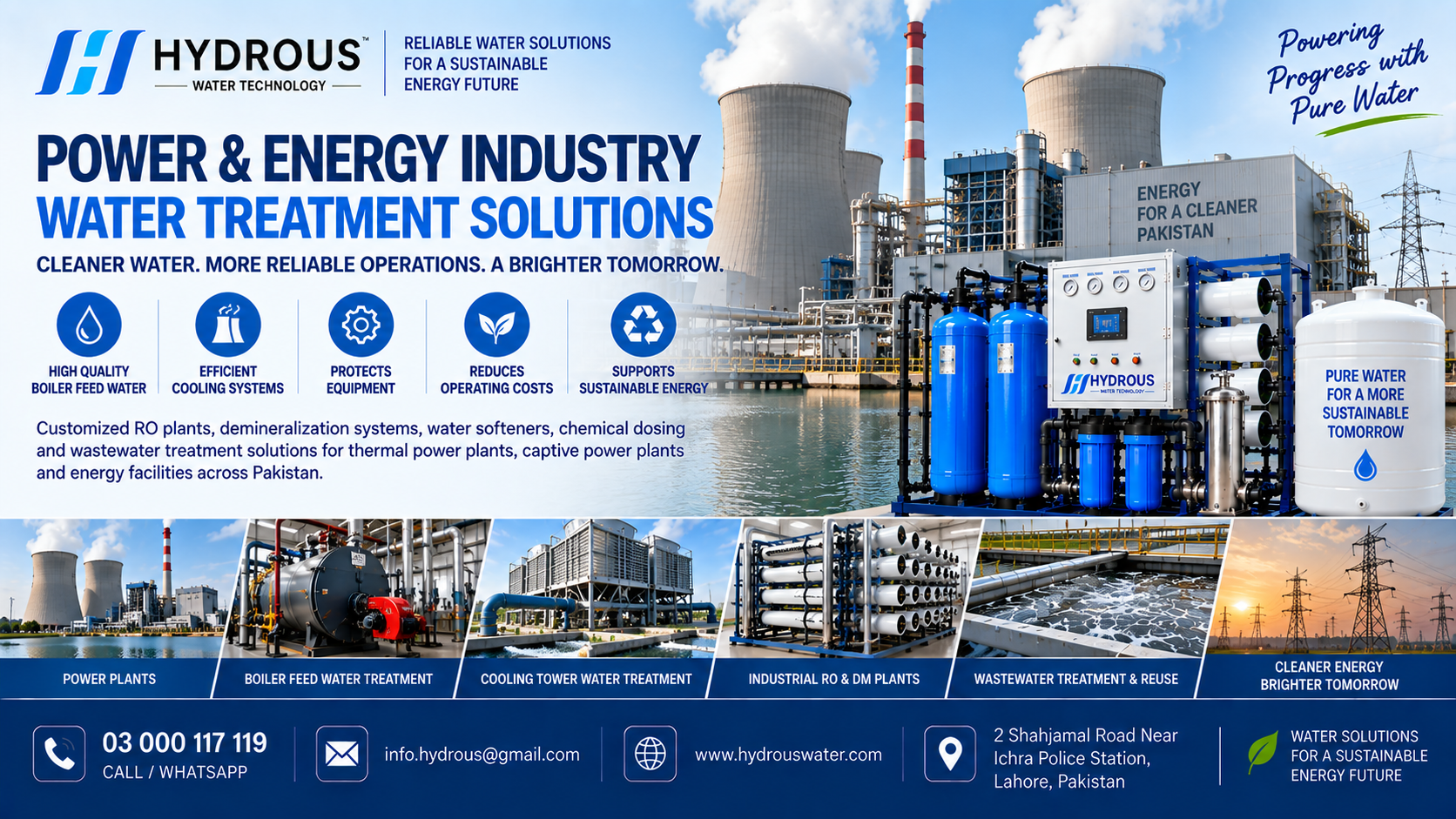
Industrial RO, boiler feedwater, cooling tower and wastewater treatment solutions for power plants in Pakistan.
Why Water Treatment Is Important in Power Plants
Power-generation equipment operates under demanding conditions.
Poor water quality can contribute to:
- Scale formation
- Corrosion
- Fouling
- Reduced heat-transfer efficiency
- Boiler problems
- Cooling-system problems
- Membrane fouling
- Increased chemical consumption
- Higher maintenance requirements
For this reason, water treatment should be considered an integral part of plant operation rather than an optional utility.
The treatment program should be designed around the specific equipment and water chemistry.
Water Treatment for Thermal Power Plants
Thermal power plants can have several water-treatment requirements.
Water may be required for:
- Boiler feedwater
- Steam generation
- Cooling towers
- Condensate systems
- Heat exchangers
- Service water
- Plant cleaning
- Wastewater treatment
A thermal power plant may therefore require several treatment stages rather than relying on a single RO plant.
A typical high-level arrangement could be:
Raw Water → Pretreatment → RO → Demineralization / Polishing → Boiler Feedwater
while cooling-water treatment may operate as a separate system.
The exact configuration depends on boiler pressure, feedwater specifications, source-water quality and plant design.
Industrial RO Plant for Power Plants
An industrial RO plant for a power plant is commonly used to reduce dissolved salts and other contaminants before downstream treatment.
A typical arrangement may include:
Raw Water Tank
↓
Multimedia Filter
↓
Activated Carbon Filter
↓
Softener / Pretreatment
↓
Cartridge Filter
↓
High-Pressure Pump
↓
RO Membranes
↓
Treated Water Tank
RO may then be followed by additional polishing or demineralization where the final water-quality specification requires it.
For high-pressure boiler applications, RO may form one stage of a larger treatment train rather than being the final purification step. A documented Pakistani power-generation project, for example, specifies RO and polishing treatment for high-pressure boiler water.
Boiler Feed Water Treatment
Boiler feedwater is one of the most important water-treatment applications in a power plant.
Boiler systems require carefully controlled water chemistry because deposits and corrosion can damage boiler components and reduce operating efficiency.
A boiler feedwater system may include:
- Pretreatment
- Softening
- RO
- Demineralization
- Mixed-bed polishing
- Deaeration
- Chemical dosing
- Condensate treatment
The required configuration depends on the boiler operating pressure and manufacturer’s water-quality requirements.
Professional training programs in Pakistan specifically cover boiler-feed characteristics, monitoring, oxygen removal, scale control and boiler-treatment chemicals, demonstrating the importance of controlled boiler-water chemistry.
Demineralization Plant for Power Plants
Where very low dissolved-mineral content is required, a demineralization plant (DM plant) can be used after pretreatment and, where appropriate, RO.
A DM system can be designed to produce water with substantially reduced ionic content.
Depending on the application, the treatment train may include:
RO → Cation Exchange → Degasser → Anion Exchange → Mixed Bed
Modern systems may use other membrane and electrodeionization technologies depending on the required water quality.
The correct solution depends on:
- Boiler pressure
- Feedwater specification
- Raw-water chemistry
- Required conductivity
- Silica requirement
- Plant operating conditions
Cooling Tower Water Treatment
Cooling towers are another major water-treatment application in power facilities.
As water circulates and evaporates, dissolved minerals can become concentrated.
Without proper control, this can contribute to:
- Scaling
- Corrosion
- Suspended-solids buildup
- Microbiological fouling
Cooling-water treatment can involve:
- Filtration
- Chemical dosing
- Scale inhibitors
- Corrosion inhibitors
- Biocides
- Blowdown management
- Side-stream filtration
Industrial water-treatment providers in Pakistan commonly offer dedicated cooling-tower programs for scale, corrosion and biological fouling control.
Cooling Tower Chemical Treatment
A cooling-tower chemical program may include several components depending on water chemistry and system design.
Scale Control
Helps control mineral deposition.
Corrosion Control
Helps protect metal surfaces and equipment.
Biocide Treatment
Helps control biological growth where required.
Dispersants
Help manage suspended particles and deposits in suitable applications.
Blowdown Control
Helps control the concentration of dissolved solids in the recirculating water.
Chemical selection should be based on water analysis, cooling-system design and operating conditions.
Boiler Water Treatment Chemicals
Power plants may use chemical treatment to control boiler-water chemistry.
Depending on the system, chemical programs can include:
- Oxygen scavengers
- Phosphate treatment
- Alkalinity control
- Scale inhibitors
- Sludge dispersants
- Condensate treatment
- pH control
The exact program should be developed according to boiler type, pressure, feedwater quality and operating conditions.
Hydrous Water Technology can provide suitable water-treatment chemicals and dosing solutions as part of an overall treatment program.
Water Filtration for Power Plants
Filtration is an important pretreatment stage.
Depending on the raw-water source, power facilities may require:
- Sand filtration
- Multimedia filtration
- Activated carbon filtration
- Cartridge filtration
- Bag filtration
- UF membranes
Pretreatment can help protect downstream RO membranes and other equipment from suspended solids and fouling contaminants.
Bore Water Treatment for Power Plants
Some industrial power facilities use groundwater as their water source.
Bore water may contain:
- High TDS
- Hardness
- Iron
- Manganese
- Silica
- Chloride
- Sulphate
- Suspended solids
- Other dissolved contaminants
A laboratory water analysis should be completed before finalizing the treatment plant.
A possible treatment arrangement is:
Bore Water → Media Filtration → Carbon → Softening → Cartridge Filtration → RO → DM / Polishing
However, this is only a conceptual example. The actual process must be based on the water analysis and required treated-water quality.
Power Plant Wastewater Treatment
Power plants can generate wastewater from multiple sources.
These may include:
- Cooling-tower blowdown
- Boiler blowdown
- RO reject
- Filter backwash
- Chemical cleaning
- Floor washing
- Equipment maintenance
- Ash-handling operations
- Domestic sewage
Industrial wastewater should be characterized before selecting treatment technology.
Depending on the source, treatment may include:
- Screening
- Equalization
- pH correction
- Coagulation
- Flocculation
- Clarification
- Filtration
- RO
- UF
- Sludge handling
- Water reuse
Different wastewater streams should be evaluated separately where their chemistry differs significantly.
RO Reject and Water Recovery
RO systems generate a reject stream containing a higher concentration of dissolved solids.
For larger power plants, water recovery can become an important consideration.
Possible approaches include:
- Improved RO recovery
- Second-pass RO
- UF pretreatment
- Reject treatment
- Evaporation
- Concentration systems
- Reuse for suitable applications
The economically suitable solution depends on the water chemistry, discharge requirements, available space and recovery target.
Water Recycling in Power Plants
Water recycling can reduce freshwater requirements where appropriate.
Potential reuse applications can include:
- Cooling-tower makeup
- Ash handling
- Dust suppression
- Gardening
- Floor washing
- Other approved non-potable applications
Treated water should only be reused when its quality is suitable for the intended application.
A power-industry water-treatment approach can therefore include both water purification and water recovery. Modern power-sector treatment solutions commonly combine RO, UF, wastewater treatment and reuse systems for this purpose.
Ash Handling Water Treatment
Where coal or other solid fuels are used, ash-handling systems can generate water containing high suspended solids.
Treatment may require:
- Screening
- Settling
- Clarification
- Filtration
- Sludge handling
- Water recycling
The actual system depends on the type of ash-handling process and wastewater characteristics.
Where applicable, recycling treated water can reduce freshwater demand.
Water Treatment for Captive Power Plants
Captive power plants serve industrial facilities such as:
- Textile mills
- Sugar mills
- Cement plants
- Food factories
- Chemical plants
- Manufacturing facilities
The water-treatment requirement may depend on the industrial process connected to the power plant.
For example, a captive power plant may simultaneously require:
Boiler Feedwater + Cooling Water + RO Water + Process Water + Wastewater Treatment
A combined water-treatment strategy can help the facility manage these requirements more efficiently.
Biomass Power Plant Water Treatment
Biomass power facilities can also require treated water for:
- Boiler feed
- Cooling systems
- Steam generation
- Plant utilities
- Cleaning
The water-treatment design should consider the boiler system, cooling configuration and raw-water chemistry.
Where condensate recovery is available, recovering and treating condensate can also be an important part of the overall water-management strategy.
Water Treatment for Energy Facilities
Beyond traditional power plants, water treatment may be required at:
- Energy-generation facilities
- Captive power units
- Cogeneration plants
- Biomass plants
- Industrial utility plants
- Large process facilities
The technology should always be selected based on the site’s actual water requirements.
Water Analysis for Power Plant Treatment
A proper water analysis is the starting point for system design.
Important parameters may include:
- pH
- TDS
- Conductivity
- Turbidity
- Total hardness
- Calcium
- Magnesium
- Alkalinity
- Chloride
- Sulphate
- Silica
- Iron
- Manganese
- Sodium
- TOC where required
- Microbiological parameters
For boiler applications, additional parameters may be required according to the boiler manufacturer’s specification.
For wastewater, testing may include:
- BOD
- COD
- TSS
- Oil and grease
- Metals
- TDS
- pH
How to Design a Power Plant RO System
Design should begin with the actual water requirement.
Step 1 — Analyze the Raw Water
Obtain a reliable laboratory analysis.
Step 2 — Identify Water Applications
Separate:
- Boiler feed
- Cooling
- Process
- Drinking
- Service water
Step 3 — Determine Required Quality
Different applications require different treatment levels.
Step 4 — Calculate Flow
Determine:
- Daily requirement
- Hourly requirement
- Peak demand
- Operating hours
Step 5 — Design Pretreatment
Select filtration, softening or other pretreatment according to the raw-water chemistry.
Step 6 — Design RO
Select membranes, pressure vessels, pumps and recovery according to the feedwater.
Step 7 — Add Polishing
DM, mixed-bed or other polishing may be required for high-purity boiler feed.
Step 8 — Design Storage and Distribution
Ensure adequate treated-water storage and reliable pumping.
Power Plant RO Capacity Calculation
Suppose a power facility requires 50,000 litres of RO-treated water per day and the plant is scheduled to operate for 10 hours.
50,000 ÷ 10 = 5,000 LPH
A production rate of approximately 5,000 LPH could therefore be an initial reference.
However, the final plant capacity should consider:
- RO recovery
- Feedwater availability
- Peak consumption
- Storage capacity
- Plant operating hours
- Maintenance downtime
- Future expansion
For power plants, capacity should always be confirmed against the actual process-water balance.
Automation for Power Plant Water Treatment
Large treatment systems can benefit from automated controls.
Possible features include:
- Automatic filter backwashing
- Automatic RO start/stop
- High-pressure protection
- Low-level protection
- High-level shutdown
- Conductivity monitoring
- Flow monitoring
- Pressure monitoring
- Chemical dosing control
- PLC-based control
Online monitoring can help operators identify changes in system performance before they become major problems.
Preventive Maintenance for Power Plant RO Systems
RO performance should be monitored regularly.
Important parameters include:
- Feed pressure
- Permeate flow
- Reject flow
- Feed conductivity
- Permeate conductivity
- Salt rejection
- Differential pressure
A significant change in these parameters can indicate:
- Membrane fouling
- Scaling
- Cartridge blockage
- Pump problems
- Changes in feedwater quality
Regular preventive maintenance can help extend membrane life and maintain stable production.
Benefits of Proper Power Industry Water Treatment
A properly designed system can help power facilities:
Protect Boilers
Controlled feedwater quality helps reduce scaling and corrosion risks.
Improve Cooling Performance
Proper cooling-water management helps control scale, corrosion and biological fouling.
Protect RO Membranes
Good pretreatment reduces the risk of particulate and mineral fouling.
Improve Water Recovery
Reuse and recovery systems can reduce freshwater demand where appropriate.
Reduce Maintenance Problems
Proper water chemistry management can help protect equipment.
Support Reliable Operations
Stable water quality is an important part of reliable industrial utility operation.
Sustainable Water Management for Power Plants
Water efficiency is becoming increasingly important for industrial facilities.
Power plants can investigate:
- RO recovery optimization
- Cooling-tower optimization
- Blowdown management
- Condensate recovery
- Wastewater recycling
- Treated-water reuse
- Efficient chemical dosing
- Side-stream filtration
- Rainwater harvesting where practical
The goal is not simply to treat more water, but to treat the right water to the right quality and recover it where technically and economically practical.
Why Choose Hydrous Water Technology?
Hydrous Water Technology provides customized water-treatment solutions for commercial, industrial and institutional applications across Pakistan.
Our solutions for power and energy facilities can include:
- Industrial RO plants
- Commercial RO plants
- Multimedia filters
- Activated carbon filters
- Water softeners
- DM / demineralization systems
- UV systems
- Cartridge filtration
- Chemical dosing systems
- RO antiscalants
- Boiler treatment chemicals
- Cooling-tower chemicals
- Membrane cleaning chemicals
- Industrial wastewater treatment
- Water recycling systems
- RO membrane replacement
- Plant maintenance
- Installation and commissioning
Our approach is based on water analysis, process requirements and practical system design rather than using a standard configuration for every project.
Power Industry Water Treatment Services Across Pakistan
Hydrous Water Technology can provide customized water-treatment solutions for:
- Thermal power plants
- Captive power plants
- Biomass power plants
- Cogeneration facilities
- Industrial utility plants
- Energy facilities
- Manufacturing plants with captive power
- Large commercial energy systems
Our team can evaluate the raw-water quality, treatment requirement, plant capacity and application before recommending the appropriate technology.
Get a Power Plant Water Treatment Solution
If you are planning a water-treatment project for a power or energy facility, provide:
- Raw-water analysis
- Water source
- Boiler capacity and pressure
- Cooling-tower capacity
- Required RO capacity
- Required boiler-feed quality
- Daily water consumption
- Existing treatment system
- Wastewater analysis, if available
- Project location
This information allows the treatment system to be designed around the actual requirements of your facility.
Frequently Asked Questions
Why is water treatment important in a power plant?
Water treatment helps control contaminants that can contribute to scaling, corrosion, fouling and other operational problems in boilers, cooling systems and treatment equipment.
Is RO enough for boiler feedwater?
Not necessarily. RO may be one stage of boiler-feedwater treatment. Depending on boiler specifications, additional demineralization or polishing may be required.
What is a DM plant used for?
A demineralization plant reduces dissolved ionic contaminants to produce higher-purity water for applications such as boiler feedwater.
Does a power plant need cooling-tower water treatment?
Where cooling towers are used, appropriate water-quality and chemical-control programs are generally important to manage scale, corrosion and biological fouling.
Can power plant wastewater be reused?
Potentially. Depending on its characteristics, treated wastewater may be reused for suitable non-potable applications such as cooling makeup or other approved utility uses.
What capacity RO plant does a power plant need?
There is no standard capacity. It depends on the plant’s water balance, boiler requirements, cooling system, operating hours, recovery and storage.
Can Hydrous design a customized power plant RO system?
Yes. Hydrous Water Technology can develop customized industrial water-treatment solutions based on water analysis, capacity and application requirements.