
Poultry & Livestock Water Treatment Solutions in Pakistan
Water is one of the most important resources on a poultry or livestock farm.
Birds and animals depend on water every day for drinking, digestion, temperature regulation and normal biological functions. On a commercial farm, the quality of that water can also affect the performance of the entire operation.
Water that contains excessive salts, hardness, iron, suspended solids or microbiological contamination may create problems in drinking lines, storage tanks and farm operations.
For this reason, poultry and livestock water treatment should be designed according to the farm’s water source, animal population and water-quality requirements.
Hydrous Water Technology provides poultry and livestock water treatment solutions in Pakistan, including RO plants, filtration systems, water softeners, cartridge filtration, UV treatment and related water-treatment equipment.
Our systems can be customized for poultry farms, hatcheries, livestock farms and other agricultural facilities.
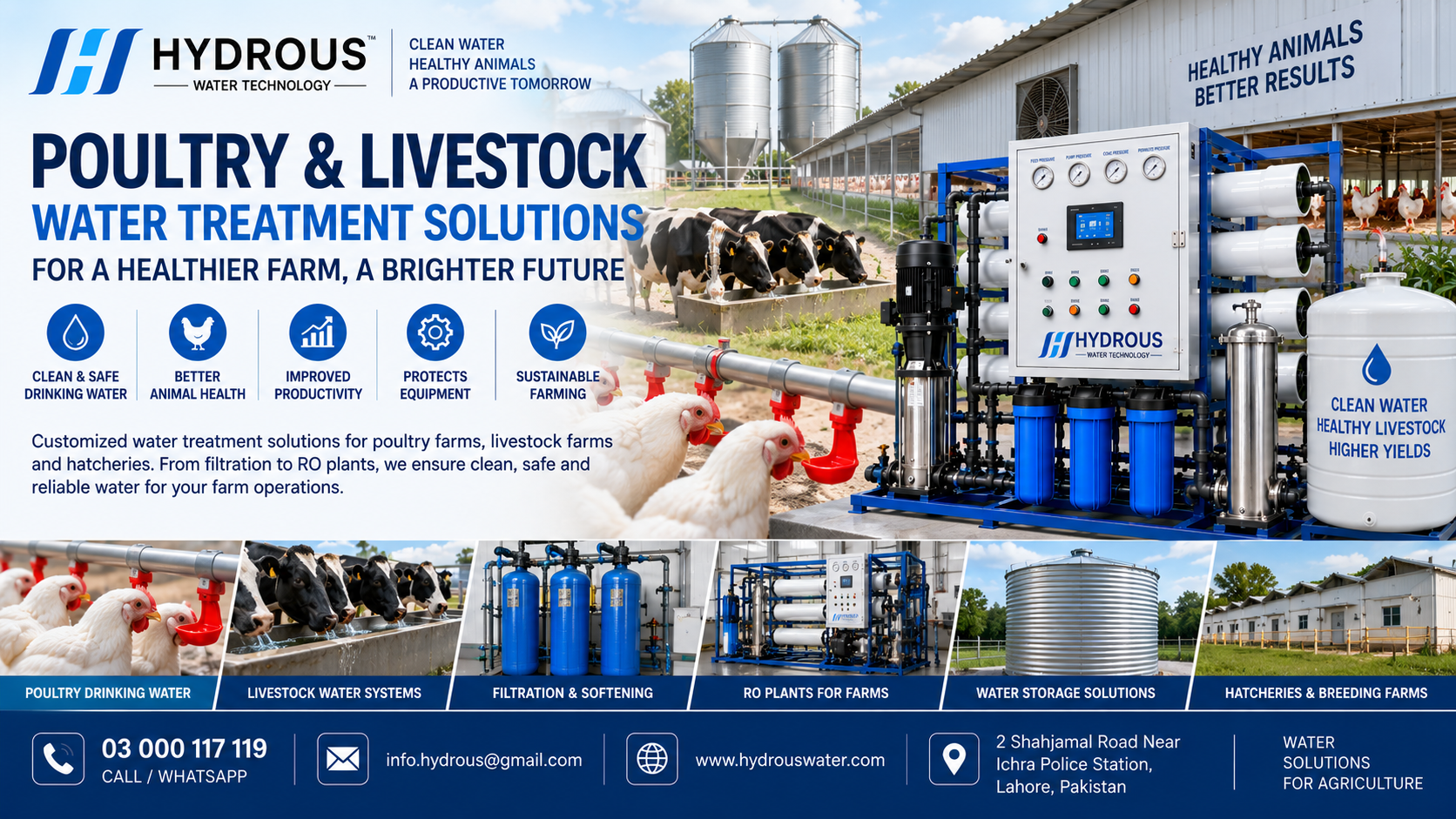
Water treatment, RO and filtration solutions for poultry and livestock farms in Pakistan.
Why Water Quality Matters on Poultry & Livestock Farms
Animals consume water throughout the day, making the farm drinking-water system an important part of overall farm management.
Poor-quality water can affect:
- Water intake
- Drinking-line performance
- Equipment condition
- Farm hygiene
- Cleaning operations
- General animal management
Water quality can vary significantly between locations.
For example, groundwater may contain elevated levels of hardness, iron or dissolved salts, while another source may have microbiological or turbidity concerns.
Therefore, water testing should be the starting point for selecting a treatment system.
Poultry-water guidance also emphasizes that drinking-water quality and cleanliness of tanks and lines are important parts of flock management.
Poultry Farm Water Treatment System
A poultry farm water-treatment system can be relatively simple or highly engineered depending on the source-water quality.
A possible treatment arrangement is:
Raw Water → Multimedia Filter → Activated Carbon → Softener → Cartridge Filter → RO → UV → Treated Water Storage → Drinking Lines
However, this should not be considered a standard design for every farm.
The actual treatment process depends on:
- Raw-water analysis
- Farm size
- Number of birds
- Daily water demand
- Water-source type
- TDS
- Hardness
- Iron
- Turbidity
- Microbiological quality
- Required treatment level
Poultry RO Plant
A poultry RO plant can be used when the farm’s water contains excessive dissolved salts or other contaminants that require membrane treatment.
RO can be particularly useful where groundwater or another source has high TDS.
The system can include:
- Raw-water filtration
- Activated carbon
- Cartridge filtration
- High-pressure pump
- RO membranes
- Pressure gauges
- Flow meters
- Conductivity/TDS monitoring
- Optional UV treatment
- Treated-water storage
Your existing Hydrous poultry RO page already targets searches around RO plants for poultry farms in Pakistan, so this industry page should link to that page rather than competing with it.
How to Choose the Right Poultry RO Capacity
RO capacity should be calculated from the farm’s actual water requirement.
Important factors include:
- Number of birds
- Type of poultry
- Farm production cycle
- Average daily water consumption
- Peak demand
- Number of sheds
- Operating hours
- Storage capacity
- Cleaning requirements
For example, if a farm requires 10,000 litres of treated water per day and the RO system operates for 10 hours:
10,000 ÷ 10 = 1,000 LPH
This gives a preliminary requirement of approximately 1,000 litres per hour.
The final system should also consider storage, peak consumption, RO recovery and future expansion.
Poultry Drinking Water Treatment
Drinking water should be treated according to its actual quality and intended use.
Depending on the source, treatment may include:
Sediment Filtration
Helps reduce suspended particles and turbidity.
Activated Carbon
Can reduce chlorine, taste, odor and certain organic compounds where appropriate.
Water Softening
Can reduce hardness where hardness is creating operational problems.
Reverse Osmosis
Can reduce dissolved salts and many dissolved contaminants.
UV Treatment
Can be incorporated where microbiological control is required.
The treatment sequence should be selected after testing the water rather than automatically installing every available treatment stage.
Water Treatment for Poultry Hatcheries
Hatcheries can have specific water requirements related to cleaning, sanitation and facility operations.
Water may be required for:
- Cleaning
- Equipment washing
- General facility use
- Drinking-water preparation
- Sanitation-related applications
A hatchery water-treatment system should therefore consider both water quality and hygiene management.
Depending on the source, a combination of filtration, softening, RO and other treatment technologies may be appropriate.
Livestock Water Treatment
Livestock farms also require reliable access to suitable drinking water.
Water treatment requirements can vary depending on:
- Animal type
- Farm size
- Water source
- Water chemistry
- Storage arrangement
- Drinking system
- Cleaning requirements
Potential treatment technologies include:
- Multimedia filtration
- Activated carbon
- Water softening
- Cartridge filtration
- RO
- UV
- Other application-specific treatment
The system should be designed according to the actual water analysis.
Bore Water Treatment for Poultry Farms
Groundwater is an important water source for many agricultural properties.
However, bore water quality can vary considerably.
Potential concerns include:
- High TDS
- Hardness
- Iron
- Silica
- Chloride
- Sulphate
- Turbidity
- Alkalinity
- Microbiological contamination
A laboratory water analysis can help determine the correct treatment process.
For example, one farm may require:
Bore Water → Multimedia Filter → Softener → Cartridge Filter → RO
while another farm may only need filtration and softening.
High TDS Water for Poultry Farms
High TDS can be a concern where groundwater contains elevated dissolved salts.
The appropriate response depends on the actual water chemistry.
If dissolved salts need to be significantly reduced, an RO plant may be considered.
However, TDS alone should not be used to design the complete system.
A proper water analysis should also consider hardness, alkalinity, chloride, sulphate, iron and other relevant parameters.
Hard Water on Poultry Farms
Hard water contains elevated concentrations of calcium and magnesium.
Hardness can contribute to mineral deposits in:
- Drinking lines
- Water tanks
- Pumps
- Pipes
- Heating equipment
- RO systems
A water softener can be used where hardness reduction is appropriate.
For RO systems, appropriate pretreatment can also help protect the membranes from scaling.
Iron Removal for Farm Water
Some groundwater sources contain elevated iron.
Iron can cause:
- Staining
- Deposits
- Taste and odor issues
- Equipment fouling
- Problems with downstream treatment
The correct iron-removal process depends on the form and concentration of iron in the water.
Possible treatment approaches can include oxidation and filtration, but the appropriate design should be based on water analysis.
Poultry Water Storage Tanks
Treated water should be stored in a properly maintained tank before being supplied to the farm where storage is required.
Important considerations include:
- Tank material
- Tank capacity
- Protection from contamination
- Cleaning access
- Pipe arrangement
- Distribution system
- Disinfection requirements
The storage system should be incorporated into the overall water-treatment design.
Poultry Drinking Lines
Water quality is not only about the treatment plant.
The entire distribution system matters.
A clean treatment system can still be undermined by poorly maintained:
- Storage tanks
- Pipes
- Drinking lines
- Nipples
- Connections
Regular inspection and appropriate cleaning of water lines can help maintain water quality. Poultry-water guidance recommends thorough cleaning and disinfection of tanks and lines between flocks to address accumulated biofilm.
Poultry Farm Water Filtration
Not every poultry farm requires RO.
A filtration system may be sufficient where the primary concern is suspended solids or other particulate contamination.
A filtration system can include:
Raw Water → Multimedia Filter → Activated Carbon → Cartridge Filter → Storage
Where hardness is a concern:
Raw Water → Multimedia Filter → Softener → Cartridge Filter
Where dissolved salts are excessive:
Raw Water → Pretreatment → RO → Storage
This application-based approach helps avoid installing unnecessary equipment.
Poultry Farm Water Softener
A water softener may be appropriate for farms where hardness is causing operational problems.
Potential benefits include:
- Reduced scale
- Better protection of equipment
- Reduced mineral deposits
- Improved RO pretreatment
- Cleaner water lines
The correct softener size depends on:
- Flow rate
- Water hardness
- Daily consumption
- Regeneration frequency
- Required operating hours
UV Treatment for Poultry Water
UV treatment may be considered as an additional microbiological-control stage where appropriate.
It is generally used after suitable filtration because excessive turbidity can reduce UV effectiveness.
A possible arrangement is:
Filtration → RO → UV → Treated Water Storage
The final treatment arrangement should be determined from the water-quality requirements and operating conditions.
Water Treatment for Poultry Feed Mills
Feed mills may require water for:
- Cleaning
- Steam generation
- General utilities
- Equipment operations
Depending on the facility, water treatment may include filtration, softening, RO or boiler-feed treatment.
Where steam boilers are involved, the water-treatment requirements should be evaluated separately.
Water Treatment for Livestock Farms
Livestock operations can include:
- Dairy farms
- Cattle farms
- Calf-rearing facilities
- Sheep farms
- Goat farms
- Mixed agricultural farms
Each facility can have different water requirements.
A suitable treatment system should consider the animals, farm size, water source and daily demand.
Water Testing for Poultry & Livestock Farms
Before selecting an RO plant or filtration system, Hydrous recommends obtaining a raw-water analysis.
Important parameters may include:
- pH
- TDS
- Conductivity
- Total hardness
- Calcium
- Magnesium
- Alkalinity
- Chloride
- Sulphate
- Iron
- Silica
- Turbidity
- Microbiological parameters
Additional testing may be required depending on the water source and application.
Why is water testing important?
Two farms can have identical TDS readings but completely different water chemistry.
One may have high hardness while another may have high iron or other contaminants.
Therefore, a poultry RO plant should be designed around the complete water analysis rather than TDS alone.
Poultry Farm Water Treatment Maintenance
Regular maintenance is important for reliable operation.
Multimedia Filters
Backwash and inspect according to operating conditions.
Carbon Filters
Monitor performance and replace or regenerate media when required.
Softener
Monitor hardness leakage and regeneration performance.
Cartridge Filters
Replace cartridges when pressure drop reaches the appropriate limit.
RO Membranes
Monitor:
- Feed pressure
- Permeate flow
- Conductivity
- Salt rejection
- Differential pressure
Storage Tanks
Inspect and clean according to the farm’s hygiene program.
Drinking Lines
Regularly inspect and clean the distribution system.
RO Membrane Cleaning for Poultry RO Plants
RO membranes can become fouled or scaled if pretreatment is inadequate.
Possible causes include:
- Hardness
- Iron
- Suspended solids
- Organic matter
- Biological fouling
Changes in:
- Permeate flow
- Differential pressure
- Salt rejection
can indicate that the system needs investigation.
The appropriate membrane-cleaning chemical depends on the type of fouling and the membrane manufacturer’s recommendations.
Hydrous supplies RO membrane cleaning chemicals and antiscalants for commercial and industrial RO systems.
Poultry Farm Water Treatment Chemicals
Depending on the treatment system, a farm may use selected water-treatment chemicals for:
- RO antiscalant dosing
- Membrane cleaning
- Equipment treatment
- Other specialized applications
Chemical selection and dosage should be based on the treatment system and water chemistry.
Chemicals should not be added to animal drinking water simply because they are used elsewhere in water treatment. Any product intended for animal drinking-water applications should be used according to its specific label and appropriate professional guidance.
Designing a Poultry Farm Water Treatment System
Hydrous follows a practical approach when evaluating a farm project.
Step 1 — Identify the Water Source
Determine whether the farm uses bore water, municipal water or another source.
Step 2 — Test the Water
Obtain a representative laboratory water analysis.
Step 3 — Calculate Water Demand
Consider the number of birds or animals and peak consumption.
Step 4 — Identify the Problem
Determine whether the main issue is:
- TDS
- Hardness
- Iron
- Turbidity
- Microbiological quality
- Multiple parameters
Step 5 — Select Treatment
Possible technologies include:
Filtration | Softening | RO | UV | Cartridge Filtration
Step 6 — Design Storage
Determine appropriate raw and treated-water storage.
Step 7 — Design Distribution
Consider the farm’s tanks, pipelines and drinking systems.
Step 8 — Commission the System
Verify flow, pressure, water quality and system operation.
Step 9 — Establish Maintenance
Set up a maintenance schedule for filters, membranes, pumps and storage.
Benefits of Proper Water Treatment on Farms
A correctly designed system can provide:
Consistent Water Quality
The treatment system is matched to the source water.
Better Equipment Protection
Pretreatment can help reduce scale and fouling.
Cleaner Drinking-Water Infrastructure
Appropriate filtration and maintenance can help maintain tanks and water lines.
Reliable Water Supply
Correctly sized treatment and storage can support continuous farm operations.
Reduced Unnecessary Treatment
Water analysis helps avoid installing treatment stages that the farm does not actually require.
Easier Maintenance
A properly designed system makes routine servicing and monitoring more manageable.
Why Choose Hydrous Water Technology?
Hydrous Water Technology provides commercial and industrial water-treatment solutions for poultry farms, livestock facilities and agricultural applications in Pakistan.
Our solutions include:
- Poultry RO plants
- Commercial RO plants
- Industrial RO plants
- Multimedia filters
- Activated carbon filters
- Water softeners
- Cartridge filtration
- UV systems
- RO membranes
- RO membrane housings
- High-pressure pumps
- Chemical dosing systems
- RO antiscalants
- Membrane cleaning chemicals
- Installation
- Commissioning
- Maintenance
Hydrous also provides water-treatment solutions across Pakistan, with systems designed around the customer’s water quality, capacity and application.
Need a Poultry or Livestock Water Treatment System?
If you are planning a new poultry farm, expanding an existing operation or dealing with poor-quality farm water, send us:
- Water test report
- Water source
- Number of birds/animals
- Daily water requirement
- Required RO capacity, if known
- Farm location
- Existing filtration or RO system
- Main water-quality problem
Our technical team can evaluate the information and recommend a suitable treatment configuration.
Frequently Asked Questions
What type of water treatment does a poultry farm need?
It depends on the water source and water analysis. A farm may require filtration, softening, RO, UV or a combination of these technologies.
Is an RO plant necessary for every poultry farm?
No. RO is mainly considered when dissolved salts or other contaminants require membrane treatment. Farms with suitable water quality may only need filtration or softening.
What RO capacity is suitable for a poultry farm?
Capacity depends on the number of birds, daily water consumption, peak demand, operating hours and storage capacity.
Can bore water be used for poultry?
Bore water can be used when it is appropriately tested and treated for the intended application. Water quality can vary significantly between different groundwater sources.
Does hard water affect poultry water systems?
Hardness can contribute to mineral deposits and scaling in tanks, pipes and equipment. A water softener may be appropriate depending on the hardness level and application.
Can RO water be used for poultry drinking?
RO-treated water can be considered where reduction of dissolved salts or other contaminants is required. The final water quality should be evaluated for the intended animal-drinking application.
Do poultry farms need UV after RO?
Not necessarily. UV may be considered where additional microbiological control is required. The need depends on the complete treatment and distribution system.
Do you provide poultry RO plants in Pakistan?
Yes. Hydrous Water Technology provides customized RO and water-treatment systems for poultry and agricultural applications.
Do you provide installation and maintenance?
Yes. Installation, commissioning, maintenance and technical support are available according to project requirements.