
Pharmaceutical Industry Water Treatment Solutions in Pakistan
Water plays an important role throughout the pharmaceutical manufacturing environment. It can be used in production processes, equipment cleaning, laboratory operations, formulation, utilities and other applications where consistent water quality is important.
Because different pharmaceutical applications have different water-quality requirements, a treatment system should be designed around the source water, intended application and required water quality.
Hydrous Water Technology provides customized water treatment solutions for pharmaceutical facilities in Pakistan, including reverse osmosis systems, water filtration, water softeners, ultrafiltration, deionization and supporting water-treatment equipment.
Our approach is to evaluate the water and application first and then develop a treatment configuration suitable for the project.
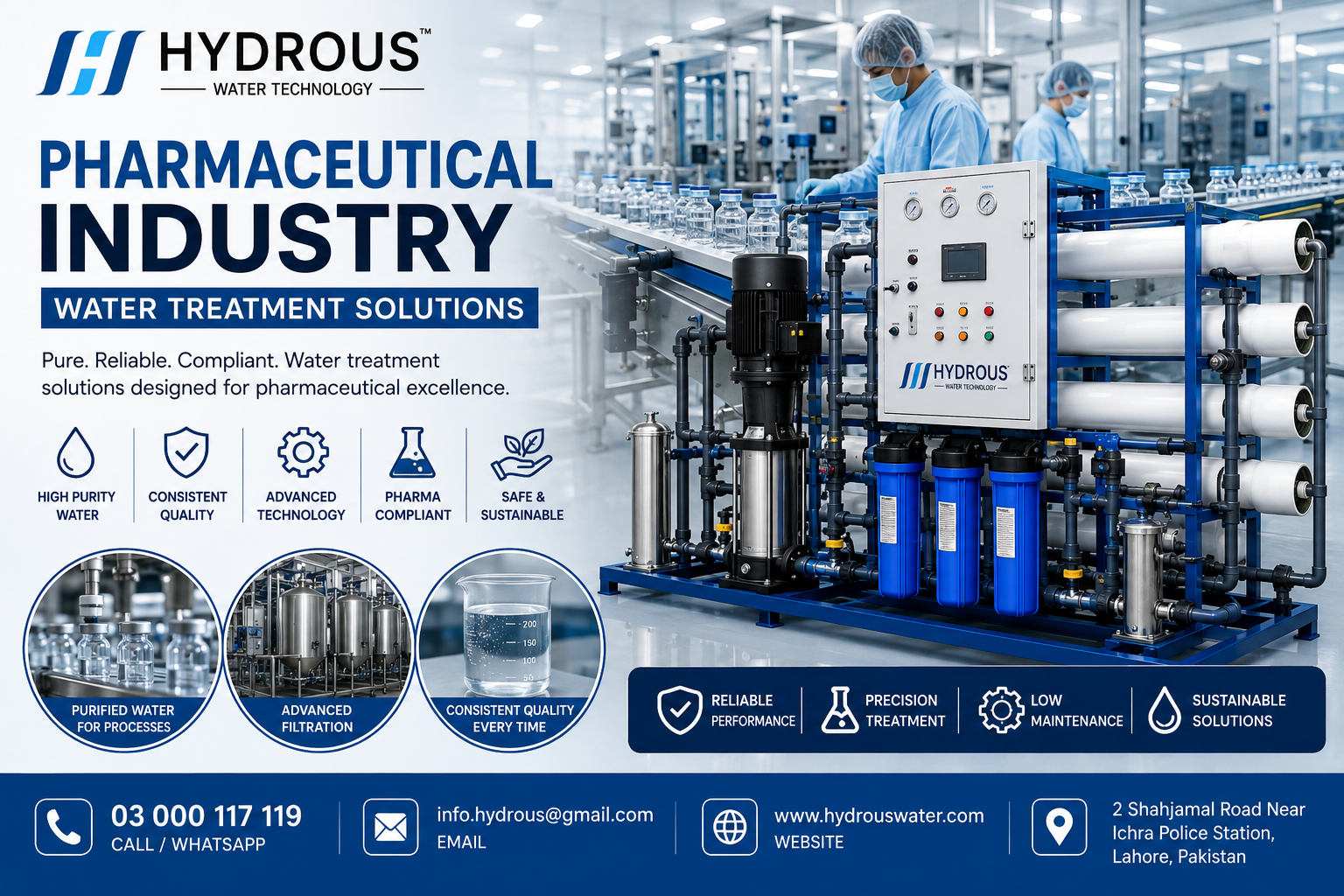
Water treatment and RO solutions for pharmaceutical industries in Pakistan.
Why Water Treatment Is Important in the Pharmaceutical Industry
Pharmaceutical manufacturing requires greater attention to water quality than many ordinary commercial applications.
Water may come into contact with:
- Manufacturing equipment
- Raw materials
- Production areas
- Cleaning systems
- Laboratory equipment
- Utility systems
- Product-contact surfaces
The required quality depends on how the water will be used.
For example, water intended for general utility purposes may have very different requirements from water used as part of a pharmaceutical manufacturing process.
A properly designed treatment system can help provide consistent water quality, protect downstream equipment and support reliable plant operation.
Pharmaceutical Water Treatment System
There is no single treatment configuration that works for every pharmaceutical facility.
A typical system may include several treatment stages depending on the raw-water analysis and final water requirements.
A possible treatment sequence can include:
Raw Water → Pretreatment → Filtration → Softening → RO → UV/UF → Deionization → Purified Water Storage
The actual process should be established after reviewing:
- Raw-water quality
- Required flow rate
- Water-quality specifications
- Production process
- Operating hours
- Storage requirements
- Distribution requirements
- Cleaning and sanitization requirements
This is particularly important because adding unnecessary treatment stages can increase capital and operating costs without providing a meaningful benefit.
Pharmaceutical RO Plant
Reverse osmosis is commonly used as an important purification stage in industrial water treatment.
An RO plant for the pharmaceutical industry can reduce dissolved salts and many other contaminants from suitable feed water.
Depending on the project, RO may be used as:
- A primary purification stage
- Pretreatment for further purification
- Part of a purified-water system
- Utility-water treatment
- Process-water treatment
The RO plant should be designed according to the raw-water characteristics rather than selecting equipment based only on production capacity.
Important design considerations include:
Feed-Water Quality
A complete raw-water analysis helps determine the necessary pretreatment and RO configuration.
Required Capacity
The plant may be designed according to the required LPH, GPD or cubic metres per hour.
Recovery
RO recovery should be selected according to feed-water chemistry, membrane characteristics and system design.
Product-Water Quality
The required permeate quality determines whether additional purification stages are necessary.
Pretreatment
Appropriate pretreatment helps protect RO membranes and improve system reliability.
Pretreatment for Pharmaceutical Water Systems
RO membranes should not normally be expected to handle untreated raw water directly.
Depending on the source, pharmaceutical water-treatment systems may require pretreatment such as:
Multimedia Filtration
Removes suspended solids and reduces turbidity before downstream treatment.
Activated Carbon Filtration
Can be used to reduce chlorine and certain organic compounds where appropriate.
Water Softening
Softening can reduce hardness and help control the risk of scale formation.
Cartridge Filtration
Fine filtration provides additional protection before sensitive downstream equipment.
Chemical Dosing
Depending on the water chemistry, dosing systems may be required for applications such as antiscalant control.
The exact pretreatment arrangement should be determined from the water analysis.
Deionized Water for Pharmaceutical Applications
Some pharmaceutical and laboratory applications require water with a much lower ionic content than conventional RO water.
A deionization system can be incorporated after RO where the application requires additional reduction of dissolved ions.
Depending on the project, deionization can be achieved using technologies such as:
- Mixed-bed ion exchange
- Separate-bed ion exchange
- Electrodeionization (EDI)
The appropriate technology depends on the required water quality, flow rate and operating requirements.
Ultrafiltration for Pharmaceutical Water Treatment
Ultrafiltration uses a membrane barrier with smaller pores than conventional filtration and can be incorporated into advanced water-treatment systems.
UF may be considered for applications requiring additional control of:
- Suspended particles
- Colloids
- Microorganisms
- High-molecular-weight substances
UF can be used independently in some applications or as part of a multi-stage purification system.
Water Filtration for Pharmaceutical Facilities
Filtration is often an important part of the overall water-treatment process.
Depending on the water source and application, a pharmaceutical facility may require:
- Sand or multimedia filtration
- Activated carbon filtration
- Micron filtration
- Cartridge filters
- Specialized membrane filtration
Proper filtration can help reduce the contaminant load reaching more sensitive treatment equipment.
Water Softening for Pharmaceutical Plants
Hard water can cause scale formation in pipes, heating equipment, membranes and other components.
A water softener uses ion-exchange technology to reduce hardness-causing calcium and magnesium.
Softening may be used as:
Raw Water → Filtration → Softener → RO
or as part of another treatment configuration based on the water chemistry.
The need for a softener should be established through water analysis and system design.
Pharmaceutical Water Storage & Distribution
Treatment does not end when water leaves the RO or purification equipment.
For systems where treated water is stored and distributed, the storage tank, piping and distribution arrangement also need to be considered.
Important considerations can include:
- Storage capacity
- Material selection
- Piping configuration
- Dead-leg control
- Recirculation
- Sanitization
- Temperature
- Water-quality monitoring
The design should be appropriate for the intended pharmaceutical application and its applicable quality requirements.
Water Quality Testing for Pharmaceutical Applications
Before designing a pharmaceutical water treatment plant, raw-water testing is highly recommended.
Depending on the source and project requirements, testing may include:
- TDS
- Conductivity
- pH
- Total hardness
- Calcium
- Magnesium
- Alkalinity
- Chloride
- Sulphate
- Iron
- Silica
- Turbidity
- Total dissolved solids
- Microbiological parameters
- Other application-specific parameters
The final testing program should be selected according to the facility’s requirements.
A TDS reading alone is not sufficient to design a complete pharmaceutical water treatment system.
Pharmaceutical Water Treatment Plant Design
At Hydrous Water Technology, our approach starts with understanding the customer’s actual requirement.
1. Raw-Water Analysis
We review the available water-quality data to understand the feed-water characteristics.
2. Application Assessment
We determine where the treated water will be used and what quality is required.
3. Capacity Calculation
The required flow rate is calculated based on production requirements, operating hours and peak demand.
4. Pretreatment Selection
Filtration, softening, carbon filtration and other pretreatment stages are selected according to the raw water.
5. Purification System Selection
The treatment train may incorporate:
RO | UF | DI | UV | Filtration | Softening
depending on the application.
6. Storage & Distribution
Where required, treated-water storage and distribution are incorporated into the project design.
7. Installation & Commissioning
The system is installed and commissioned according to the project requirements.
8. Maintenance & Monitoring
Regular inspection and maintenance help keep the system operating consistently.
Pharmaceutical Water Treatment Solutions by Application
Different areas of a pharmaceutical facility may have different water requirements.
Manufacturing
Water may be required for production and process-related applications.
Equipment Cleaning
Treated water can be used where water quality is important for cleaning processes.
Laboratory
Laboratories may require RO, DI or other purified-water systems depending on analytical requirements.
Utility Systems
Water treatment may be required for boilers, cooling systems and other utilities.
General Facility Use
Commercial water-treatment systems may be appropriate for drinking water and general facility requirements.
This application-based approach prevents the facility from purchasing a treatment system that is either insufficient or unnecessarily complicated.
Water Treatment Chemicals for Pharmaceutical Facilities
Water-treatment chemicals can play an important role in maintaining certain treatment systems.
Depending on the application, chemical treatment may include:
- RO antiscalant
- Membrane cleaning chemicals
- Biocides
- pH-control chemicals
- Boiler-water treatment chemicals
- Cooling-water treatment chemicals
Chemical selection and dosing should be based on the equipment, water chemistry and manufacturer’s recommendations.
Hydrous provides a range of water treatment chemicals and RO treatment products for commercial and industrial applications.
RO Membrane Cleaning & Maintenance
RO membrane performance can decline because of:
- Scaling
- Fouling
- Biofouling
- Suspended solids
- Organic contamination
- Incorrect operating conditions
Monitoring parameters such as feed pressure, permeate flow, rejection and differential pressure can help identify changes in membrane performance.
Where cleaning is required, the appropriate cleaning procedure and chemical should be selected according to the type of fouling.
Regular maintenance can help extend membrane service life and maintain system performance.
Benefits of a Properly Designed Pharmaceutical Water Treatment System
A properly engineered system can provide several operational advantages:
Consistent Water Quality
Treatment is designed around the intended water application.
Protection of Equipment
Pretreatment can reduce scaling, fouling and other problems.
Better Process Reliability
Stable water quality supports consistent plant operation.
Reduced Maintenance Problems
Appropriate pretreatment can help protect RO membranes and downstream equipment.
Scalable Design
The treatment system can be designed around current requirements with future expansion considered where appropriate.
Better Operating Control
Instrumentation and monitoring can help operators track important system parameters.
Why Choose Hydrous Water Technology?
Hydrous Water Technology provides water treatment equipment and solutions for industrial and commercial applications across Pakistan.
Our solutions can include:
- Industrial RO plants
- Commercial RO plants
- Water filtration systems
- Water softeners
- Ultrafiltration systems
- Deionization systems
- RO membranes
- Membrane housings
- Pumps
- Chemical dosing systems
- Water treatment chemicals
- Membrane cleaning chemicals
- Installation
- Commissioning
- Maintenance
We focus on designing treatment systems according to water quality, capacity and application, rather than simply supplying a standard RO plant.
Get a Pharmaceutical Water Treatment Solution
Planning a new pharmaceutical facility or upgrading an existing water-treatment system?
Share your requirements with our team, including:
1. Raw-water test report
2. Required capacity
3. Water source
4. Intended application
5. Required treated-water quality
6. Existing treatment equipment
Our technical team can evaluate the requirements and recommend a suitable treatment configuration.
Frequently Asked Questions
What type of water treatment is used in the pharmaceutical industry?
The treatment depends on the application. Systems may include filtration, softening, RO, UF, UV and deionization, with different combinations used according to the required water quality.
Is RO water suitable for pharmaceutical manufacturing?
RO can be an important purification stage, but whether RO water alone is suitable depends on the specific application and required water-quality specification. Additional purification may be necessary.
What is the purpose of RO in a pharmaceutical water system?
RO reduces dissolved salts and other contaminants from suitable feed water and can serve as a major purification stage or as pretreatment for further purification.
Does a pharmaceutical RO plant require pretreatment?
Often, yes. Pretreatment can protect RO membranes from suspended solids, chlorine, hardness, iron and other contaminants, depending on the raw-water quality.
Can Hydrous design a customized pharmaceutical RO plant?
Yes. The system can be designed according to the raw-water analysis, required capacity, application and desired treated-water quality.
Do pharmaceutical plants need deionized water?
Some applications require additional ion removal beyond RO. In such cases, a deionization system or another polishing technology may be incorporated.
How often should pharmaceutical RO membranes be cleaned?
There is no universal cleaning interval. Cleaning should be based on changes in normalized flow, salt rejection, pressure differential and evidence of fouling or scaling, following the membrane manufacturer’s recommendations.
Can Hydrous provide installation and maintenance?
Yes. Hydrous provides water-treatment equipment along with installation, commissioning and maintenance support according to project requirements.