
Mineral Water & Bottled Water Industry Water Treatment Solutions in Pakistan
The bottled-water industry depends on a consistent and well-controlled water purification process.
Whether the source is groundwater, bore water, municipal water or another approved source, the incoming water may contain dissolved salts, hardness, suspended particles, iron, chlorine, microorganisms and other contaminants. The treatment process therefore needs to be designed according to the actual source-water quality and the required finished-water specification.
Hydrous Water Technology provides mineral water and bottled water industry water treatment solutions in Pakistan, including reverse osmosis plants, multimedia filtration, activated carbon filtration, cartridge filtration, water softening, UV treatment, ozone systems and treated-water storage solutions.
For a new bottled-water project, we can also help evaluate the water-treatment requirements as part of a broader mineral water plant setup.
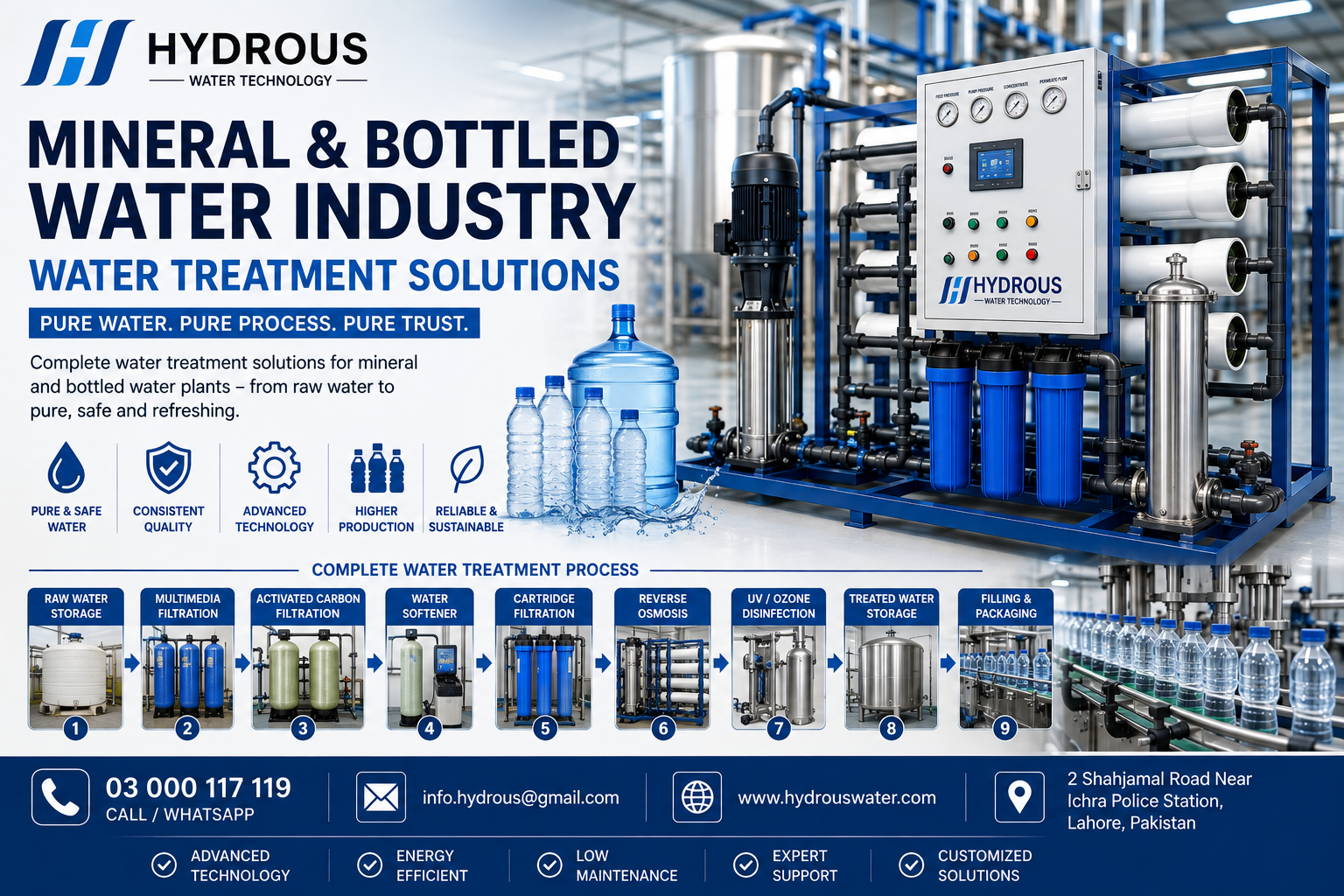
Water purification and RO solutions for mineral and bottled water plants in Pakistan.
What Is a Mineral Water Plant?
A mineral or bottled-water plant is more than an RO machine.
A complete production facility may include several interconnected stages, such as:
Raw Water → Pretreatment → Purification → Disinfection → Treated Water Storage → Filling → Capping → Labeling → Packaging
The exact treatment process depends on the source water and the characteristics of the final product.
A plant producing drinking water from high-TDS groundwater may require a substantially different treatment system from a facility starting with relatively good-quality municipal water.
This is why the first step should always be water analysis and process evaluation.
Why Water Treatment Is Important for Bottled Water Production
Water is the primary raw material in bottled-water production.
If the incoming water quality varies, it can create challenges for the purification system and make it more difficult to maintain consistent finished-water quality.
Water treatment can help address problems such as:
- High TDS
- Hardness
- Turbidity
- Suspended solids
- Iron
- Chlorine
- Unwanted taste and odor
- Certain dissolved contaminants
- Microbiological contamination
Not every plant will have all of these problems.
The treatment process should therefore be selected based on a laboratory analysis of the actual source water.
Mineral Water Plant Process
A typical bottled-water purification process can contain several stages.
A simplified example is:
1. Raw Water Storage
Incoming water is collected in a raw-water tank before treatment.
2. Multimedia Filtration
A multimedia filter can reduce suspended solids and turbidity from suitable source water.
3. Activated Carbon Filtration
Activated carbon may be used to reduce chlorine, taste, odor and certain organic compounds, depending on the source water.
4. Water Softening
Where hardness is high, a softener can be used to reduce calcium and magnesium before downstream treatment.
5. Cartridge Filtration
Cartridge filtration provides finer particulate filtration and protects sensitive equipment.
6. Reverse Osmosis
RO can substantially reduce dissolved salts and other contaminants from suitable feed water.
7. UV Treatment
UV can be incorporated as an additional microbiological control step where appropriate.
8. Ozone Treatment
Ozone may be incorporated into certain bottled-water processes for disinfection and maintaining microbiological control.
9. Treated Water Storage
Purified water can be stored before being supplied to the filling line.
10. Filling & Packaging
The treated water is then transferred to the appropriate filling and packaging equipment.
Important: This is an example process, not a universal recipe. The final configuration should be based on the raw-water analysis, production requirements and applicable requirements for the bottled-water product.
RO Plant for Mineral Water Production
Reverse osmosis is commonly used where dissolved salts and other contaminants need to be reduced.
An RO plant for a mineral water facility can be designed according to:
- Raw-water TDS
- Feed-water chemistry
- Required production capacity
- Desired permeate quality
- Recovery
- Operating hours
- Pretreatment
- Membrane selection
- Storage requirements
For example, a plant may require a 500 LPH, 1,000 LPH, 2,000 LPH or larger RO system, depending on the planned production and operating schedule.
The RO capacity should not be selected simply because a particular size is popular.
Instead, calculate the actual water requirement for:
Production + Cleaning + Process Losses + Other Water Uses
and then determine the appropriate treatment and storage capacity.
How to Calculate Mineral Water Plant RO Capacity
Suppose a bottling facility needs approximately 20,000 litres of treated water per day and plans to operate its RO system for 10 hours per day.
The basic production requirement is:
20,000 ÷ 10 = 2,000 LPH
This gives a theoretical RO production requirement of approximately 2,000 litres per hour.
However, practical design should also consider:
- Peak demand
- RO recovery
- System downtime
- Membrane cleaning
- Production schedule
- Treated-water storage
- Future expansion
Therefore, the final plant design should be completed after evaluating the complete production process.
RO Recovery in a Bottled Water Plant
An RO plant does not convert every litre of feed water into product water.
For example, if an RO system receives:
2,000 LPH feed water
and produces:
1,300 LPH permeate
the recovery is:
1,300 ÷ 2,000 × 100 = 65%
The remaining water leaves the system as concentrate.
The appropriate recovery depends on:
- TDS
- Hardness
- Silica
- Alkalinity
- Temperature
- Membrane configuration
- Scaling potential
- Pretreatment
Higher recovery is not automatically better. Excessively high recovery can increase scaling risk if the water chemistry is not suitable.
What Pretreatment Does a Mineral Water Plant Need?
Pretreatment protects the RO system and helps stabilize its operation.
The required stages depend on the source water.
Multimedia Filter
Useful for reducing suspended solids and turbidity.
Activated Carbon Filter
Can reduce chlorine and certain organic compounds where appropriate.
Water Softener
Used when hardness reduction is required.
Iron Removal
Specialized treatment may be necessary when iron concentration is elevated.
Cartridge Filters
Provide fine filtration before RO.
Antiscalant Dosing
May be used where appropriate to control scale-forming salts.
The correct pretreatment should be determined from water analysis rather than automatically installing every available treatment stage.
Water Quality Testing for a Mineral Water Plant
Water analysis is one of the most important steps before designing a bottled-water treatment plant.
A representative source-water analysis may include:
- pH
- TDS
- Conductivity
- Total hardness
- Calcium
- Magnesium
- Alkalinity
- Chloride
- Sulphate
- Iron
- Silica
- Turbidity
- Chlorine
- Microbiological parameters
- Other parameters relevant to the source and intended product
The required analysis should be determined according to the source water and the intended use.
Why is this important?
Two water sources can have similar TDS but very different chemistry.
For example:
Water A: High hardness
Water B: High silica
Both could have a similar TDS reading, but the appropriate RO pretreatment and operating strategy could be different.
Therefore, TDS alone should not be used to design a complete mineral-water treatment plant.
UV Treatment in Bottled Water Plants
Ultraviolet treatment can provide an additional microbiological control barrier.
A UV system can be incorporated at an appropriate point in the treatment process.
For example:
RO → UV → Treated Water
may be used in selected applications.
The UV system should be sized according to flow rate and the required application.
Water clarity is also important because excessive turbidity can reduce UV effectiveness.
Ozone Treatment for Bottled Water
Ozone is another technology used in some bottled-water treatment and disinfection processes.
It can be incorporated into a properly designed system for microbiological control and, depending on the process, maintaining water quality during storage.
A typical arrangement may include:
Purified Water → Ozone Treatment → Treated Water Storage / Distribution
Ozone equipment requires proper generation, dosing, contact and monitoring arrangements.
The system should be designed around the specific production process rather than adding ozone simply because it is commonly used in bottled-water plants.
Treated Water Storage
Treated-water storage is an important part of a complete bottled-water operation.
The tank needs to be considered together with:
- RO production rate
- Filling-line capacity
- Peak demand
- Operating hours
- Cleaning requirements
- Distribution arrangement
For example, if the RO produces water continuously while the filling line operates in batches, a treated-water tank can provide a buffer between purification and filling.
The material and design of the tank should be suitable for the intended application.
Filling & Packaging Considerations
Water treatment is only one part of a bottled-water project.
The complete production system may also include:
- Bottle preparation
- Bottle rinsing
- Filling
- Capping
- Labeling
- Date coding
- Shrink wrapping
- Carton packaging
- Finished-product storage
The treatment plant and filling line should be sized so that water production can keep pace with the intended bottling operation.
Mineral Water Plant Capacity Planning
When planning a bottled-water project, capacity should be considered at several levels.
Water Treatment Capacity
Measured in LPH, GPD or cubic metres per hour.
Treated Water Storage
Provides a buffer between purification and production.
Filling Capacity
Usually expressed in bottles per hour.
Daily Production
Depends on filling-line speed and operating hours.
For example, a filling line producing:
2,000 bottles/hour
for:
8 hours/day
could theoretically fill:
16,000 bottles/day
The actual output will depend on bottle size, machine efficiency, downtime, changeovers and operating conditions.
This demonstrates why RO capacity and bottling capacity should be planned together.
Mineral Water Plant Equipment
A complete project can involve many different types of equipment.
Depending on the plant, these may include:
Water Treatment Equipment
- Raw-water tanks
- Multimedia filters
- Activated carbon filters
- Water softeners
- Cartridge filters
- Industrial RO plants
- UV systems
- Ozone generators
- Treated-water tanks
- Chemical dosing systems
Bottling Equipment
- Bottle rinsing equipment
- Filling machines
- Capping machines
- Labeling machines
- Date coding systems
- Shrink-wrapping machines
- Packaging equipment
The exact equipment list depends on the required production capacity and project scope.
Mineral Water Plant Setup in Pakistan
Setting up a bottled-water business requires more than purchasing an RO plant.
A project should be evaluated across several areas.
1. Source Water
Identify a suitable and reliable water source.
2. Water Analysis
Determine the source-water characteristics.
3. Treatment Design
Develop the appropriate purification process.
4. Production Capacity
Determine the expected daily production and peak demand.
5. Bottling Line
Select filling and packaging equipment appropriate for the intended production.
6. Storage
Plan raw-water, treated-water and finished-product storage.
7. Quality Control
Establish appropriate testing and quality-control procedures.
8. Plant Layout
Arrange treatment, filling, packaging and storage areas logically.
9. Utilities
Consider electricity, drainage, compressed air, water supply and other utilities.
10. Regulatory Requirements
The business should identify and comply with the applicable Pakistani regulatory and product requirements before commercial production.
Water Treatment Chemicals for Bottled Water Plants
Chemical requirements depend on the treatment process.
Potential products can include:
- RO antiscalant
- Membrane cleaning chemicals
- Biocide
- pH-control chemicals
- Boiler treatment chemicals
- Cooling-water chemicals
Not every chemical is suitable for every application.
For water that becomes part of a finished drinking-water product, chemical selection and use require particular care and should follow the applicable specifications and supplier instructions.
RO Membrane Cleaning
RO membranes can gradually experience:
- Scaling
- Organic fouling
- Biological fouling
- Suspended-solids fouling
- Iron deposits
A decline in permeate flow, changes in differential pressure or reduced salt rejection can indicate that membrane performance needs investigation.
Cleaning should be based on the actual fouling condition and membrane manufacturer’s recommendations.
Different foulants can require different cleaning chemistry.
Hydrous provides RO membrane cleaning chemicals for industrial RO applications.
How to Maintain a Mineral Water RO Plant
Regular monitoring is important for maintaining consistent performance.
Operators should monitor parameters such as:
- Feed pressure
- Permeate pressure
- Concentrate flow
- Permeate flow
- Feed TDS
- Product-water conductivity
- Recovery
- Salt rejection
- Differential pressure
- Chemical dosing
Keeping operating records makes it easier to identify gradual changes before they become major problems.
Common Mistakes When Setting Up a Bottled Water Plant
Choosing an RO Plant Without Testing the Water
The same RO configuration will not necessarily work for every water source.
Selecting Capacity Based Only on Filling Machine Speed
The purification system, storage and bottling line should be evaluated together.
Ignoring Pretreatment
Poor pretreatment can increase membrane fouling and maintenance.
Designing for Today’s Demand Only
If production is expected to increase, future expansion should be considered during the initial design.
Focusing Only on RO Price
The lowest initial equipment price does not necessarily produce the lowest total operating cost.
Ignoring Water Storage
Insufficient treated-water storage can create bottling interruptions even when the RO system itself is working correctly.
Why Choose Hydrous Water Technology?
Hydrous Water Technology provides water treatment equipment and solutions for commercial and industrial applications across Pakistan.
Our capabilities include:
- Industrial RO plants
- Commercial RO plants
- Mineral water plant water treatment
- Multimedia filtration
- Activated carbon filtration
- Water softeners
- Cartridge filtration
- UV systems
- Ozone systems
- Chemical dosing
- RO membranes
- Membrane housings
- Pumps
- Water treatment chemicals
- Membrane cleaning chemicals
- Installation
- Commissioning
- Maintenance
Our objective is to develop a treatment system around the customer’s source water, required capacity and intended application.
Need a Mineral Water Plant or Bottled Water Treatment System?
If you are planning a new bottled-water business or upgrading an existing plant, start with the water.
Send us:
1. Raw-water laboratory report
2. Water source details
3. Required daily production
4. Required RO capacity
5. Bottle sizes
6. Filling-line capacity
7. Operating hours
8. Required treated-water quality
9. Existing equipment, if any
Our technical team can evaluate the requirements and recommend an appropriate water-treatment configuration.
Frequently Asked Questions
What is required for a mineral water plant?
A bottled-water project generally requires a suitable water source, water analysis, purification system, treated-water storage, filling and packaging equipment, quality-control procedures and compliance with applicable requirements.
Is RO necessary for a mineral water plant?
Not every source requires RO. The need for RO depends on the raw-water quality and required finished-water specification. Some sources may require RO, while others may need a different treatment configuration.
What RO capacity is suitable for a bottled-water plant?
It depends on daily production, operating hours, filling capacity, storage and water demand. Capacity should be calculated from the complete production requirement.
What pretreatment is required before RO?
It depends on the raw water. Common stages can include multimedia filtration, activated carbon, softening, iron removal, cartridge filtration and antiscalant dosing.
What is the role of UV in bottled-water production?
UV can provide an additional microbiological control barrier when properly designed and operated. It is generally part of a larger treatment process rather than a replacement for filtration or RO.
Why is ozone used in bottled-water plants?
Ozone can be used for disinfection and microbiological control in appropriate bottled-water processes. The ozone system should be designed around the water-quality and production requirements.
Can Hydrous provide a complete mineral water plant?
Hydrous can provide water-treatment equipment and solutions for mineral and bottled-water projects. The exact scope should be discussed according to the required production capacity and project requirements.
How often should an RO membrane be cleaned?
There is no single fixed interval. Cleaning should be based on changes in normalized performance and evidence of fouling or scaling, following the membrane manufacturer’s recommendations.
Can RO reject water be reused?
Potentially, depending on its quality and the intended non-product application. Because RO concentrate has a higher contaminant concentration, its suitability should be evaluated before reuse.
Do you provide mineral water plant solutions across Pakistan?
Yes. Hydrous Water Technology provides commercial and industrial water treatment solutions for customers across Pakistan.