
Laboratory Water Treatment Solutions in Pakistan
Water is one of the most frequently used resources in a laboratory, but the required quality can vary considerably depending on the application.
A laboratory carrying out routine glassware washing does not necessarily require the same water quality as a facility performing HPLC, ICP-MS, molecular biology or other sensitive analytical work.
That is why laboratory water treatment should be designed according to the application, required water quality and incoming-water chemistry.
Hydrous Water Technology provides laboratory water treatment solutions in Pakistan, including reverse osmosis, deionization, filtration, UV treatment and customized purified-water systems.
The objective is not simply to remove as many contaminants as possible. The objective is to produce water that is appropriate for the laboratory’s actual requirements.
Laboratory water is commonly divided into different purity levels according to application. Type 3 RO water can be suitable for less critical uses, while higher-purity Type 2 and Type 1 water require additional purification technologies.
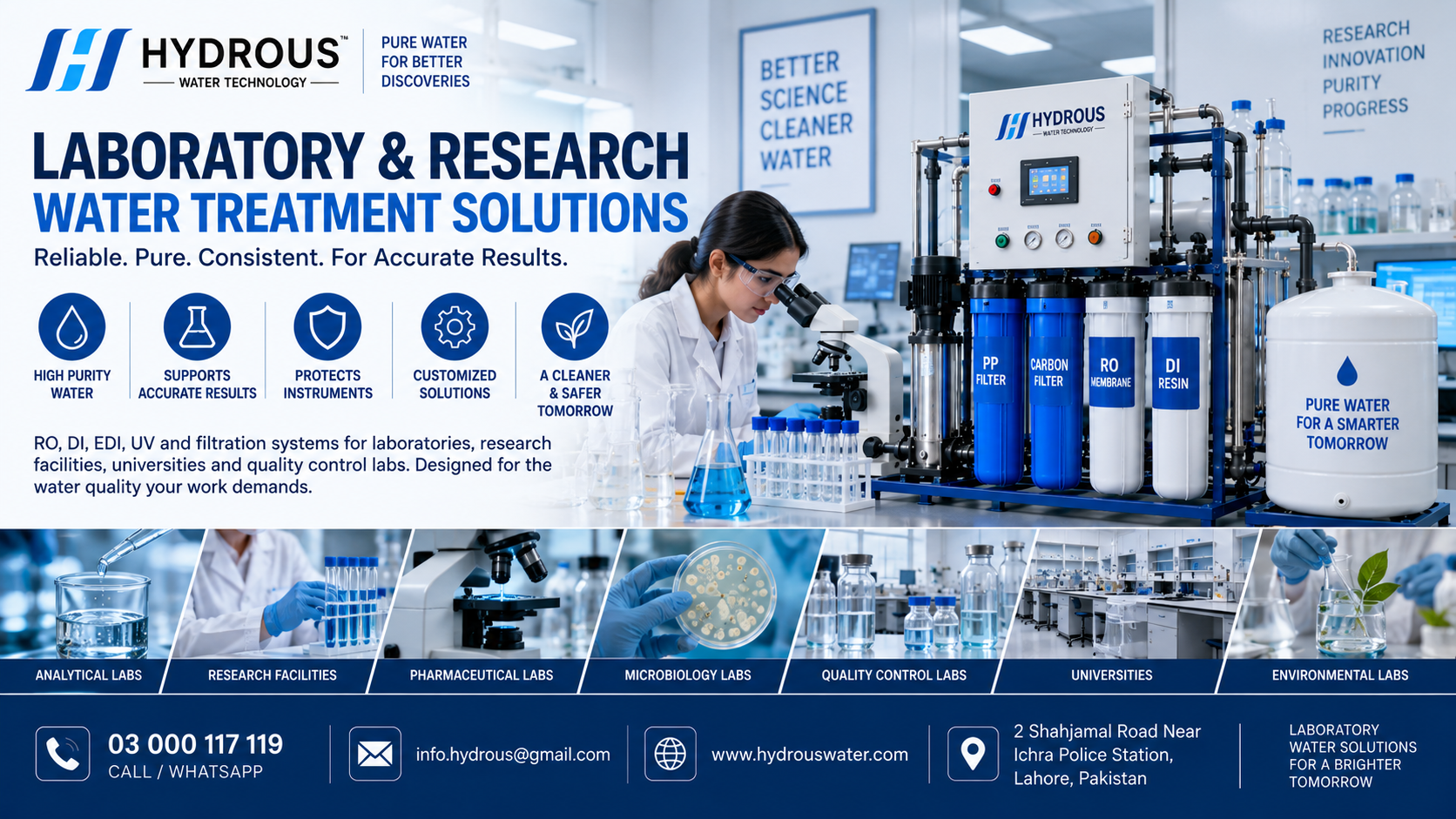
RO, DI and purified water treatment solutions for laboratories and research facilities in Pakistan.
Why Water Quality Matters in Laboratories
Water can be used in laboratories for:
- Reagent preparation
- Buffer preparation
- Sample dilution
- Glassware rinsing
- Instrument feeding
- Microbiology
- Molecular biology
- Analytical testing
- Autoclaves
- Water baths
- General laboratory cleaning
Impurities in water can potentially interfere with laboratory procedures or analytical results.
Depending on the application, laboratories may need to control:
- Dissolved ions
- TDS
- Conductivity
- Organic compounds
- Particles
- Microorganisms
- Silica
- Chlorine
- Hardness
For sensitive analytical work, water purity becomes particularly important because contaminants can interfere with measurements and reproducibility.
Laboratory Water Purification System
A laboratory purification system can combine several treatment technologies.
A typical configuration may look like:
Raw Water → Sediment Filtration → Activated Carbon → RO → DI / EDI → UV → Final Filtration → Point of Use
However, this is not a universal design.
The correct system depends on:
- Incoming water quality
- Laboratory application
- Required water grade
- Daily water consumption
- Peak demand
- Storage requirements
- Required conductivity or resistivity
- Microbiological requirements
Different purification methods are often combined because no single technology removes every type of contaminant equally well.
Laboratory RO System
Reverse osmosis is commonly used as a primary purification stage for laboratory water.
RO uses a semipermeable membrane to separate water from a large portion of dissolved salts, particles and other contaminants.
RO water is often suitable for less critical laboratory applications and can also be used as feed water for additional purification stages.
Typical applications can include:
- Glassware rinsing
- Water baths
- Autoclave feed
- General laboratory applications
- Feed water for DI systems
- Feed water for ultrapure-water systems
RO water is generally considered a lower laboratory water grade than Type 1 or Type 2 water, so it should not automatically be treated as suitable for every laboratory application.
Laboratory RO DI Water Purification System
For laboratories requiring higher-purity water, RO can be followed by deionization.
A typical system can be:
Feed Water → Pretreatment → RO → DI → UV / Final Filtration → Purified Water
RO reduces the contaminant load before the DI stage, which can help improve the operating life of ion-exchange resin.
Deionization removes dissolved ions through ion exchange.
However, DI alone should not be considered a complete solution for every laboratory application because ion-exchange systems do not address all types of contaminants.
Deionized Water System for Laboratories
Deionized or DI water is produced by removing dissolved ionic contaminants using ion-exchange technology.
It can be used for applications such as:
- Reagent preparation
- Buffer preparation
- Sample dilution
- General laboratory work
- Instrument rinsing
- Glassware rinsing
For laboratories requiring higher purity, DI may be combined with RO, UV, ultrafiltration or final polishing.
The exact configuration should be determined by the laboratory’s required water quality.
Type 1, Type 2 and Type 3 Laboratory Water
Laboratory water is often described according to different purity levels.
Type 3 Water
Type 3 water is commonly associated with RO-treated water.
It can be used for less critical applications such as:
- Glassware rinsing
- Water baths
- Autoclaves
- General laboratory utility applications
- Feed water for higher-purity systems
Type 2 Water
Type 2 water provides a higher level of purity and may be used for:
- Reagent preparation
- Buffer preparation
- Microbiology applications
- General analytical work
- Laboratory instruments
Type 1 Water
Type 1 is the highest-purity laboratory water and is intended for highly sensitive applications.
Examples can include:
- HPLC
- LC-MS
- ICP-MS
- Molecular biology
- Cell culture
- Sensitive analytical procedures
The appropriate water grade should always be selected based on the actual laboratory application rather than simply choosing the highest available purity.
Laboratory Water for HPLC
High-performance liquid chromatography requires carefully controlled water quality.
Water used in sensitive analytical procedures can contain impurities that affect chromatographic results.
For this reason, laboratories performing HPLC commonly require high-purity water rather than basic RO water.
A laboratory purification system for such applications may include:
RO → DI / EDI → UV → Final Polishing → Point-of-Use Filtration
The final configuration should be selected according to the instrument manufacturer’s requirements and laboratory method.
Water Treatment for Research Laboratories
Research laboratories can have widely different water requirements.
A chemistry laboratory may require purified water for reagents and analytical work.
A microbiology laboratory may require water for media preparation and other laboratory procedures.
A molecular biology laboratory may have much more demanding purity requirements.
Therefore, a research facility may benefit from a centralized water purification system with dedicated point-of-use treatment where necessary.
Laboratory Water Treatment for Universities
Universities often operate multiple laboratories with different requirements.
A centralized system can supply purified water to:
- Chemistry laboratories
- Biology laboratories
- Microbiology laboratories
- Environmental laboratories
- Research laboratories
- Teaching laboratories
Centralized systems can be designed around:
- Number of laboratories
- Daily water consumption
- Peak demand
- Distribution distance
- Required water quality
- Storage capacity
A smaller laboratory may instead benefit from a compact point-of-use purification system.
Clinical Laboratory Water Treatment
Clinical laboratories use water for a variety of purposes, including analytical instruments and preparation of laboratory materials.
The required water quality depends on the instrument, method and applicable laboratory requirements.
Clinical laboratory water should therefore be specified according to the relevant application rather than simply relying on general terms such as “purified water.”
For clinical analyzers, specific water-quality requirements may apply; CLSI terminology includes Clinical Laboratory Reagent Water (CLRW).
Pharmaceutical Research Laboratory Water Treatment
Pharmaceutical laboratories can have demanding water-quality requirements.
Applications may include:
- Research
- Quality control
- Analytical testing
- Sample preparation
- Cleaning
- Instrument supply
Depending on the application, a system can combine:
- Pretreatment
- RO
- DI
- EDI
- UV
- Ultrafiltration
- Final polishing
The system should be designed around the relevant application and quality requirements.
Environmental Laboratory Water Treatment
Environmental laboratories analyze water, soil and other samples for various parameters.
Purified water may be required for:
- Sample preparation
- Reagent preparation
- Blank preparation
- Equipment rinsing
- Analytical procedures
The purification system should be designed to minimize contaminants that could interfere with the analytical method.
Microbiology Laboratory Water Purification
Microbiology laboratories can require purified water for:
- Culture media
- Reagents
- Dilutions
- Glassware
- Laboratory cleaning
Water quality requirements vary by application.
Where microbiological control is important, the treatment system may include additional stages such as UV or final filtration.
The final system should be selected based on the laboratory’s specific procedures.
Molecular Biology Water Purification
Molecular biology applications can be particularly sensitive to contaminants.
Applications can include:
- PCR
- DNA preparation
- RNA-related procedures
- Cell and tissue work
- Molecular research
High-purity laboratory water systems can combine multiple purification technologies to produce water suitable for sensitive applications.
For critical molecular biology applications, laboratory water systems may require control of ions, organics, microorganisms and other contaminants.
Laboratory Water Filtration
Pretreatment is an important part of many laboratory water systems.
A typical pretreatment arrangement may include:
Sediment Filter
Helps reduce suspended particles.
Activated Carbon Filter
Can reduce chlorine and certain organic compounds.
Water Softener
May be used when hardness needs to be reduced to protect downstream equipment.
Cartridge Filter
Provides additional particulate protection before RO or other sensitive equipment.
Pretreatment requirements should be based on the incoming water analysis.
Laboratory UV Water Treatment
UV treatment can be incorporated into laboratory purification systems where microbiological control or organic reduction is required.
UV is often positioned after major purification stages.
For highly sensitive applications, UV may be combined with additional purification and final filtration rather than being used as the only purification technology.
EDI Water System for Laboratories
Electrodeionization, commonly known as EDI, can be used to produce high-purity water after RO.
A simplified configuration is:
Pretreatment → RO → EDI → Final Treatment
EDI can provide continuous ion removal without the conventional chemical regeneration cycle associated with mixed-bed ion-exchange systems.
It can be considered for laboratories requiring a reliable supply of high-purity water.
The suitability of EDI depends on feed-water quality, required purity and system capacity.
Laboratory Water Storage
Water storage can be required when production and consumption do not occur at the same rate.
A laboratory water storage system should consider:
- Tank material
- Tank size
- Water turnover
- Contamination protection
- Recirculation
- Distribution piping
- Cleaning and sanitization
- Point-of-use requirements
For high-purity applications, storage and distribution need particular attention because purified water can be affected by the system downstream of the purification equipment.
Point-of-Use Laboratory Water
Some laboratories may benefit from point-of-use purification.
For example, a centralized RO system can provide primary purified water, while individual laboratories or instruments can have additional polishing systems.
This approach can be useful when different departments require different water qualities.
A centralized system might therefore provide:
Central RO → Distribution → Local DI / Polishing → Point of Use
This can be more practical than producing the highest purity water for every application.
Water Testing Before Installing a Laboratory RO System
Before designing a laboratory purification system, the incoming water should be tested.
Important parameters can include:
- pH
- TDS
- Conductivity
- Total hardness
- Calcium
- Magnesium
- Alkalinity
- Chloride
- Sulphate
- Silica
- Iron
- Turbidity
- Free chlorine
- Microbiological parameters
Additional parameters may be required depending on the laboratory’s application.
Why is water analysis important?
Two laboratories located in different cities may have completely different source-water chemistry.
Even if both receive municipal water, their treatment requirements may not be identical.
Water analysis helps determine the appropriate:
- Pretreatment
- RO configuration
- Membrane selection
- DI capacity
- UV requirements
- Final polishing
- Storage arrangement
Laboratory Water Treatment Maintenance
A purification system needs regular monitoring and maintenance.
RO System
Monitor:
- Feed pressure
- Permeate flow
- Conductivity
- Rejection
- Differential pressure
DI System
Monitor conductivity or resistivity and replace resin when required.
Filters
Replace sediment and cartridge filters according to pressure drop and operating conditions.
UV
Monitor lamp condition and replace according to the manufacturer’s recommended service interval.
Storage
Keep tanks and distribution systems clean and properly maintained.
Water Quality
Regularly verify the final water quality according to the laboratory’s application.
Common Problems in Laboratory Water Systems
Laboratories may experience:
High Conductivity
Possible causes include exhausted DI resin, RO performance problems or contamination downstream.
Low RO Production
Possible causes include:
- Low feed pressure
- Fouled membranes
- Blocked filters
- Temperature changes
- Scaling
Rapid DI Resin Exhaustion
This can occur when the RO pretreatment is inadequate or the incoming contaminant load is high.
Microbiological Contamination
Possible sources include storage tanks, distribution lines or inadequate system maintenance.
Unstable Water Quality
This may indicate changes in feed-water conditions or insufficient monitoring.
A proper maintenance and monitoring program can help identify these issues early.
How to Choose a Laboratory Water Purification System
Before purchasing a system, consider:
- What will the water be used for?
- What purity level is required?
- What is the incoming water quality?
- How many litres are required per day?
- What is the peak demand?
- Is centralized or point-of-use purification better?
- Is storage required?
- Does the system require DI or EDI?
- Does the application require UV or final filtration?
- What monitoring equipment is required?
Choosing the system based on these factors is usually more effective than selecting equipment based only on the RO capacity or advertised purity level.
Laboratory RO Plant Capacity
Laboratory systems can range from compact point-of-use units to centralized systems supplying multiple departments.
For example:
- Small laboratory: compact RO/DI system
- Medium laboratory: higher-capacity RO/DI system with storage
- Research facility: centralized RO + DI/EDI system
- Multiple laboratories: centralized purification and distribution system
The correct capacity should be calculated from actual consumption.
If a laboratory requires 200 litres per day and the system operates for 5 hours, the basic production requirement is:
200 ÷ 5 = 40 LPH
The final system should account for peak demand, recovery, storage and maintenance.
Why Choose Hydrous Water Technology?
Hydrous Water Technology provides customized water treatment and purification solutions for laboratories, research facilities, educational institutions, healthcare facilities and industrial customers in Pakistan.
Our solutions can include:
- Laboratory RO systems
- RO plants
- RO + DI systems
- Deionization systems
- EDI systems
- Multimedia filtration
- Activated carbon filtration
- Cartridge filtration
- Water softeners
- UV systems
- RO membranes
- Membrane housings
- Pumps
- Chemical dosing systems
- Water-treatment chemicals
- Installation
- Commissioning
- Maintenance
We focus on designing the treatment process according to water analysis, application requirements and required water quality.
Get a Laboratory Water Treatment Solution
If you are setting up a new laboratory or upgrading an existing purification system, provide the following information:
- Raw-water analysis
- Water source
- Laboratory type
- Required water quality
- Daily water requirement
- Peak water demand
- Number of users or instruments
- Existing purification equipment
- Required storage capacity
This information allows the treatment system to be designed around your actual laboratory requirements.
Frequently Asked Questions
What type of water is required in a laboratory?
The required water quality depends on the application. Routine laboratory work may use RO or Type 2 water, while highly sensitive analytical applications may require Type 1 ultrapure water.
Is RO water enough for a laboratory?
Not always. RO can be suitable for basic applications and as feed water for higher-purity systems. Sensitive applications may require additional DI, EDI, UV, ultrafiltration or final polishing.
What is a laboratory RO DI system?
It is a purification system that generally uses reverse osmosis followed by deionization to produce higher-purity water than RO alone.
What is DI water?
DI water is water from which dissolved ions have been removed through ion-exchange technology.
What is the difference between RO and DI water?
RO primarily reduces dissolved salts and many other contaminants through a membrane process. DI removes dissolved ionic species through ion exchange. They are often combined in laboratory systems.
Do laboratories need a water softener?
Not necessarily. A softener may be required when hardness in the incoming water could cause scaling or affect downstream treatment.
Can one water purification system supply an entire laboratory?
Yes, a centralized system can supply multiple laboratory areas when properly sized and designed. Individual point-of-use polishing can then be used where different purity levels are required.
Do you provide laboratory RO and DI systems in Pakistan?
Yes. Hydrous Water Technology provides customized RO, DI and related water purification systems for laboratories and research facilities.