
Hotel & Hospitality Water Treatment Solutions in Pakistan
Water is one of the most important utilities in a hotel.
Guests use water for drinking, bathing and other daily needs, while hotel operations consume water in kitchens, restaurants, laundry, housekeeping, boilers, cooling systems and general facility maintenance.
For this reason, hotels and hospitality facilities need a water-treatment strategy that considers different applications instead of treating the entire building’s water in exactly the same way.
Hydrous Water Technology provides hotel and hospitality water treatment solutions in Pakistan, including commercial and industrial RO plants, filtration systems, water softeners, UV treatment, ultrafiltration, chemical dosing and water-treatment equipment for hotel utilities.
Our systems can be designed around the hotel’s water source, occupancy, consumption, operating hours and individual water-quality requirements.
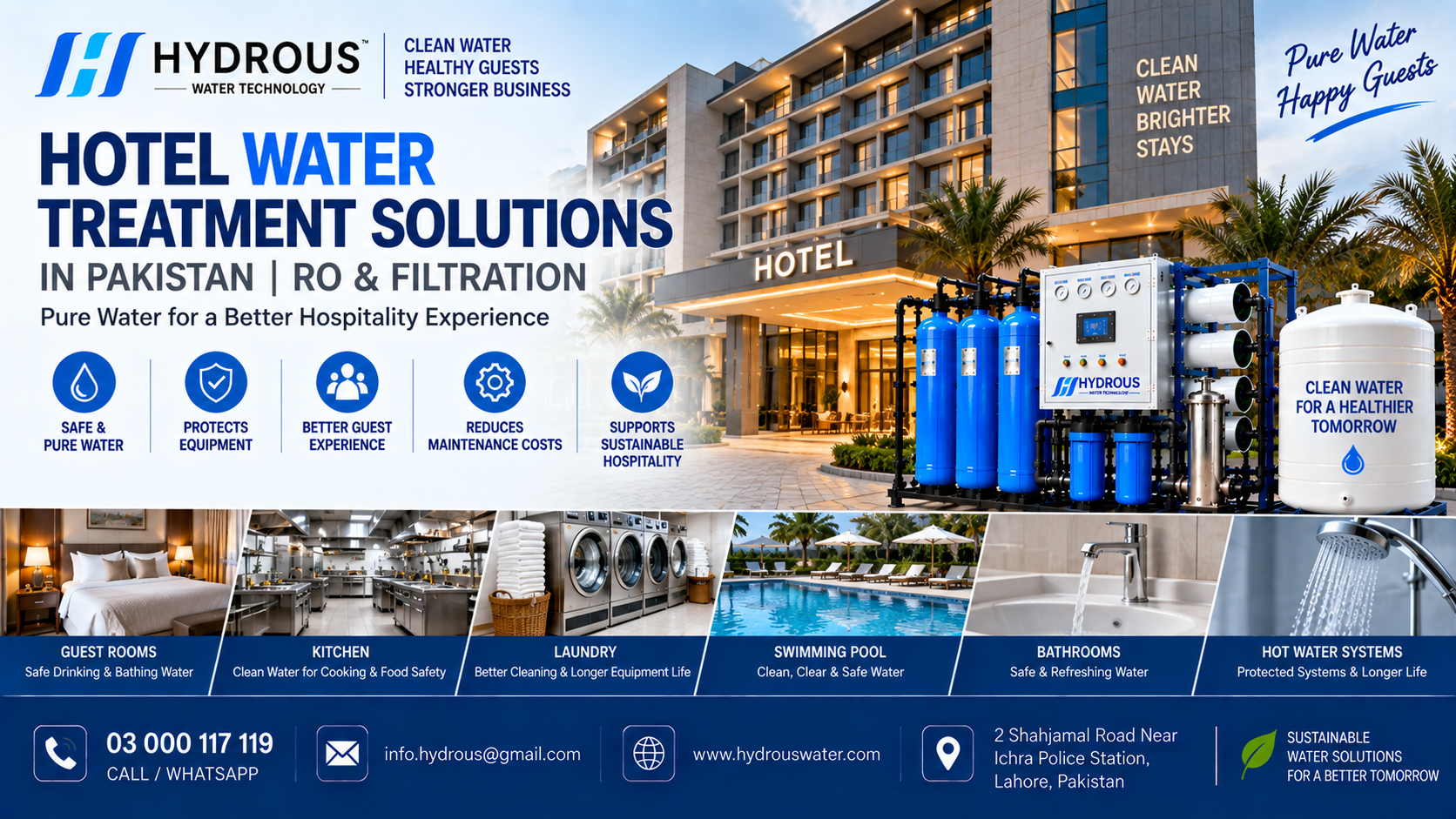
Hotel RO and water filtration solutions for clean, safe and reliable water in Pakistan.
Why Water Treatment Is Important for Hotels
Hotels can have substantial and highly variable water demand.
Water may be required for:
- Guest rooms
- Drinking water
- Restaurants
- Commercial kitchens
- Laundry
- Housekeeping
- Swimming pools
- Boilers
- Cooling towers
- HVAC systems
- Staff facilities
- General cleaning
The quality required for each application can be different.
For example, water supplied to a boiler has different treatment requirements from water supplied to a guest drinking-water system.
A well-designed hotel water-treatment system therefore considers the entire water cycle of the property.
Hotel Water Treatment System
A hotel water-treatment system can range from a relatively simple commercial RO plant to a centralized multi-stage treatment facility for a large property.
A possible treatment arrangement could be:
Raw Water → Multimedia Filtration → Activated Carbon → Softening → Cartridge Filtration → RO → UV → Treated Water Storage → Distribution
However, this is not a standard configuration for every hotel.
The actual system depends on:
- Raw-water source
- Water analysis
- Hotel size
- Number of rooms
- Occupancy
- Restaurant capacity
- Laundry requirements
- Boiler capacity
- Cooling-water requirements
- Desired treated-water quality
Hotel RO Plant
A hotel RO plant can be used where reduction of dissolved salts and other contaminants is required.
Depending on the property, RO-treated water may be used for:
- Drinking water
- Restaurant and kitchen applications
- Guest water systems
- Laundry
- Utility applications
- Certain equipment requirements
For smaller hotels, a commercial RO plant may be sufficient.
Larger hotels and resorts may require an industrial RO system with higher production capacity and centralized storage.
How to Select RO Capacity for a Hotel
RO capacity should be calculated from the hotel’s actual water demand.
Important factors include:
Number of Rooms
More rooms generally mean greater water demand, especially at higher occupancy.
Occupancy
Peak occupancy should be considered rather than designing only around average occupancy.
Restaurant & Kitchen
Restaurants can significantly increase daily water consumption.
Laundry
On-site laundry can create a substantial additional water requirement.
Operating Hours
The RO plant’s daily operating schedule affects the required hourly capacity.
Storage
Treated-water storage can reduce the need to run the RO continuously at peak consumption times.
Example Hotel RO Capacity Calculation
Suppose a hotel requires approximately 24,000 litres of treated water per day and the RO plant is planned to operate for 12 hours.
The basic calculation would be:
24,000 ÷ 12 = 2,000 LPH
The theoretical RO requirement is therefore approximately 2,000 litres per hour.
But the final system should also consider:
- Peak demand
- RO recovery
- Storage
- Maintenance downtime
- Membrane cleaning
- Future expansion
- Other water uses
Therefore, the actual plant capacity should be finalized after evaluating the hotel’s complete water requirement.
Drinking Water Treatment for Hotels
Guest drinking water requires particular attention because it is directly consumed.
Depending on the source-water quality, a drinking-water treatment system may include:
Sediment Filtration → Activated Carbon → RO → UV → Treated Water Storage
The appropriate treatment depends on the raw-water analysis and the required water-quality specification.
Hotels may provide treated drinking water through:
- Guest-room water stations
- Restaurant service
- Bottled-water production
- Centralized dispensers
- Staff drinking-water points
For larger properties, centralized treatment can provide a consistent supply to multiple locations.
Hotel Kitchen Water Treatment
Commercial kitchens consume water throughout the day.
Water may be used for:
- Cooking
- Food preparation
- Drinking
- Dishwashing
- Equipment cleaning
- Ice production
- General kitchen operations
Hard water can contribute to scale in:
- Hot-water equipment
- Dishwashers
- Steam equipment
- Coffee machines
- Water heaters
- Pipes
Depending on water quality, filtration, softening or RO may be appropriate for different kitchen applications.
Water Softener for Hotels
Hardness is a common consideration in hotel water systems.
Calcium and magnesium can contribute to scale formation in equipment and plumbing.
A hotel water softener may be used for applications such as:
- Hot-water systems
- Boilers
- Laundry
- Kitchen equipment
- RO pretreatment
- General utility water
A typical arrangement may be:
Raw Water → Filtration → Water Softener → Hotel Distribution
or:
Filtration → Softener → RO
depending on the application.
The need for softening should be determined through water analysis.
Hotel Laundry Water Treatment
Laundry operations can consume large quantities of water, particularly in hotels with in-house linen washing.
Water quality can affect:
- Washing equipment
- Heating systems
- Detergent performance
- Scale formation
- Equipment maintenance
Hard water can increase mineral deposits and may affect the efficiency of washing equipment.
Depending on the water quality, a laundry treatment system may use:
- Sediment filtration
- Water softening
- RO
- Other application-specific treatment
Not every laundry requires RO, so the treatment should be matched to the actual requirement.
Boiler Feed Water Treatment for Hotels
Large hotels often use boilers or hot-water systems.
Boiler feed water can require treatment to control hardness and dissolved contaminants.
A possible treatment arrangement is:
Filtration → Softening → RO → Chemical Treatment → Boiler Feed
The actual configuration depends on:
- Boiler pressure
- Feed-water quality
- Steam requirements
- Condensate recovery
- Operating conditions
Appropriate treatment can help reduce scale and corrosion and support reliable boiler operation.
Cooling Tower Water Treatment
Hotels with centralized HVAC systems may operate cooling towers or other recirculating cooling systems.
Cooling-water problems can include:
- Scale
- Corrosion
- Biological growth
- Suspended solids
A cooling-water treatment program can include:
- Filtration
- Chemical dosing
- Scale control
- Corrosion control
- Biocide treatment
- Blowdown management
- Water-quality monitoring
Hydrous supplies water-treatment chemicals for industrial and commercial applications.
Swimming Pool Water Treatment
Hotels and resorts with swimming pools have additional water-quality management requirements.
Pool water treatment is different from drinking-water RO treatment and should be designed around the pool system and applicable operating requirements.
Depending on the facility, pool-water management may involve:
- Filtration
- Disinfection
- pH control
- Chemical dosing
- Circulation
- Water-quality monitoring
Hydrous can evaluate water-treatment requirements for hospitality facilities where pool and other utility systems are part of the overall project.
Water Filtration for Hotels
Filtration is an important part of many hotel water-treatment systems.
Depending on the raw-water quality, filtration may include:
Multimedia Filtration
Reduces suspended solids and turbidity.
Activated Carbon Filtration
Can reduce chlorine, taste, odor and certain organic compounds where appropriate.
Cartridge Filtration
Provides finer particulate filtration before sensitive equipment.
Iron Removal
Specialized treatment may be needed when iron levels are elevated.
Water Softening
Reduces calcium and magnesium hardness where required.
These stages can be used individually or combined according to the water analysis.
Hotel Water Treatment for Bore Water
Many properties may use groundwater or bore water as an important source.
Bore water quality can vary considerably depending on location.
Potential issues may include:
- High TDS
- Hardness
- Iron
- Turbidity
- Silica
- Alkalinity
- Chloride
- Other dissolved contaminants
A complete laboratory analysis should therefore be performed before selecting treatment equipment.
For example:
Bore Water → Multimedia Filter → Carbon Filter → Softener → Cartridge Filter → RO
may be appropriate for one source, while another may require a substantially different configuration.
Hotel Water Treatment for Municipal Water
Municipal water may already receive treatment, but additional filtration or purification may still be appropriate depending on the hotel’s application and incoming water quality.
Potential treatment can include:
- Sediment filtration
- Activated carbon
- RO
- UV
- Softening
The treatment level should be determined by testing the actual incoming water and identifying the hotel’s requirements.
Water Quality Testing for Hotels
Before installing an RO plant or centralized filtration system, water analysis should be carried out.
Important parameters may include:
- pH
- TDS
- Conductivity
- Total hardness
- Calcium
- Magnesium
- Alkalinity
- Chloride
- Sulphate
- Iron
- Silica
- Turbidity
- Chlorine
- Microbiological parameters
- Other application-specific parameters
The required testing depends on the source and intended use.
Why is this important?
A water source with high TDS may require RO, while another source with moderate TDS but high hardness may primarily require softening.
Therefore, TDS alone is not enough to design a hotel water-treatment plant.
Hotel Water Storage
Storage plays an important role in balancing treatment capacity and hotel demand.
A treated-water tank can provide a buffer between:
RO Production → Hotel Consumption
This can be particularly useful when water demand changes significantly throughout the day.
Storage capacity should be considered according to:
- Daily consumption
- Peak demand
- RO production
- Operating hours
- Backup requirements
- Available space
RO Reject Water Management in Hotels
RO systems produce concentrate in addition to treated permeate.
Depending on the water quality, concentrate may sometimes be suitable for selected non-product applications after proper evaluation.
Potential uses vary from property to property.
However, RO reject water has a higher concentration of dissolved contaminants and should not be reused without assessing its suitability.
The objective should be to manage wastewater responsibly while maintaining appropriate water quality.
RO Membrane Protection
Hotel RO plants can experience membrane scaling and fouling when pretreatment is inadequate or operating conditions are not properly controlled.
Possible causes include:
- Hardness
- Suspended solids
- Iron
- Silica
- Organic fouling
- Biological fouling
- Incorrect chemical dosing
Monitoring the system can help identify changes in performance.
Important parameters include:
- Feed pressure
- Permeate flow
- Concentrate flow
- Conductivity
- Salt rejection
- Differential pressure
- Recovery
RO Membrane Cleaning & Maintenance
RO membranes should be cleaned based on their actual condition rather than following an arbitrary schedule.
Performance changes such as:
- Reduced permeate flow
- Increased differential pressure
- Reduced salt rejection
may indicate the need for investigation and potentially cleaning.
Different fouling conditions can require different cleaning chemistry.
For example, mineral scaling may require an appropriate acidic cleaning procedure, while organic or biological fouling may require an alkaline or specialized cleaning approach.
Cleaning should follow membrane manufacturer recommendations.
Water Treatment Chemicals for Hotels
Hotel utility systems may require different types of water-treatment chemicals.
These can include:
- RO antiscalant
- RO membrane cleaning chemicals
- Biocides
- Boiler treatment chemicals
- Cooling-tower chemicals
- pH-control chemicals
Chemical selection should be based on the specific treatment system and water chemistry.
Hydrous provides water-treatment chemicals for commercial and industrial applications.
Designing a Hotel Water Treatment System
Hydrous Water Technology recommends an engineering-based approach.
Step 1 — Identify the Water Sources
Determine whether the hotel uses bore water, municipal water or another source.
Step 2 — Test the Water
Obtain a representative laboratory analysis.
Step 3 — Identify Water-Use Areas
Separate requirements for:
- Guest rooms
- Drinking water
- Kitchen
- Laundry
- Boiler
- Cooling
- Pool
- General utilities
Step 4 — Calculate Demand
Determine daily consumption, peak demand and operating hours.
Step 5 — Select Treatment
Choose appropriate technologies such as:
Filtration | Softening | RO | UV | UF | Chemical Treatment
Step 6 — Design Storage
Size raw and treated-water storage appropriately.
Step 7 — Plan Distribution
Consider how treated water will be delivered to the required areas.
Step 8 — Installation & Commissioning
Proper installation and commissioning help ensure reliable operation.
Step 9 — Maintenance
Establish a maintenance schedule for filters, membranes, pumps, chemical systems and instruments.
Water Treatment Solutions for Different Hospitality Facilities
Hotels
Centralized water treatment for guest rooms, kitchens, laundry and utilities.
Resorts
Higher-capacity systems for guest facilities, restaurants, pools and landscaping-related applications where appropriate.
Guest Houses
Compact commercial RO and filtration systems.
Restaurants & Banquet Halls
Drinking, kitchen and food-service water treatment.
Apartment Hotels
Centralized water filtration, softening and drinking-water treatment.
Large Hospitality Complexes
Integrated industrial water treatment covering multiple applications.
Benefits of a Properly Designed Hotel Water Treatment System
Better Water Quality
Treatment is selected according to the intended application.
Equipment Protection
Pretreatment can help reduce scaling and fouling.
Consistent Guest Experience
Reliable water treatment supports consistent water quality for appropriate guest applications.
Reduced Maintenance
Proper treatment can reduce avoidable water-related equipment problems.
Efficient Operation
Correctly sized equipment avoids unnecessary treatment capacity.
Centralized Management
Large properties can manage multiple water requirements through an integrated treatment strategy.
Future Expansion
Treatment infrastructure can be planned with future hotel expansion in mind.
Why Choose Hydrous Water Technology?
Hydrous Water Technology provides commercial and industrial water-treatment solutions for hotels, resorts and other hospitality facilities across Pakistan.
Our solutions include:
- Commercial RO plants
- Industrial RO plants
- Water filtration systems
- Water softeners
- Ultrafiltration
- Deionization
- UV treatment
- Chemical dosing
- RO membranes
- Pumps
- Membrane housings
- RO antiscalants
- Membrane cleaning chemicals
- Boiler treatment chemicals
- Cooling-water chemicals
- Installation
- Commissioning
- Maintenance
We focus on selecting equipment according to water quality, capacity and application.
Need a Water Treatment System for Your Hotel?
Whether you are developing a new hotel, upgrading an existing property or experiencing problems with your current RO or filtration system, the first step is understanding the water.
Provide:
- Raw-water laboratory report
- Number of rooms
- Expected occupancy
- Daily water consumption
- Kitchen and restaurant requirements
- Laundry requirements
- Boiler/cooling requirements
- Required treated-water quality
- Existing treatment equipment
Our technical team can evaluate the requirements and recommend an appropriate treatment configuration.
Frequently Asked Questions
What type of water treatment does a hotel need?
It depends on the hotel’s water source and applications. A hotel may require filtration, softening, RO, UV or other treatment technologies for different parts of the facility.
Is an RO plant necessary for a hotel?
Not every hotel requires RO for its entire water supply. RO is appropriate where dissolved salts and other contaminants need to be reduced. Water testing should determine whether RO is required.
What RO capacity is suitable for a hotel?
Capacity depends on rooms, occupancy, kitchen, laundry, operating hours, daily consumption and peak demand. Treated-water storage should also be considered.
Why does a hotel need a water softener?
A softener can reduce hardness and help control scale in hot-water systems, boilers, laundry equipment, kitchen equipment and RO pretreatment.
Can one water treatment system serve the entire hotel?
It can be possible for some applications, but different uses may require different treatment levels. A centralized system can also be combined with dedicated treatment for specific applications.
Is hotel bore water suitable for drinking?
It should be tested and appropriately treated before being used for drinking. The required treatment depends on the source-water quality and applicable requirements.
Can RO water be used in hotel kitchens?
RO water can be suitable for selected kitchen applications where reduced dissolved salts are required. The appropriate treatment should be determined from the water analysis and application.
Does Hydrous provide hotel RO plants?
Yes. Hydrous provides commercial and industrial RO systems that can be designed according to hotel water requirements.
Do you provide hotel water softeners and filtration systems?
Yes. Water softeners and filtration systems can be supplied as standalone equipment or as part of a larger treatment system.
Do you provide installation and maintenance?
Yes. Hydrous provides installation, commissioning and maintenance support for commercial and industrial water-treatment systems.