
Hospital & Healthcare Water Treatment Solutions in Pakistan
Water is an essential utility in every healthcare facility.
Hospitals, clinics, laboratories and healthcare complexes can use water for drinking, food preparation, cleaning, laundry, laboratories, sterilization-related processes, cooling systems, boilers and general facility operations.
However, not every application requires the same water quality.
A hospital may therefore need several types of water treatment rather than one system serving every application.
Hydrous Water Technology provides hospital and healthcare water treatment solutions in Pakistan, including commercial and industrial RO plants, water filtration systems, water softeners, ultrafiltration, UV treatment, deionization and supporting water-treatment equipment.
Our approach starts with the water source, laboratory analysis, required capacity and intended application before selecting the treatment technology.
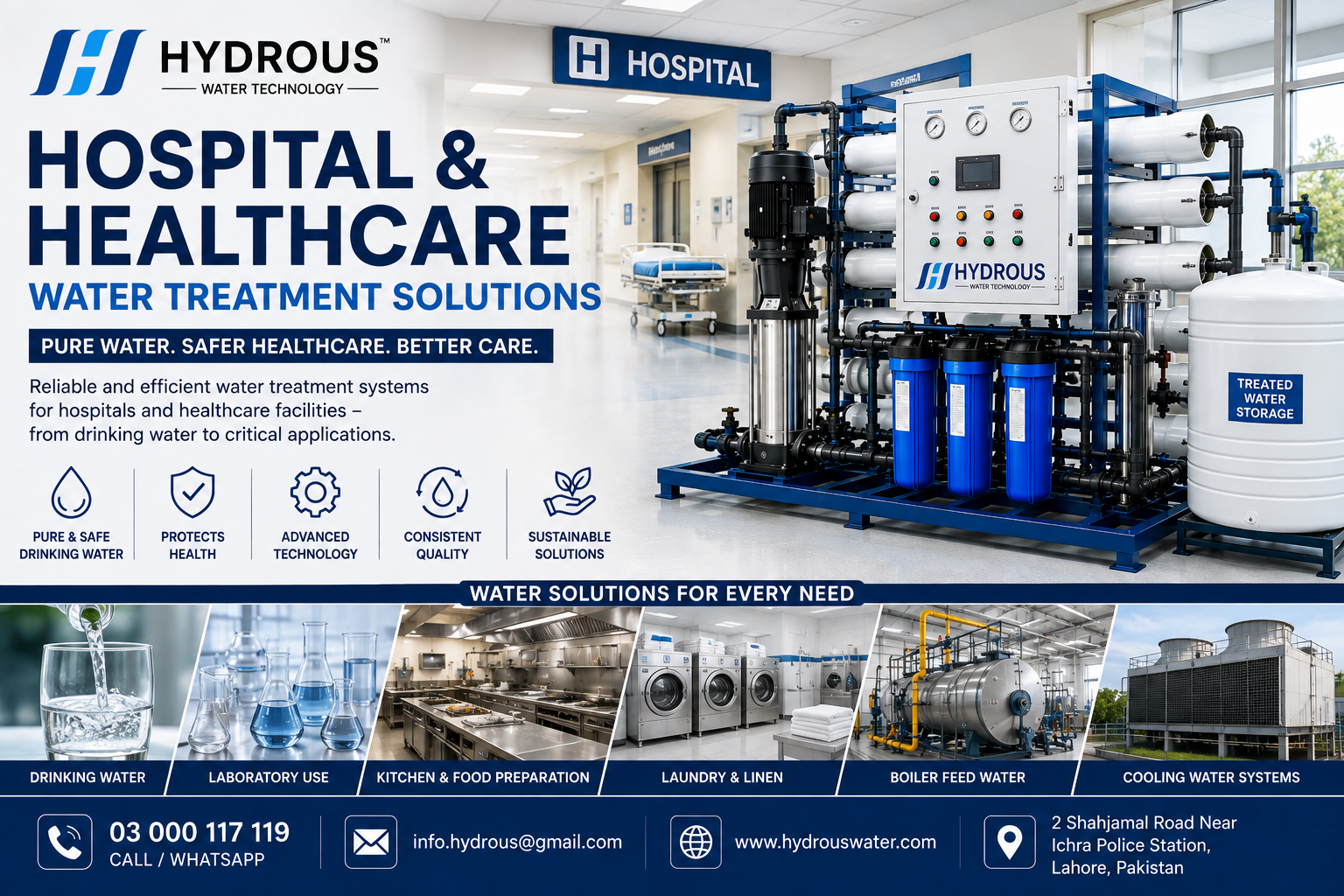
RO and water treatment solutions for hospitals and healthcare facilities in Pakistan.
Why Water Treatment Is Important in Hospitals
Healthcare facilities can have continuous and varied water demand.
Water may be required for:
- Drinking
- Food preparation
- Patient and staff facilities
- Laundry
- Cleaning
- Laboratory operations
- Equipment-related applications
- Boiler feed
- Cooling systems
- General utilities
The quality requirements can vary significantly between these applications.
For example, water used for a cooling system does not necessarily require the same treatment as water intended for a specific laboratory application.
A properly planned hospital water treatment system should therefore separate different water requirements and provide the appropriate treatment for each one.
Hospital Water Treatment System
There is no universal water-treatment system for every hospital.
The appropriate configuration depends on:
- Water source
- Raw-water quality
- Hospital size
- Number of beds
- Daily water consumption
- Peak demand
- Intended applications
- Required treated-water quality
- Existing plumbing and storage
- Future expansion
A simplified treatment arrangement could be:
Raw Water → Pretreatment → Filtration → Softening → RO → UV / Other Treatment → Treated Water Storage → Distribution
This is only an example.
Some facilities may require fewer stages, while others may require additional purification or specialized treatment.
Hospital RO Plant
Reverse osmosis can be an important component of a hospital water-treatment system where reduction of dissolved salts and other contaminants is required.
A hospital RO plant can be used for suitable applications such as:
- Drinking-water treatment
- General purified-water applications
- Laboratory support
- Food-service applications
- Certain equipment-related uses
- Utility-water treatment
The RO plant should be sized according to actual consumption rather than selecting a system based only on the number of beds.
Important design considerations include:
Raw-Water Quality
The source-water analysis helps determine pretreatment and RO requirements.
Required Capacity
The system can be designed according to LPH, GPD or cubic metres per hour.
Operating Hours
A hospital may require water around the clock, so operating hours and storage should be considered.
Peak Demand
Water demand can increase at particular times of day.
Storage
A treated-water tank can provide a buffer between production and consumption.
Product-Water Quality
The required water quality determines whether RO alone is sufficient or additional treatment is necessary.
RO Plant Capacity for Hospitals
Hospital water demand depends on many factors.
These can include:
- Number of beds
- Occupancy
- Staff
- Kitchen facilities
- Laundry
- Laboratories
- Operating departments
- Cleaning requirements
- General utilities
For example, suppose a healthcare facility needs 30,000 litres of treated water per day and plans to operate its RO system for 15 hours.
The basic production requirement would be:
30,000 ÷ 15 = 2,000 LPH
This gives a theoretical production requirement of approximately 2,000 litres per hour.
But this calculation is only a starting point.
A practical design should also consider:
- Peak demand
- Storage capacity
- RO recovery
- Maintenance downtime
- Membrane cleaning
- Future expansion
- Additional water uses
Hospital Water Filtration System
RO should not automatically be considered the first treatment stage.
Pretreatment is often important for protecting downstream equipment and improving overall system performance.
Depending on the source water, a hospital filtration system may include:
Multimedia Filtration
Helps reduce suspended particles and turbidity.
Activated Carbon Filtration
Can be used to reduce chlorine, taste, odor and certain organic compounds where appropriate.
Cartridge Filtration
Provides fine particulate filtration before sensitive equipment such as an RO system.
Iron Removal
Specialized treatment may be required where iron levels are elevated.
Water Softening
Reduces calcium and magnesium hardness where scale control is required.
The correct combination depends on the raw-water analysis.
Hospital Water Softener
Hard water can create scale in:
- Boilers
- Hot-water systems
- Pipes
- Heat exchangers
- Washing equipment
- RO membranes
A water softener uses ion-exchange technology to reduce hardness-causing calcium and magnesium.
Depending on the hospital’s water system, a softener can be installed before:
RO → Boiler → Hot-Water System
or another suitable application.
Softener sizing should consider:
- Water hardness
- Flow rate
- Daily consumption
- Resin capacity
- Regeneration frequency
- Peak demand
Drinking Water Treatment for Hospitals
Hospitals require reliable drinking-water facilities for patients, visitors and staff.
Depending on the incoming water quality, drinking-water treatment may include:
Sediment Filtration → Carbon Filtration → RO → UV
The actual configuration should be determined from the source-water analysis and the required water quality.
For smaller healthcare facilities, a commercial RO system may be sufficient.
Large hospitals may require a centralized treatment plant with multiple distribution points and adequate treated-water storage.
Water Treatment for Hospital Laboratories
Laboratories can have more specific water-quality requirements than general hospital applications.
Depending on the type of laboratory work, treatment may include:
- RO
- Deionization
- Ultrafiltration
- UV
- Micron filtration
- Combination purification systems
The required water quality should be determined by the laboratory’s actual analytical and operational requirements.
A hospital should not assume that ordinary drinking-water RO is automatically suitable for every laboratory application.
Deionized Water for Healthcare Facilities
Some laboratory and technical applications require water with reduced ionic content.
A deionization system can be used where additional ion removal is required after RO or another suitable pretreatment process.
Possible technologies include:
- Mixed-bed deionization
- Separate-bed ion exchange
- Electrodeionization
The appropriate system depends on:
- Required water quality
- Flow rate
- Feed-water quality
- Operating conditions
- Maintenance requirements
Ultrafiltration for Hospital Water Treatment
Ultrafiltration is a membrane-based process that can provide additional removal of fine suspended material, colloids and microorganisms within its separation range.
UF may be considered as:
- Pretreatment for RO
- A standalone treatment stage for certain applications
- Part of a multi-stage purification system
For example:
Pretreatment → UF → RO
may be appropriate for some challenging water sources.
The decision should be based on water analysis and the intended application.
UV Water Treatment for Hospitals
Ultraviolet treatment can provide an additional microbiological control barrier in appropriate water-treatment systems.
A UV unit may be installed after filtration or purification.
For example:
RO → UV → Treated Water
can be considered for suitable applications.
UV performance depends on factors such as:
- Flow rate
- UV dose
- Water clarity
- Lamp condition
- System design
UV should therefore be properly sized and maintained.
Water Treatment for Hospital Boilers
Large healthcare facilities may use boilers for steam and hot-water applications.
Boiler feed water requires appropriate treatment to reduce problems associated with hardness and dissolved contaminants.
Depending on the boiler system, a treatment arrangement may include:
Filtration → Softening → RO → Chemical Treatment → Boiler Feed
The exact design depends on:
- Boiler pressure
- Feed-water chemistry
- Steam requirements
- Condensate recovery
- Operating conditions
Proper water treatment can help manage scale and corrosion and support boiler performance.
Cooling Water Treatment for Hospitals
Large hospitals can also have cooling towers or centralized HVAC systems.
Cooling-water systems can experience:
- Scale
- Corrosion
- Biological growth
- Suspended solids
Treatment can involve a combination of:
- Filtration
- Chemical dosing
- Scale control
- Corrosion control
- Biocide treatment
- Blowdown management
- Water-quality monitoring
Hydrous supplies water-treatment chemicals for industrial and commercial applications.
Laundry Water Treatment
Hospital laundry operations can consume significant amounts of water.
Water hardness can affect:
- Washing equipment
- Heating systems
- Detergent performance
- Fabric handling
- Equipment maintenance
Depending on the water quality, treatment may include:
- Filtration
- Water softening
- RO
- Other appropriate treatment
The correct system depends on the laundry operation and water-quality requirements.
Water Treatment for Hospital Kitchens
Hospital kitchens may prepare meals for patients, staff and visitors.
Water may be used for:
- Cooking
- Drinking
- Food preparation
- Washing
- Cleaning
- Dishwashing
A commercial RO or filtration system can be designed according to the kitchen’s water demand and raw-water quality.
For larger healthcare facilities, kitchen water treatment can be integrated into a centralized water-treatment strategy.
Raw-Water Testing for Hospital Water Treatment
Before designing a hospital RO or filtration system, a representative raw-water analysis should be obtained.
Important parameters can include:
- pH
- TDS
- Conductivity
- Total hardness
- Calcium
- Magnesium
- Alkalinity
- Chloride
- Sulphate
- Iron
- Silica
- Turbidity
- Chlorine
- Microbiological parameters
- Other application-specific parameters
The required testing depends on the source and intended application.
Why is water testing important?
Two water sources can have similar TDS values but very different chemical characteristics.
For example, one source may have high hardness while another has elevated iron or silica.
These differences can significantly influence pretreatment and RO design.
Therefore:
A TDS reading alone is not enough to design a complete hospital water-treatment system.
Hospital Water Treatment Plant Design
Hydrous Water Technology recommends an application-based design process.
Step 1 — Identify the Water Source
Determine whether the hospital uses:
- Bore water
- Municipal water
- Tanker water
- Another source
Step 2 — Analyze the Water
Obtain a laboratory report to understand the source-water chemistry.
Step 3 — Identify Water Demand
Separate water requirements for:
- Drinking
- Kitchen
- Laundry
- Laboratory
- Boiler
- Cooling
- General utilities
Step 4 — Determine Required Water Quality
Each application should be evaluated independently.
Step 5 — Calculate Treatment Capacity
Calculate:
- LPH
- Daily consumption
- Peak demand
- Operating hours
- Storage requirement
Step 6 — Select Pretreatment
Choose filtration, softening, carbon treatment or other processes according to the water analysis.
Step 7 — Select Purification Technology
Depending on the application:
RO | UF | UV | DI | Filtration | Softening
can be incorporated.
Step 8 — Design Storage & Distribution
The treated-water tank and distribution system should be considered together with the treatment plant.
Step 9 — Installation & Commissioning
The system should be properly installed, tested and commissioned before regular operation.
Step 10 — Maintenance
Filters, membranes, pumps, chemical dosing systems and instrumentation require routine inspection.
Hospital Water Storage
Treated-water storage is particularly useful where demand changes throughout the day.
A storage tank can provide a buffer between:
Water Treatment Production → Hospital Consumption
Tank sizing depends on:
- Treatment capacity
- Daily consumption
- Peak demand
- Operating hours
- Backup requirements
Storage design should also consider the intended water application and appropriate material selection.
RO Membrane Protection in Hospitals
RO membranes can experience scaling and fouling due to inadequate pretreatment or unsuitable operating conditions.
Potential causes include:
- Hardness
- Iron
- Suspended solids
- Organic fouling
- Biological fouling
- Silica
- Incorrect chemical dosing
Membrane performance should be monitored through:
- Feed pressure
- Permeate flow
- Concentrate flow
- Conductivity
- Salt rejection
- Differential pressure
Changes in these parameters can help identify developing problems.
RO Membrane Cleaning & Maintenance
Membrane cleaning should be based on actual system performance and the type of fouling present.
For example:
Scale deposits may require an appropriate acidic cleaning procedure.
Organic or biological fouling may require an appropriate alkaline or specialized cleaning procedure.
Cleaning chemicals should be compatible with the membrane and used according to the manufacturer’s recommendations.
Hydrous provides RO membrane cleaning chemicals for industrial RO applications.
Water Treatment Chemicals for Healthcare Facilities
Some hospital utility systems may require water-treatment chemicals.
These can include:
- RO antiscalants
- Membrane cleaning chemicals
- Biocides
- Boiler treatment chemicals
- Cooling-water chemicals
- pH-control chemicals
Chemical selection should always consider the specific application and treatment system.
Where water is intended for drinking or other sensitive applications, only appropriate treatment chemicals and procedures should be used.
Hospital Water Treatment for New Projects
For a new hospital or healthcare complex, water treatment should be considered during the building-design stage.
Important planning areas include:
Water Source
Identify the expected source and quality.
Daily Consumption
Estimate water use across all departments.
Peak Demand
Consider periods of higher consumption.
Treatment Room
Allocate suitable space for treatment equipment, tanks and maintenance access.
Electrical Supply
Plan adequate power for pumps and treatment equipment.
Drainage
RO concentrate, filter backwash and other wastewater streams require appropriate drainage planning.
Storage
Plan raw-water and treated-water storage according to demand.
Future Expansion
If the healthcare facility is expected to expand, treatment capacity and infrastructure should allow for future requirements where practical.
Hospital Water Treatment for Existing Facilities
Existing hospitals may face different challenges from new projects.
A treatment upgrade may be required because of:
- Increasing water demand
- High TDS
- Hardness
- Frequent membrane problems
- Old filtration equipment
- Inadequate treatment capacity
- Poor water quality
- Increased maintenance
- Expansion of hospital facilities
Instead of replacing everything, an existing system can be evaluated to identify which components need upgrading.
Possible improvements include:
- Pretreatment upgrades
- New RO membranes
- Pump replacement
- Additional filtration
- Softener replacement
- Chemical dosing improvements
- Instrumentation upgrades
- Additional RO capacity
- Storage expansion
Benefits of a Properly Designed Hospital Water Treatment System
Consistent Water Quality
Provides treated water appropriate for the intended application.
Equipment Protection
Pretreatment can help reduce scale and fouling.
Better System Reliability
A properly sized system can better match the facility’s actual water requirements.
Reduced Maintenance
Correct pretreatment can help protect membranes and downstream equipment.
Application-Based Treatment
Different hospital departments can receive water appropriate to their requirements.
Future Expandability
The system can be planned with future capacity requirements in mind.
Why Choose Hydrous Water Technology?
Hydrous Water Technology provides commercial and industrial water treatment solutions for healthcare facilities and other sectors across Pakistan.
Our solutions include:
- Industrial RO plants
- Commercial RO plants
- Water filtration systems
- Water softeners
- Ultrafiltration systems
- Deionization systems
- UV treatment
- Chemical dosing systems
- RO membranes
- Membrane housings
- Pumps
- RO antiscalants
- Membrane cleaning chemicals
- Boiler treatment chemicals
- Cooling-water chemicals
- Installation
- Commissioning
- Maintenance
Our design approach focuses on the water source, treatment capacity and actual application rather than supplying the same system to every customer.
Get a Hospital Water Treatment Solution
Planning a new hospital water-treatment system or upgrading an existing facility?
Provide our technical team with:
- Raw-water laboratory report
- Water source
- Required daily capacity
- Peak water demand
- Number of beds, where relevant
- Required treated-water applications
- Existing RO/filtration system details
- Required water-quality specification
This information allows the treatment requirement to be evaluated before equipment is selected.
Frequently Asked Questions
What type of water treatment system does a hospital need?
It depends on the hospital’s water source and applications. A facility may use filtration, softening, RO, UV, UF or deionization for different water requirements.
Is RO suitable for hospitals?
RO can be suitable for many hospital applications where reduction of dissolved salts and other contaminants is required. The appropriate configuration depends on the application and water-quality requirements.
What RO capacity is required for a hospital?
Capacity depends on water consumption, number of beds, departments, operating hours, peak demand and storage. A proper calculation should be performed before selecting the plant.
Does hospital water require a softener?
A softener may be appropriate where hardness is high and scale control is required. Water analysis should be used to determine whether softening is necessary.
Can the same RO water be used throughout a hospital?
Not necessarily. Different applications can have different water-quality requirements. Drinking, laboratory, laundry, boiler and cooling applications should be evaluated separately.
Is UV required after RO?
UV can provide an additional microbiological control barrier in suitable applications, but whether it is required depends on the system design and intended water use.
Can Hydrous design a customized hospital RO plant?
Yes. Hydrous can evaluate the raw-water quality, required capacity and application to develop an appropriate treatment configuration.
Do you provide hospital water filtration systems?
Yes. Filtration, softening, RO and other treatment technologies can be combined according to the facility’s requirements.
Do you provide maintenance for hospital RO plants?
Hydrous provides maintenance and technical support for commercial and industrial water-treatment systems according to project requirements.
Do you supply water-treatment chemicals?
Yes. Hydrous supplies RO antiscalants, membrane cleaning chemicals and chemicals for selected boiler and cooling-water applications.