
Agriculture Water Treatment Solutions in Pakistan
Agriculture depends on a reliable supply of water, but having enough water is only part of the equation. Water quality can also affect irrigation systems, soil conditions, crops and farm infrastructure.
Water from boreholes, canals, tube wells, reservoirs and other sources can contain suspended solids, hardness, iron, salts and other substances that may need to be managed before the water is used for a particular agricultural application.
The right treatment depends on the source water, crop, irrigation method and water-quality requirements.
Hydrous Water Technology provides customized agriculture water treatment solutions in Pakistan, including filtration systems, water softeners, RO plants, cartridge filters and other water-treatment technologies.
Pakistan’s agriculture sector faces significant water-management challenges, making efficient treatment and reuse technologies increasingly relevant to agricultural applications. Recent research has also examined treatment of wastewater for irrigation reuse in Pakistan, including parameters such as electrical conductivity, TDS, sodium, chloride and SAR.
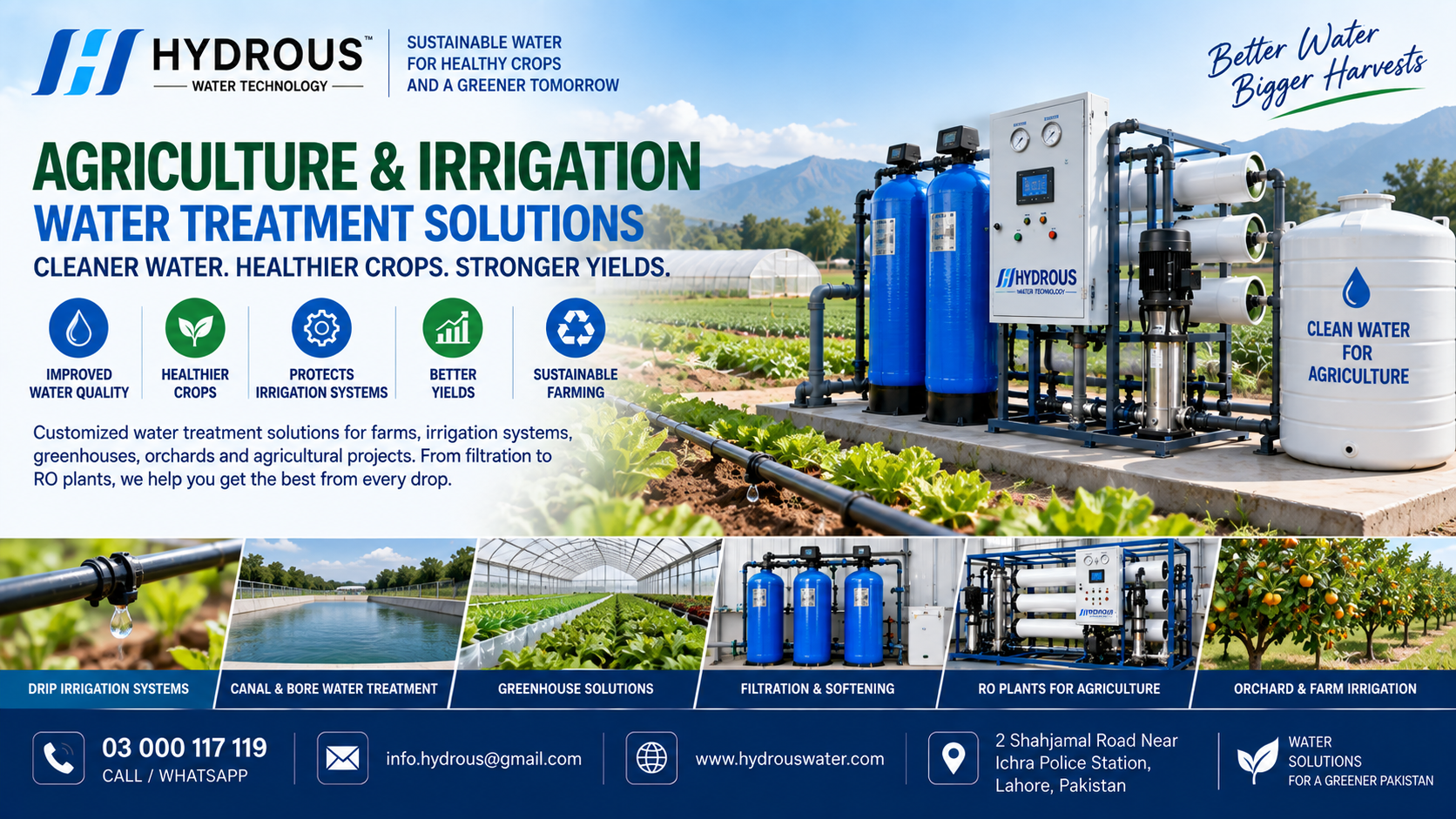
Agricultural water filtration, RO and irrigation water treatment solutions in Pakistan.
Why Water Quality Matters in Agriculture
Agricultural water may be used for:
- Crop irrigation
- Orchards
- Vegetable farming
- Greenhouses
- Nurseries
- Livestock farms
- Dairy farms
- Agricultural processing
- Farmhouses
- Landscape irrigation
The required water quality can vary significantly between these applications.
For example, water suitable for one crop or irrigation system may not be ideal for another.
Water analysis can help identify potential concerns such as:
- High TDS
- High EC
- Hardness
- Sodium
- Chloride
- Bicarbonate
- Iron
- Suspended solids
- Turbidity
- Biological contamination
A treatment system should therefore be designed around the actual water analysis rather than using the same equipment for every farm.
Irrigation Water Treatment
Irrigation water treatment is the process of managing water quality before it enters an irrigation system.
The treatment required depends on the source and the irrigation technology.
A filtration system may be particularly important for drip and sprinkler irrigation because suspended particles can contribute to clogging. Agricultural filtration equipment in Pakistan is commonly used as a pre-treatment stage for drip and sprinkler irrigation systems.
A basic agricultural filtration arrangement may include:
Raw Water → Sand/Media Filter → Disc or Cartridge Filter → Irrigation System
Where dissolved salts or other contaminants are a concern, additional treatment may be required.
Agricultural Water Filtration System
Filtration is often the first treatment step for agricultural water.
A properly selected filtration system can help remove suspended particles before water enters:
- Drip irrigation
- Sprinkler irrigation
- Fertigation equipment
- Pumps
- Valves
- Pipelines
- Nozzles
- Emitters
Possible filtration technologies include:
Multimedia Filtration
Used to reduce suspended solids and turbidity.
Sand Filtration
Useful where the raw water contains significant particulate matter.
Disc Filtration
Often used as a fine filtration stage for irrigation systems.
Screen Filtration
Can provide additional particulate protection.
Cartridge Filtration
Can be used where finer filtration is required.
The correct micron rating and filter type should be selected according to the water quality and irrigation equipment.
Water Treatment for Drip Irrigation
Drip irrigation delivers water through small emitters, making filtration particularly important.
Particles can accumulate in:
- Emitters
- Drip lines
- Valves
- Filters
- Fertigation equipment
A typical arrangement may be:
Water Source → Pump → Media Filter → Disc Filter → Fertigation → Drip Lines
The exact configuration depends on the source-water quality and irrigation system.
Good filtration can help reduce clogging and support consistent water distribution.
Water Treatment for Sprinkler Irrigation
Sprinkler systems can also be affected by suspended particles.
Water containing excessive solids may contribute to:
- Nozzle blockage
- Reduced flow
- Uneven distribution
- Increased maintenance
A suitable filtration system can be installed before the sprinkler network.
For open-source water, filtration can be especially important because surface water may carry a higher particulate load.
Bore Water Treatment for Agriculture
Bore and tube-well water are widely used for agricultural purposes.
However, groundwater chemistry can differ substantially from one location to another.
A bore-water analysis may identify:
- TDS
- EC
- Hardness
- Iron
- Chloride
- Sulphate
- Sodium
- Bicarbonate
- pH
- Silica
If the primary concern is suspended solids, filtration may be sufficient.
If hardness is causing scaling, a softening system may be considered.
If dissolved salts are excessively high, RO may be considered.
High TDS Water for Agriculture
High TDS is an important consideration when evaluating irrigation water.
However, TDS alone does not provide the complete picture.
Agricultural water quality may also require evaluation of parameters such as:
- Electrical conductivity
- Sodium
- Chloride
- Bicarbonate
- Boron
- SAR
These parameters can help determine whether the water is suitable for a particular irrigation application.
Research involving wastewater treatment for irrigation reuse in Pakistan has specifically evaluated EC, TDS, SAR, sodium, chloride, boron and other parameters.
Agricultural RO Plant
Reverse osmosis can be considered for agricultural applications where dissolved salts or other contaminants need substantial reduction.
A possible system configuration is:
Bore Water → Multimedia Filter → Activated Carbon → Cartridge Filter → RO → Treated Water Storage
However, RO is not automatically the best solution for every irrigation project.
RO produces a concentrated reject stream, and the economics and disposal or management of this stream need to be considered before installation.
For this reason, water analysis and application-specific design are essential.
When Is RO Required for Agriculture?
RO may be considered when:
- Dissolved salts are excessively high
- Irrigation water quality is unsuitable for the intended crop
- Specific contaminants require membrane treatment
- Water must be reused after appropriate treatment
- A high-purity water source is required for a specialized agricultural application
The final decision should be based on laboratory water analysis and agronomic requirements.
Water Softener for Agriculture
Hard water contains calcium and magnesium that can contribute to scaling.
A water softener may be useful when hardness is causing problems in:
- Pumps
- Pipes
- Irrigation equipment
- Heating systems
- Water-treatment equipment
However, a softener is not a universal solution for high-salt irrigation water.
If sodium or salinity is already an agricultural concern, the treatment approach needs careful evaluation.
Iron Removal for Agricultural Water
Some bore-water sources contain elevated iron.
Iron can cause:
- Brown or reddish deposits
- Staining
- Filter loading
- Pipeline deposits
- Irrigation equipment problems
An iron-removal system can be designed depending on the concentration and chemical form of the iron.
Possible treatment may involve oxidation followed by filtration.
A proper water test is recommended before selecting the system.
Agricultural Water Treatment for Greenhouses
Greenhouse operations can have more controlled water requirements than conventional field irrigation.
Water may be used for:
- Drip irrigation
- Hydroponic systems
- Fertigation
- Plant nurseries
- Seedling production
In these applications, water chemistry can have a direct effect on nutrient management.
Depending on the source, treatment may include:
Filtration → Softening or RO → Storage → Fertigation → Irrigation
The required treatment level depends on the crop and growing system.
Water Treatment for Nurseries
Plant nurseries often use drip or sprinkler systems and may require consistent water quality.
Treatment can help manage:
- Suspended solids
- Hardness
- Iron
- Salinity
- Other source-water issues
Fine filtration can be particularly useful where small irrigation emitters are used.
Agricultural Water Treatment for Orchards
Orchards may use drip or micro-irrigation systems.
The treatment requirements depend on:
- Water source
- Tree type
- Soil
- Irrigation technology
- Water chemistry
- Fertigation program
A suitable filtration system can help protect irrigation infrastructure from suspended particles.
Where salinity is a concern, the irrigation-water analysis should be reviewed before deciding whether RO or another treatment approach is appropriate.
Water Treatment for Hydroponic Agriculture
Hydroponic systems can have more demanding water-quality requirements because water is an important component of the nutrient solution.
The source water can contain minerals that influence nutrient formulation.
Depending on the application, treatment may include:
- Sediment filtration
- Activated carbon
- RO
- UV
- DI or other polishing
The appropriate system depends on the crop, nutrient program and required starting-water quality.
Agriculture Water Filtration and Fertigation
Fertigation combines irrigation and fertilizer application.
The water-treatment system should therefore be compatible with:
- Fertilizer dosing
- Irrigation pressure
- Filtration
- Pumps
- Valves
- Emitters
Fine filtration before the irrigation network can help reduce particulate-related problems.
A complete system may be:
Water Source → Pump → Media Filter → Disc Filter → Fertilizer Dosing → Irrigation Network
Agricultural Water Storage
Storage tanks can be used to balance water production and irrigation demand.
A farm water-storage system should consider:
- Daily water requirement
- Peak irrigation demand
- Tank capacity
- Pump capacity
- Treatment capacity
- Water turnover
- Tank hygiene
For treated water, the storage arrangement should also be designed to minimize recontamination.
Solar-Powered Agricultural Water Treatment
Agricultural sites may not always have reliable grid electricity.
A solar-powered pumping and water-treatment system can therefore be considered for suitable locations.
Solar power can be integrated with:
- Bore pumps
- Irrigation pumps
- RO systems
- Water-treatment equipment
- VFD-controlled pumps
The system should be designed according to the actual pump load, operating hours and solar availability.
Hydrous can also design water-treatment systems around agricultural site conditions where customized equipment and solar pumping are required.
Agricultural Water Treatment System Design
At Hydrous Water Technology, we recommend starting with the water rather than the equipment.
Step 1 — Identify the Source
Determine whether the water comes from:
- Bore
- Tube well
- Canal
- River
- Reservoir
- Municipal supply
- Recycled water
Step 2 — Conduct Water Analysis
Test the relevant physical, chemical and microbiological parameters.
Step 3 — Identify the Agricultural Application
Determine whether the water will be used for:
- Field irrigation
- Drip irrigation
- Sprinkler irrigation
- Greenhouse
- Hydroponics
- Nursery
- Orchard
- Livestock
Step 4 — Calculate Water Demand
Determine:
- Daily requirement
- Peak requirement
- Pumping hours
- Irrigation schedule
Step 5 — Select Treatment
Possible technologies include:
Media Filtration | Disc Filtration | Cartridge Filtration | Softening | RO | UV
Step 6 — Design Storage and Distribution
Match storage tanks, pumps and pipelines to the required flow.
Step 7 — Commission and Monitor
Check:
- Flow
- Pressure
- Water quality
- Filter performance
- RO performance where applicable
Benefits of Proper Agricultural Water Treatment
A correctly designed treatment system can provide several operational benefits.
Protect Irrigation Equipment
Filtration can help reduce particulate-related clogging.
Improve Water Consistency
Treatment can provide a more predictable water quality.
Support Drip Irrigation
Fine filtration helps protect small emitters and irrigation components.
Reduce Scaling Problems
Appropriate treatment can help manage hardness-related scaling.
Improve System Maintenance
Proper pretreatment can reduce the load on downstream equipment.
Support Water Reuse
Where technically and economically appropriate, treated wastewater can be considered for irrigation reuse.
Research in Pakistan is actively investigating treatment approaches for wastewater reuse in agriculture, reflecting the importance of water conservation and irrigation-water management.
Agriculture Water Treatment Maintenance
Regular maintenance is essential for reliable agricultural water treatment.
Media Filters
Backwash according to pressure differential and operating conditions.
Disc Filters
Clean and inspect the discs regularly.
Cartridge Filters
Replace when pressure drop indicates loading.
RO Membranes
Monitor:
- Feed pressure
- Permeate flow
- TDS
- Salt rejection
- Differential pressure
Pumps
Inspect seals, pressure and electrical performance.
Storage Tanks
Inspect and clean as required.
Irrigation Lines
Check for clogging, leaks and uneven flow.
Water Testing for Agricultural Applications
Before selecting treatment equipment, Hydrous recommends obtaining a representative laboratory water analysis.
Depending on the application, important parameters may include:
- pH
- TDS
- Electrical conductivity
- Total hardness
- Calcium
- Magnesium
- Sodium
- Chloride
- Sulphate
- Bicarbonate
- Boron
- Iron
- Manganese
- Silica
- Turbidity
- SAR
The exact testing panel should be selected according to the water source and intended agricultural use.
Why Choose Hydrous Water Technology?
Hydrous Water Technology provides customized water-treatment solutions for agricultural, commercial and industrial applications across Pakistan.
Our solutions can include:
- Agricultural water filtration
- Irrigation filtration systems
- Commercial RO plants
- Industrial RO plants
- Agricultural RO systems
- Multimedia filters
- Activated carbon filters
- Disc and cartridge filtration
- Water softeners
- UV systems
- RO membranes
- Pumps
- Chemical dosing systems
- RO antiscalants
- Membrane cleaning chemicals
- Installation and commissioning
- Maintenance services
Hydrous states that its engineering process includes raw-water testing, customized system design, installation and maintenance, which is particularly relevant for agriculture because source-water quality varies considerably between sites.
Get an Agriculture Water Treatment Solution
If you need a water-treatment system for a farm, orchard, greenhouse or irrigation project, send us:
- Water analysis report
- Water source
- Farm location
- Crop or agricultural application
- Irrigation method
- Daily water requirement
- Peak flow requirement
- Existing pump and filtration system
- Main water-quality problem
Our technical team can use this information to recommend a treatment configuration and suitable capacity.
Frequently Asked Questions
What is agriculture water treatment?
Agriculture water treatment involves treating irrigation or farm water to manage contaminants such as suspended solids, hardness, iron and excessive dissolved salts according to the intended agricultural application.
Does agricultural irrigation water always need RO?
No. Many agricultural applications require filtration rather than RO. RO should be considered when the water analysis and application indicate that substantial reduction of dissolved contaminants is required.
Which filter is best for irrigation water?
There is no single filter that is best for every farm. Media, disc, screen and cartridge filters can all have different roles depending on the source water and irrigation system.
Is bore water suitable for irrigation?
Bore water can be suitable for irrigation, but it should be tested first. Parameters such as EC, TDS, sodium, chloride, bicarbonate and SAR can be important when assessing irrigation water.
Can RO water be used for agriculture?
RO-treated water can be used for specific agricultural applications, but the suitability depends on the crop, soil, irrigation method and water chemistry. RO reject management should also be considered.
Can water treatment protect drip irrigation?
Yes. Appropriate filtration can help reduce suspended-particle clogging in drip systems and other precision irrigation equipment.
Do you provide agricultural water treatment systems in Pakistan?
Yes. Hydrous Water Technology provides customized filtration, softening, RO and other water-treatment solutions for agricultural applications.