
Manufacturing Industry Water Treatment Solutions in Pakistan
Water is an important part of many manufacturing processes.
Factories and production facilities use water for different purposes, including process operations, equipment cooling, boilers, cleaning, washing, production support and employee facilities.
However, the water requirements of a manufacturing plant can vary significantly from one industry to another.
A textile factory may need water for production and boilers, while a food-processing facility may require treated water for production and cleaning. An engineering factory may mainly need water treatment for cooling systems, boilers and general utilities.
This is why a manufacturing water-treatment system should be designed around the actual water source, water chemistry, production process and required capacity.
Hydrous Water Technology provides industrial water treatment solutions for manufacturing facilities across Pakistan, including industrial RO plants, filtration systems, water softeners, ultrafiltration, UV treatment, chemical dosing systems and water-treatment chemicals.
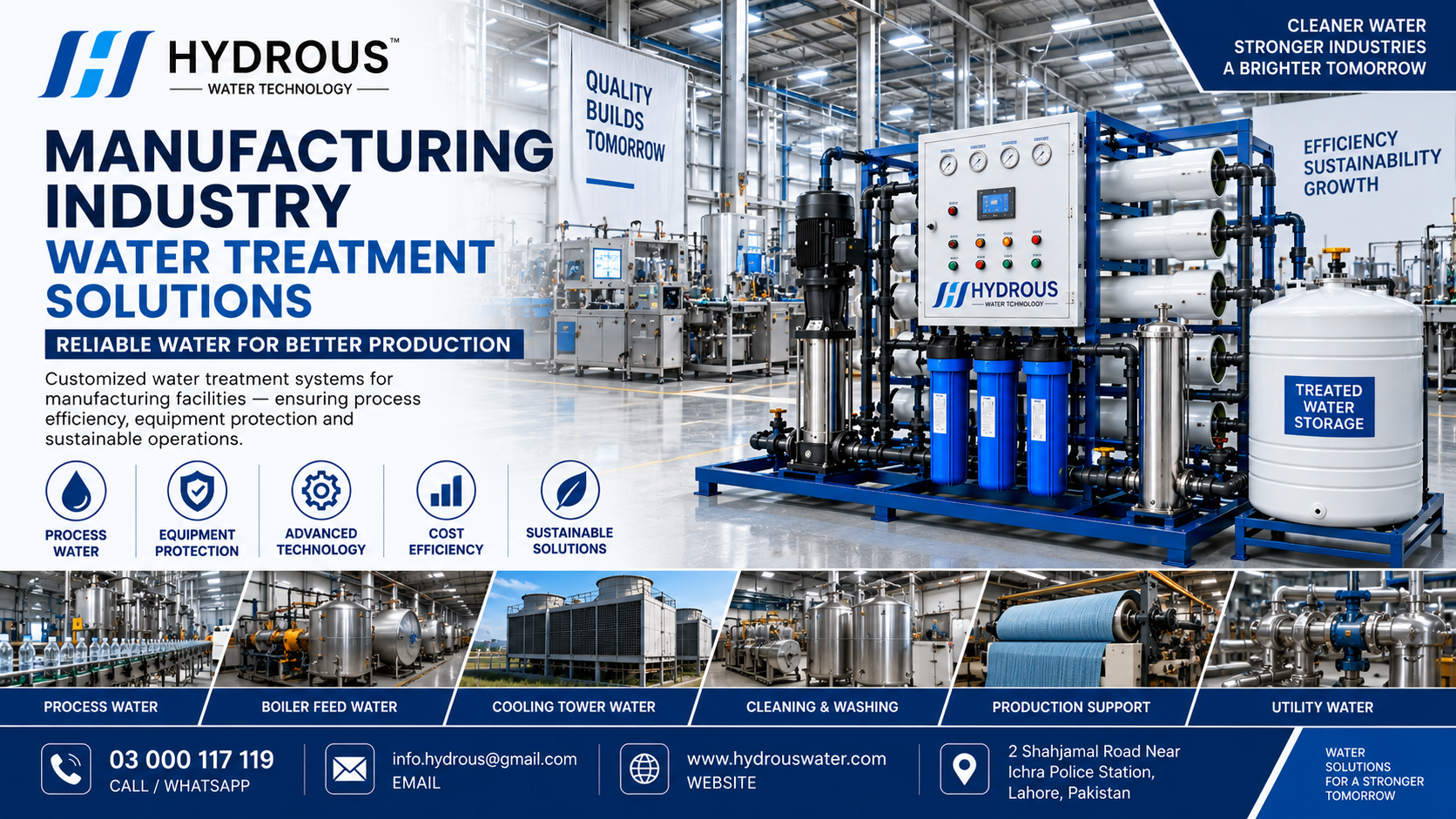
Industrial RO and water treatment solutions for manufacturing facilities in Pakistan.
Why Water Treatment Is Important in Manufacturing
Poor-quality water can affect industrial equipment and processes.
Depending on the application, untreated water may contain:
- High TDS
- Hardness
- Suspended solids
- Iron
- Silica
- Chlorine
- Organic matter
- Microbiological contaminants
These parameters can create problems such as:
- Scale formation
- Corrosion
- Membrane fouling
- Equipment deposits
- Reduced heat-transfer efficiency
- Increased maintenance
- Process-water quality problems
A properly designed treatment system helps manage these risks by treating water according to its intended use.
Industrial Water Treatment for Factories
There is no single water-treatment configuration that works for every manufacturing facility.
A typical industrial treatment arrangement may include:
Raw Water → Multimedia Filter → Activated Carbon → Water Softener → Cartridge Filter → RO → UV / Other Treatment → Treated Water Storage
The final configuration depends on:
- Raw-water analysis
- Required flow rate
- Manufacturing process
- Required water quality
- Operating hours
- Production schedule
- Existing equipment
- Future expansion
Some factories may only need filtration and softening, while others may require a complete RO and membrane-treatment system.
Industrial RO Plant for Manufacturing
An industrial RO plant can reduce dissolved salts and other contaminants from suitable feed water.
RO systems are commonly considered for manufacturing applications where lower-TDS or purified process water is required.
Potential applications include:
- Process water
- Production water
- Boiler feed pretreatment
- Equipment water
- Cleaning applications
- Product-related water applications
- General industrial utilities
The RO plant should be designed according to the water chemistry and required product-water quality.
How to Calculate RO Capacity for a Factory
Industrial RO capacity should be based on actual water consumption.
Important factors include:
- Daily water requirement
- Production hours
- Peak water demand
- Number of shifts
- Process-water consumption
- Boiler requirements
- Cleaning requirements
- Treated-water storage
For example, if a factory needs 40,000 litres of treated water per day and plans to operate the RO plant for 16 hours:
40,000 ÷ 16 = 2,500 LPH
The basic production requirement would therefore be approximately 2,500 litres per hour.
This is only a preliminary calculation.
The final plant capacity should also account for:
- RO recovery
- Peak demand
- Storage
- Maintenance downtime
- Membrane cleaning
- Future expansion
Process Water Treatment
Manufacturing processes can be sensitive to water quality.
Depending on the production process, water may need to meet specific requirements for:
- TDS
- Hardness
- Turbidity
- Iron
- Silica
- Chlorine
- Conductivity
- Microbiological quality
For this reason, process-water treatment should begin with an understanding of the actual manufacturing process.
A system designed only around TDS may not adequately address other water-quality problems.
Factory Water Filtration System
Filtration is often used as pretreatment before RO or as a standalone treatment process.
Multimedia Filtration
A multimedia filter can reduce suspended solids and turbidity.
It is commonly considered as a first-stage filtration system for industrial water treatment.
Activated Carbon Filtration
Activated carbon can be used to reduce chlorine, taste, odor and certain organic compounds where appropriate.
Carbon filtration can also be important for protecting chlorine-sensitive RO membranes.
Cartridge Filtration
Cartridge filters provide finer particulate filtration before sensitive downstream equipment.
Iron Removal
Where groundwater contains elevated iron, specialized iron-removal treatment may be required.
Industrial Water Softener
Hardness is a common concern in industrial water systems.
Calcium and magnesium can form scale in:
- Boilers
- Heat exchangers
- Cooling systems
- Pipes
- Washing equipment
- RO membranes
- Hot-water systems
An industrial water softener reduces hardness through ion exchange.
A typical arrangement may be:
Raw Water → Filtration → Water Softener → Industrial Application
or:
Filtration → Softener → RO
The appropriate configuration depends on the water analysis and application.
Boiler Feed Water Treatment for Manufacturing
Many manufacturing facilities operate boilers for steam or heating requirements.
Boiler systems require appropriate water treatment because hardness and other dissolved contaminants can contribute to scale and operational problems.
A treatment system may include:
Multimedia Filtration → Softening → RO → Chemical Treatment → Boiler Feed
The exact configuration depends on:
- Boiler pressure
- Feed-water quality
- Steam demand
- Condensate recovery
- Operating conditions
Proper water treatment can help manage scale and corrosion and support boiler efficiency.
Cooling Tower Water Treatment
Cooling towers are common in larger industrial facilities.
Poor cooling-water quality can contribute to:
- Scale
- Corrosion
- Biological growth
- Suspended-solids accumulation
A cooling-water treatment program may include:
- Side-stream filtration
- Chemical dosing
- Biocide treatment
- Scale control
- Corrosion control
- Blowdown management
- Water-quality monitoring
Hydrous supplies selected cooling-water treatment chemicals for industrial applications.
Industrial Chemical Dosing Systems
Chemical dosing can be an important part of an industrial water-treatment system.
Depending on the application, dosing systems can be used for:
- RO antiscalant
- pH adjustment
- Biocide
- Coagulant
- Boiler treatment
- Cooling-water treatment
A dosing system generally consists of:
- Chemical tank
- Dosing pump
- Injection point
- Calibration arrangement
- Appropriate control system
Chemical selection and dosing rates should be based on water chemistry and equipment requirements.
RO Antiscalant for Industrial RO Plants
Industrial RO membranes can be affected by scaling when dissolved minerals become concentrated during the RO process.
An appropriate antiscalant may help control scale formation under suitable operating conditions.
Hydrous supplies RO antiscalant chemicals, including Flocon 260, for industrial RO applications.
Antiscalant selection should be based on:
- Water analysis
- RO recovery
- Membrane type
- Operating conditions
- Concentration factors
Chemical dosing should be properly calculated rather than estimated.
RO Membrane Cleaning in Manufacturing Plants
Industrial RO membranes require monitoring and periodic maintenance.
Membrane fouling may result from:
- Suspended solids
- Organic material
- Hardness
- Iron
- Biological growth
- Other deposits
Indicators that may require investigation include:
- Reduced permeate flow
- Increased differential pressure
- Changes in salt rejection
- Increased operating pressure
The correct cleaning chemical depends on the type of fouling.
Hydrous supplies RO membrane cleaning chemicals for industrial treatment systems.
Water Treatment for Textile Manufacturing
Textile manufacturing can have significant water requirements.
Water may be used in:
- Dyeing
- Washing
- Processing
- Boiler systems
- Cleaning
- General utilities
Water quality can influence production processes and equipment.
Depending on the textile process, treatment can include:
- Filtration
- Softening
- RO
- UF
- Chemical treatment
- Wastewater treatment
For textile facilities, treatment should be designed around the specific production process and water-quality requirements.
Water Treatment for Food Manufacturing
Food-processing facilities can have water requirements for:
- Production
- Ingredient preparation
- Cleaning
- Washing
- Boilers
- Cooling
- General utilities
Different water uses may require different treatment levels.
A commercial or industrial RO system can be considered where reduced dissolved solids are required, while filtration and softening may be suitable for other applications.
Water Treatment for Pharmaceutical Manufacturing
Pharmaceutical manufacturing can require carefully controlled water quality.
Depending on the application, systems can include:
- RO
- UF
- UV
- Deionization
- EDI
- Specialized purification systems
The treatment system should be designed according to the specific process and applicable quality requirements.
Hydrous can design the pretreatment and purification stages around the facility’s water source and required capacity.
Water Treatment for Chemical Manufacturing
Chemical manufacturing facilities can have specialized process-water requirements.
The appropriate treatment depends on:
- Raw-water chemistry
- Production process
- Chemical compatibility
- Required water quality
- Equipment requirements
Potential technologies include:
- Multimedia filtration
- Activated carbon
- Softening
- RO
- UF
- Deionization
- Chemical dosing
Bore Water Treatment for Factories
Many industrial facilities use groundwater or bore water.
Groundwater can contain varying levels of:
- TDS
- Hardness
- Iron
- Silica
- Chloride
- Sulphate
- Alkalinity
- Suspended solids
A laboratory water analysis is therefore recommended before designing the treatment plant.
For example:
Bore Water → Multimedia Filter → Carbon Filter → Softener → Cartridge Filter → RO
may be suitable for one water source.
Another factory may require a completely different arrangement.
Municipal Water Treatment for Manufacturing
Factories using municipal water may still require additional treatment for specific industrial applications.
Depending on the intended use, the treatment system may include:
- Sediment filtration
- Carbon filtration
- Softening
- RO
- UV
The requirement should be evaluated based on the actual incoming water quality rather than assuming that all municipal water requires the same treatment.
Water Testing Before Industrial RO Installation
Water analysis is one of the most important steps before designing an industrial RO system.
Parameters may include:
- pH
- TDS
- Conductivity
- Total hardness
- Calcium
- Magnesium
- Alkalinity
- Chloride
- Sulphate
- Iron
- Silica
- Turbidity
- Free chlorine
- Microbiological parameters
- Other application-specific parameters
Why is laboratory analysis important?
Two factories can have the same TDS but completely different water chemistry.
One may have high hardness, while another may have elevated iron or silica.
Those differences can affect:
- Pretreatment
- Membrane selection
- RO recovery
- Antiscalant requirements
- Operating pressure
- Expected membrane life
Therefore, industrial RO design should be based on a complete water analysis rather than TDS alone.
Industrial Water Storage
Treated-water storage helps balance RO production with factory consumption.
A storage tank can act as a buffer between:
RO Production → Industrial Consumption
Storage requirements depend on:
- Daily demand
- Peak consumption
- RO production
- Operating hours
- Number of shifts
- Backup requirements
The tank should also be selected according to the intended water application.
RO Reject Water Management
RO systems generate concentrate, commonly called RO reject water.
The amount and quality of reject depend on the RO system’s recovery and feed-water chemistry.
For some industrial facilities, reject water may be evaluated for selected non-critical applications, subject to water-quality assessment.
Possible reuse opportunities can include certain:
- Cleaning applications
- Cooling-related uses
- Landscaping applications
- Other suitable utility uses
Reuse should only be implemented after evaluating the water chemistry and application.
Industrial Water Treatment Maintenance
Regular maintenance helps maintain the performance of industrial treatment systems.
A maintenance program may include:
Filters
Inspect pressure differential and backwash or replace media when required.
Cartridge Filters
Replace cartridges when pressure drop reaches the appropriate limit.
RO Membranes
Monitor flow, pressure and conductivity.
Pumps
Inspect mechanical seals, bearings and operating conditions.
Chemical Dosing
Check dosing pumps, tanks and injection points.
Instruments
Verify pressure gauges, flow meters, conductivity meters and other instruments.
Water Analysis
Periodic testing helps identify changes in feed-water quality.
New Factory Water Treatment System Design
Water treatment should be considered during the planning stage of a new manufacturing facility.
Important considerations include:
- Water source
- Laboratory analysis
- Production process
- Daily demand
- Peak demand
- Number of shifts
- RO capacity
- Storage capacity
- Electrical requirements
- Drainage
- Chemical storage
- Maintenance access
- Future expansion
Early planning can help avoid costly modifications after production begins.
Upgrading an Existing Factory RO Plant
An existing treatment system does not always need complete replacement.
Hydrous can evaluate existing equipment and identify potential improvements.
An upgrade may involve:
- New RO membranes
- Pretreatment modification
- Additional filtration
- Water softener
- Pump replacement
- Chemical dosing system
- Additional RO capacity
- New control panel
- Instrumentation
- Storage expansion
The objective is to improve the system according to the factory’s current requirements.
Benefits of a Properly Designed Industrial Water Treatment System
Consistent Water Quality
Treatment is selected according to the intended manufacturing application.
Equipment Protection
Pretreatment can reduce scale, fouling and suspended solids.
Better RO Performance
Proper pretreatment helps protect RO membranes.
Reduced Maintenance
A correctly designed system can reduce avoidable equipment problems.
Process Support
Suitable water quality can support manufacturing processes where treated water is required.
Operational Reliability
Correct sizing helps match treatment capacity with factory demand.
Future Expansion
Treatment infrastructure can be planned with future production requirements in mind.
Why Choose Hydrous Water Technology?
Hydrous Water Technology provides commercial and industrial water-treatment solutions for manufacturing facilities across Pakistan.
Our solutions include:
- Industrial RO plants
- Commercial RO plants
- Multimedia filtration
- Activated carbon filtration
- Water softeners
- Ultrafiltration
- UV systems
- Deionization
- Chemical dosing systems
- RO membranes
- RO membrane housings
- Pumps
- RO antiscalants
- Membrane cleaning chemicals
- Boiler treatment chemicals
- Cooling-water chemicals
- Installation
- Commissioning
- Maintenance
We focus on application-based engineering, using water analysis and actual operating requirements to determine the appropriate treatment configuration.
Get a Manufacturing Water Treatment Solution
Planning a new factory or upgrading an existing water-treatment system?
Share the following information with our technical team:
- Raw-water laboratory report
- Water source
- Required daily capacity
- Peak water demand
- Number of production shifts
- Manufacturing process
- Required treated-water quality
- Existing RO or filtration system details
- Boiler and cooling requirements
This information helps determine the appropriate treatment process and equipment capacity.
Frequently Asked Questions
What water treatment does a manufacturing factory need?
It depends on the raw-water quality and manufacturing process. A factory may require filtration, softening, RO, UF, UV, deionization or chemical treatment.
Is an industrial RO plant necessary for every factory?
No. RO is recommended only where the required application needs reduction of dissolved salts and other contaminants that RO can address.
What RO capacity does a factory need?
Capacity depends on daily consumption, production shifts, peak demand, operating hours and storage. A water-demand calculation should be performed before selecting the plant.
Why is water testing important before installing an industrial RO?
Water analysis identifies parameters such as hardness, iron, silica, TDS and alkalinity that directly influence RO and pretreatment design.
Can one RO plant supply the whole factory?
It can supply multiple suitable applications if the required water quality is compatible. However, some applications may require dedicated treatment.
Does a factory need a water softener before RO?
A softener may be required when hardness and operating conditions make it appropriate. The decision should be based on water analysis and RO design.
Can RO water be used for boiler feed?
RO can be used as part of boiler feed-water treatment, but the complete boiler-water treatment system depends on boiler specifications and feed-water chemistry.
Do you provide industrial RO plants in Pakistan?
Yes. Hydrous Water Technology provides customized commercial and industrial RO plants for factories and manufacturing facilities.
Do you supply RO chemicals?
Yes. Hydrous supplies RO antiscalants and membrane cleaning chemicals, along with selected boiler and cooling-water treatment chemicals.
Do you provide maintenance for factory RO plants?
Yes. Installation, commissioning, maintenance and technical support can be provided according to project requirements.