
Dairy Industry Water Treatment Solutions in Pakistan
Water is used throughout dairy processing—from production support and equipment cleaning to steam generation, cooling and general plant utilities. Because these applications have different requirements, selecting a water treatment system for a dairy facility involves much more than simply choosing an RO plant by capacity.
A dairy plant may receive bore water, municipal water or another source containing hardness, dissolved salts, suspended solids, iron or other constituents that can affect equipment and production operations.
Hydrous Water Technology provides customized dairy industry water treatment solutions in Pakistan, including industrial reverse osmosis plants, filtration systems, water softeners, ultrafiltration, chemical dosing and treatment solutions for boiler and cooling-water applications.
Our approach starts with understanding three things: your raw water, required water quality and actual application.
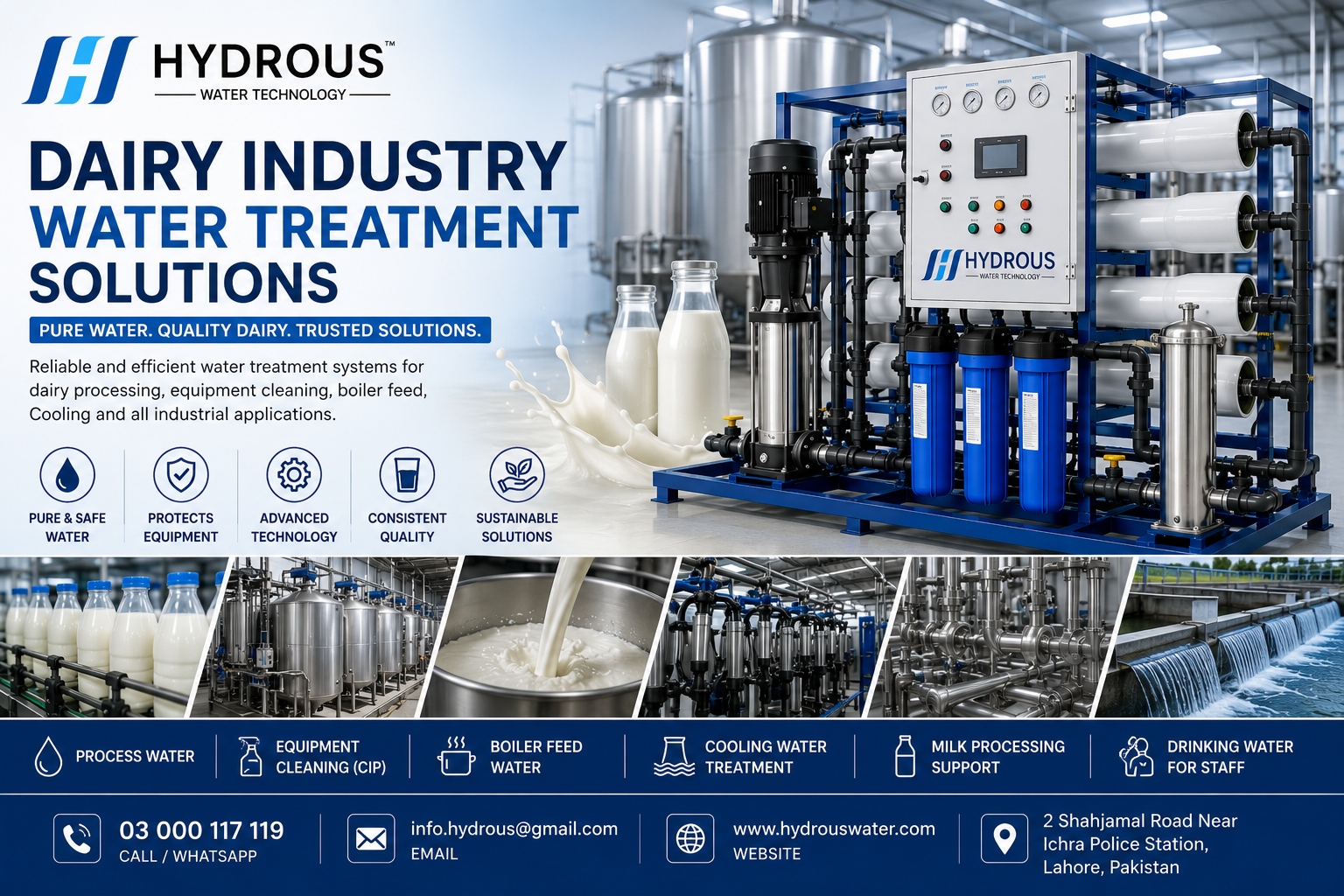
Industrial RO and water treatment solutions for dairy processing facilities in Pakistan.
Why Water Treatment Matters in Dairy Processing
A modern dairy facility can use water in several areas of operation.
These may include:
- Milk-processing support
- Equipment and pipeline cleaning
- CIP operations
- Bottle and container washing
- Floor and facility cleaning
- Boiler feed
- Steam generation
- Cooling systems
- Laboratory operations
- General utility water
- Drinking water
The required water quality is not necessarily the same for each application.
Water being treated for a boiler, for example, has different operational requirements from water intended for drinking or certain processing applications.
For this reason, an efficient dairy water treatment plant should be designed according to the specific water-use points within the facility.
Common Water Problems in Dairy Plants
The problems encountered in a dairy facility depend heavily on the source water.
A bore-water supply can be very different from municipal water, and even groundwater quality can vary considerably from one location to another.
Some parameters that may influence treatment design include:
Hardness
Calcium and magnesium can contribute to scale formation in pipes, heat exchangers, boilers, RO membranes and other equipment.
High TDS
High concentrations of dissolved salts may require reverse osmosis where lower-TDS water is needed.
Suspended Solids
Sediment and turbidity can interfere with equipment and increase the load on downstream filtration.
Iron
Elevated iron may cause deposits, staining and treatment-system problems.
Chlorine
Where chlorinated feed water is used, chlorine management may be necessary before chlorine-sensitive RO membranes.
Silica and Alkalinity
These parameters can influence scaling potential and should be considered when designing higher-recovery RO systems.
This is why TDS alone is not enough to design an industrial RO plant.
RO Plant for Dairy Industry
Reverse osmosis is an important treatment technology for many dairy facilities where reduction of dissolved salts is required.
A properly designed RO plant for a dairy industry may provide treated water for different process and utility applications, depending on the required water specification.
Industrial RO systems can be designed according to:
- Feed-water analysis
- Required flow rate
- Product-water specification
- Operating hours
- Recovery target
- Feed pressure
- Pretreatment requirements
- Storage capacity
- Future expansion
Rather than selecting a system based only on GPD or LPH, the complete treatment process should be evaluated.
Typical Dairy Water Treatment Process
There is no universal treatment sequence for every dairy factory.
Depending on the raw water, a possible configuration could be:
Raw Water Tank → Multimedia Filter → Activated Carbon Filter → Water Softener / Antiscalant → Cartridge Filter → Industrial RO Plant → Post-Treatment → Treated Water Tank
For some applications, additional technologies may be required.
These can include:
- UV treatment
- Ultrafiltration
- Chemical dosing
- Specialized filtration
- Deionization
Conversely, not every dairy facility needs every treatment stage shown above.
The correct configuration should be based on water analysis and the intended use of the treated water.
Pretreatment for Dairy RO Plants
Good RO performance starts before water reaches the membranes.
Pretreatment is designed to reduce contaminants that can contribute to fouling, scaling or membrane damage.
Multimedia Filtration
Multimedia filters can reduce suspended solids and turbidity from suitable feed water.
They are often installed as an early treatment stage before more sensitive equipment.
Activated Carbon Filtration
Activated carbon can be used for appropriate applications to reduce chlorine and certain organic compounds, as well as taste and odor issues.
Chlorine control is particularly important where chlorine-sensitive polyamide RO membranes are used.
Water Softening
A water softener reduces hardness through ion exchange.
Softening can be useful where high calcium and magnesium concentrations create scaling concerns.
Cartridge Filtration
Cartridge filters provide fine filtration immediately before the RO system and help protect high-pressure pumps and membranes from particulate matter.
Antiscalant Dosing
Where appropriate, antiscalant can be dosed before the RO system to help control the precipitation of certain scale-forming salts.
Antiscalant selection and dosage should be based on feed-water chemistry and system design.
Water Softener for Dairy Industry
Hardness can create significant operational problems in facilities that heat, circulate or purify water.
Scale can form on:
- Heat-transfer surfaces
- Boilers
- Pipelines
- RO membranes
- Heating equipment
- Washing systems
A correctly sized industrial water softener can reduce calcium and magnesium hardness before water enters sensitive equipment.
A typical configuration may be:
Raw Water → Filtration → Water Softener → RO Plant
or, for a particular utility:
Filtered Water → Water Softener → Boiler Feed System
Softener sizing should consider water hardness, flow rate, resin capacity and regeneration requirements.
Process Water for Dairy Production
Process-water requirements depend on how the water is being used within the dairy operation.
Where water comes into direct or indirect contact with food-processing operations, its required quality should be established according to the facility’s process and applicable quality requirements.
A process-water treatment system may therefore incorporate:
- Filtration
- Activated carbon
- Softening
- Reverse osmosis
- UV
- Ultrafiltration
- Other polishing stages
The objective should not be to achieve the lowest possible TDS simply because RO equipment can do so.
The objective is to produce water appropriate for the intended process.
Water Treatment for CIP & Equipment Cleaning
Cleaning-in-place systems are important in many dairy-processing environments.
Water characteristics can affect cleaning performance, chemical consumption and mineral deposition on equipment.
Hardness, for example, may contribute to deposits when untreated water is repeatedly heated or used in cleaning processes.
Depending on plant requirements, treated water used for cleaning may come from:
- Softened-water systems
- Filtered-water systems
- RO systems
- Other appropriately treated sources
The required quality should be established by the facility according to its cleaning process and operating requirements.
Boiler Feed Water Treatment for Dairy Plants
Steam is widely used in food and dairy processing.
Boiler feed water quality can directly affect boiler operation.
Untreated or inadequately treated water may contribute to:
- Scale
- Corrosion
- Deposits
- Poor heat transfer
- Increased blowdown
- Maintenance problems
A dairy boiler-water treatment arrangement may include:
Raw Water → Filtration → Softener → RO → Chemical Dosing → Boiler Feed
The actual configuration depends on the boiler operating pressure, feed-water chemistry, condensate return and manufacturer’s requirements.
Why RO May Be Used for Boiler Feed
Softening primarily addresses hardness, while RO can substantially reduce dissolved salts.
For certain boiler applications, combining these technologies can provide better feed-water control.
A typical arrangement could therefore use:
Softener → RO → Boiler Feed Treatment
However, whether RO is economically justified depends on the boiler and water conditions.
It should not be added automatically to every boiler installation.
Cooling Water Treatment for Dairy Facilities
Cooling towers and other recirculating cooling systems can develop problems related to:
- Scale
- Corrosion
- Suspended solids
- Biological growth
Treatment may involve a combination of water-quality management and chemical control.
Depending on the system, solutions may include:
- Filtration
- Softening
- Chemical dosing
- Scale inhibitors
- Corrosion inhibitors
- Biocides
- Blowdown control
Hydrous Water Technology also supplies chemicals for industrial cooling-water applications.
Ultrafiltration for Dairy Water Treatment
Ultrafiltration uses membrane technology to remove fine suspended material and other larger contaminants within its separation range.
UF can be used in selected industrial water-treatment applications either as a primary treatment stage or in combination with other technologies.
For example:
Raw Water → Pretreatment → UF → RO
may be considered for certain challenging feed-water conditions.
The decision to use UF should be based on the raw-water characteristics and treatment objectives rather than simply adding another membrane stage.
UV Treatment
UV can provide an additional treatment barrier for appropriate water-treatment applications.
A UV system may be positioned after filtration or other purification processes depending on the project design.
For example:
RO → UV → Treated Water Storage
may be used in selected applications.
UV equipment must be correctly sized for the flow and operating conditions, and upstream water quality affects its performance.
Industrial RO Plant Capacity for Dairy Factories
Dairy facilities vary significantly in size.
The correct RO capacity should therefore be calculated from actual water consumption rather than selecting an arbitrary system.
For example, if a facility requires 24,000 litres of treated water per day and wants the RO system to operate for approximately 12 hours:
24,000 ÷ 12 = 2,000 litres per hour
The theoretical production requirement would therefore be approximately 2,000 LPH.
However, practical design should also consider:
- Peak demand
- Storage capacity
- Downtime
- Membrane performance
- Feed-water temperature
- Cleaning requirements
- Future expansion
- Operating schedule
A reasonable design margin may therefore be required.
Water Recovery & RO Reject Water
Industrial RO systems produce both permeate and concentrate.
The percentage of feed water converted into permeate is known as recovery.
For example, if an RO system receives 2,000 litres per hour of feed water and produces 1,300 litres per hour of permeate:
Recovery = 1,300 ÷ 2,000 × 100 = 65%
The remaining flow leaves as concentrate.
Higher recovery is not automatically better.
Recovery should be selected according to feed-water chemistry, scaling potential, membrane design and operating requirements.
Can RO Reject Water Be Reused?
Depending on its quality and the site’s requirements, RO concentrate may sometimes be considered for non-product applications where appropriate.
Possible uses can vary by facility.
However, concentrate has a higher dissolved-salt concentration than the incoming feed stream, so its suitability should be evaluated before reuse.
Reuse should never be assumed solely for the purpose of claiming zero wastewater.
Water Quality Testing Before Plant Design
Before recommending a dairy water treatment system, we recommend obtaining a representative raw-water analysis.
Important parameters may include:
- pH
- TDS
- Conductivity
- Total hardness
- Calcium
- Magnesium
- Alkalinity
- Chloride
- Sulphate
- Iron
- Silica
- Turbidity
- Chlorine, where relevant
- Microbiological parameters where relevant
Additional testing may be necessary depending on the water source and intended application.
A complete analysis helps determine:
Pretreatment → Membrane selection → Recovery → Chemical dosing → Post-treatment
more accurately.
Monitoring an Industrial Dairy RO Plant
A water treatment plant should be monitored rather than operated until water quality visibly deteriorates.
Useful RO operating parameters include:
Feed Pressure
Helps assess the hydraulic condition of the system.
Differential Pressure
Changes can indicate fouling or flow restrictions.
Permeate Flow
A reduction can indicate changes in operating conditions or membrane performance.
Conductivity / TDS
Helps monitor feed and product-water quality.
Salt Rejection
Provides an important indicator of RO membrane separation performance.
Flow Rates
Feed, permeate and concentrate flow should be monitored to understand recovery and system operation.
Recording these parameters creates a useful operating history for troubleshooting.
RO Membrane Cleaning & Maintenance
RO membranes can experience fouling and scaling over time.
Possible causes include:
- Hardness scale
- Silica-related deposits
- Iron
- Suspended solids
- Organic fouling
- Biological fouling
Membrane cleaning should be based on system performance and the likely type of foulant.
Acidic and alkaline cleaning chemicals serve different purposes, and the correct cleaning procedure should follow membrane and chemical supplier recommendations.
Hydrous provides RO membrane cleaning chemicals for industrial water-treatment applications.
Water Treatment Chemicals for Dairy Facilities
Chemical treatment can be part of the overall water-management program.
Depending on the application, products may include:
- RO antiscalant
- Acidic membrane cleaner
- Alkaline membrane cleaner
- Biocide
- Boiler treatment chemicals
- Cooling-tower treatment chemicals
- pH-control chemicals
Chemical dosing should be based on water chemistry and operating requirements.
Using more chemical than necessary is not a substitute for correct system design.
Designing a Dairy Water Treatment Plant
At Hydrous Water Technology, we recommend following an engineering-based design process.
Step 1 — Identify the Water Source
Is the plant using bore water, municipal water or another source?
Step 2 — Test the Raw Water
Obtain the parameters required to understand the feed-water chemistry.
Step 3 — Identify Water Uses
Determine how much water is needed for process, cleaning, boiler, cooling and other applications.
Step 4 — Define Required Water Quality
Different applications may require different water specifications.
Step 5 — Calculate Capacity
Determine hourly and daily water requirements and the appropriate operating schedule.
Step 6 — Design Pretreatment
Select filtration, softening, chemical dosing or other processes according to the analysis.
Step 7 — Design the Main Treatment System
This may include RO, UF, UV or another appropriate technology.
Step 8 — Plan Storage & Distribution
The treatment plant, storage and water distribution should work as one system.
Step 9 — Installation & Commissioning
Equipment should be properly installed and commissioned before routine operation.
Step 10 — Establish Maintenance
Filters, membranes, chemicals, pumps and instrumentation should be monitored according to the system’s requirements.
Applications of Treated Water in Dairy Facilities
A dairy facility may require different treatment systems for different applications.
Dairy Processing
Treated water can support production processes according to the facility’s required specifications.
CIP & Cleaning
Softened, filtered or otherwise treated water can be used depending on the cleaning process.
Boiler Feed
Softening, RO and chemical treatment may be required depending on boiler requirements.
Cooling Towers
Water-quality and chemical control can help manage scale, corrosion and biological growth.
Laboratory
RO or further purification may be required depending on laboratory requirements.
Drinking Water
Commercial RO and filtration systems can provide treated drinking water for staff and facilities.
Benefits of a Properly Designed Dairy Water Treatment System
Consistent Water Quality
A properly selected treatment train provides water according to the intended application.
Scale Control
Softening, RO and chemical treatment can help control mineral scaling where appropriate.
RO Membrane Protection
Correct pretreatment reduces the load on RO membranes.
Equipment Protection
Water treatment can help reduce water-related deposits and operational problems.
Better System Efficiency
Correctly sized equipment avoids unnecessary capital and operating costs.
Easier Maintenance
Proper instrumentation and monitoring make it easier to identify changes in system performance.
Expandable Design
Future production requirements can be considered during the initial design.
Why Choose Hydrous Water Technology?
Hydrous Water Technology provides commercial and industrial water treatment solutions for businesses across Pakistan.
Our product and service range includes:
- Industrial RO plants
- Commercial RO plants
- Water filtration plants
- Industrial water softeners
- Ultrafiltration systems
- Deionization systems
- Chemical dosing systems
- RO membranes
- Membrane housings
- Pumps and components
- RO antiscalant
- Membrane cleaning chemicals
- Boiler treatment chemicals
- Cooling-tower chemicals
- Installation
- Commissioning
- Maintenance and technical support
Rather than offering the same RO package for every customer, we focus on water analysis, required capacity and application.
Need a Water Treatment Plant for Your Dairy Facility?
Whether you are planning a new dairy processing unit or upgrading an existing treatment plant, the first step is understanding your water requirements.
For a more accurate technical recommendation, share:
- Raw-water test report
- Required treated-water capacity
- Water source
- Daily operating hours
- Intended use of treated water
- Required product-water quality
- Details of existing treatment equipment, if any
Our technical team can use this information to evaluate a suitable treatment configuration.
Frequently Asked Questions
What water treatment system is suitable for a dairy factory?
It depends on the source water and intended application. A dairy water treatment plant may include filtration, activated carbon, softening, RO, UV, UF and chemical treatment in different combinations.
Does a dairy plant need an RO system?
Not every application requires RO. RO is useful where dissolved salts and other contaminants need to be reduced. The need should be determined from the water analysis and required product-water quality.
Why is a water softener used in dairy plants?
A softener reduces calcium and magnesium hardness and can help control scale in boilers, pipelines, heating equipment and certain water-treatment systems.
What is the difference between a water softener and an RO plant?
A softener primarily exchanges hardness ions, while RO provides much broader reduction of dissolved salts through membrane separation. They serve different purposes and are sometimes used together.
Can RO be used for dairy boiler feed water?
Yes, RO may form part of a boiler feed-water treatment system where reduced dissolved solids are required. The complete treatment depends on the boiler and feed-water conditions.
How do I select RO capacity for a dairy plant?
Calculate the total treated-water requirement, operating hours and peak demand. Storage, downtime and future expansion should also be considered.
Is raw-water testing necessary before buying an industrial RO plant?
It is strongly recommended. A detailed analysis helps determine pretreatment, membrane configuration, recovery and chemical dosing.
Does Hydrous provide customized dairy RO plants?
Yes. Systems can be configured according to raw-water quality, required capacity and the intended application.
Does Hydrous provide installation and maintenance?
Yes. Hydrous provides installation, commissioning and maintenance support for industrial and commercial water-treatment systems according to project requirements.
Do you supply water treatment chemicals?
Yes. Hydrous supplies chemicals for RO systems, membrane cleaning, boiler-water treatment and cooling-water applications.