
Food & Beverage Industry Water Treatment Solutions in Pakistan
Water is an essential part of food and beverage manufacturing. It can be used as an ingredient, for product preparation, equipment cleaning, bottle washing, steam generation, cooling and many other production activities.
Because water can directly or indirectly affect production, consistent water quality is an important part of a reliable food and beverage operation.
Hydrous Water Technology provides customized food and beverage industry water treatment solutions in Pakistan, including industrial RO plants, commercial RO systems, filtration, water softeners, ultrafiltration, UV treatment, chemical dosing and other supporting equipment.
Our systems are designed according to the raw-water quality, required capacity and intended application, rather than using the same treatment configuration for every facility.
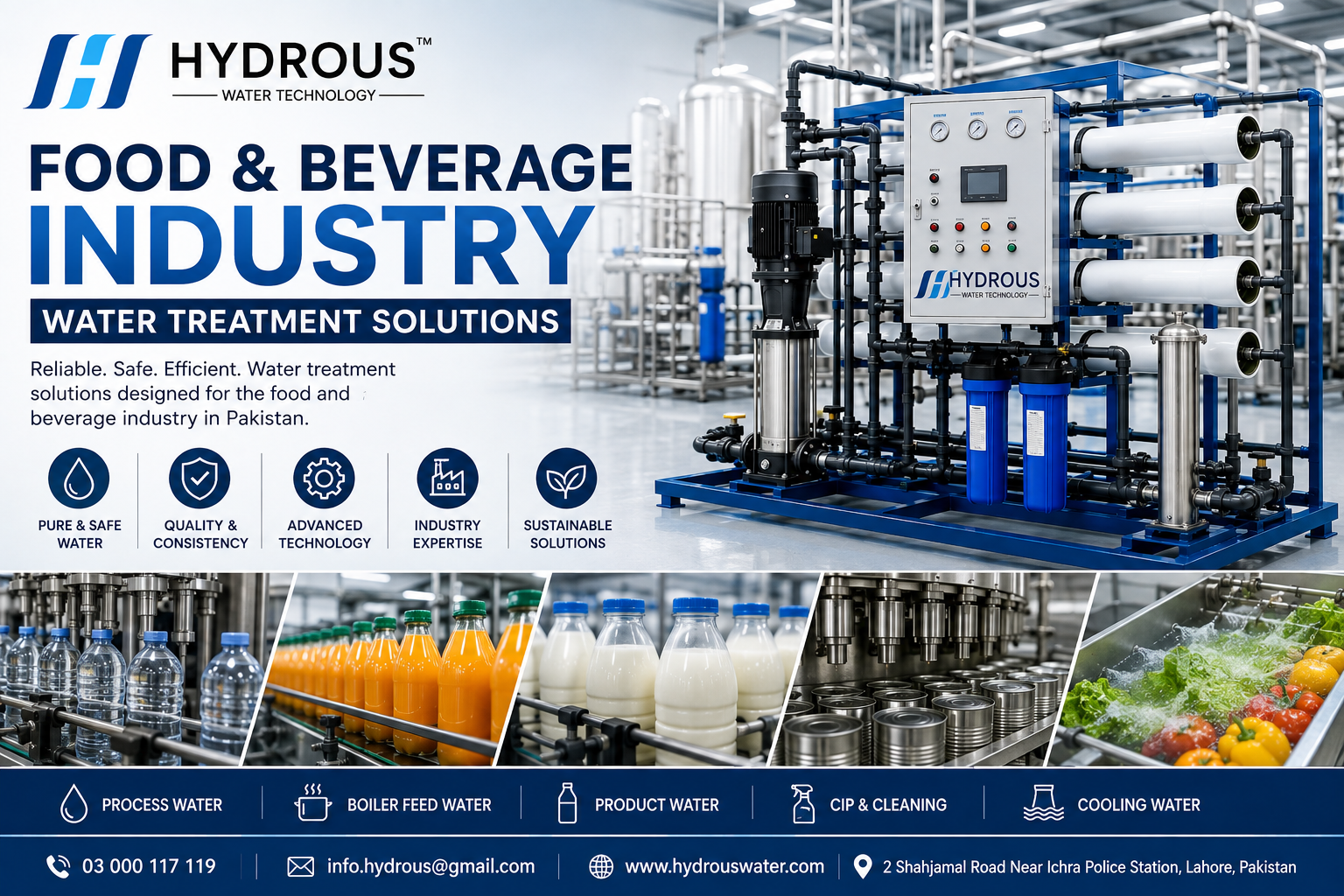
Industrial RO and water treatment solutions for food and beverage facilities in Pakistan.
Why Water Treatment Is Important in the Food & Beverage Industry
Food and beverage facilities can have several different water requirements within the same plant.
Water may be used for:
- Product manufacturing
- Ingredient preparation
- Beverage production
- Bottling
- Bottle and container washing
- Equipment cleaning
- CIP-related processes
- Steam generation
- Cooling systems
- Staff and facility use
The quality required for each application may be different.
For example, water used as an ingredient can require a different treatment approach from water used for general cleaning or cooling.
A properly designed treatment system helps a facility achieve the required water quality for its intended application while also protecting equipment from problems associated with poor-quality feed water.
Water Treatment for Food Processing Plants
Food processing facilities may use significant volumes of water throughout their operations.
Depending on the type of food being manufactured, water may be used in:
- Washing raw materials
- Food preparation
- Processing
- Ingredient mixing
- Equipment cleaning
- Packaging
- Boiler systems
- Cooling systems
The treatment system should therefore be designed around the plant’s actual water consumption and production process.
A typical treatment arrangement may include:
Raw Water → Pretreatment → Filtration → RO → UV/Other Treatment → Treated Water Storage → Distribution
This is only an example. The actual configuration should be determined from water analysis and the specific application.
RO Plant for Food & Beverage Industry
Reverse osmosis is widely used as a purification stage where reduction of dissolved salts and other contaminants is required.
An industrial RO plant for the food and beverage industry can be used for applications such as:
- Process water
- Ingredient water
- Beverage production
- Bottling
- Cleaning
- Utility water
- Boiler feed pretreatment
The required RO capacity depends on the facility’s water demand.
Hydrous can design RO systems according to requirements such as:
- LPH production
- GPD capacity
- Raw-water TDS
- Feed-water chemistry
- Operating hours
- Required product-water quality
- Recovery requirements
- Available storage
- Application
A water analysis should be reviewed before finalizing the RO design.
Beverage Industry Water Treatment
Water quality is particularly important when water becomes part of a beverage.
Depending on the beverage manufacturing process, treated water may be used for:
- Soft drinks
- Juices
- Flavored drinks
- Bottled drinking water
- Syrups
- Concentrates
- Other beverage products
A treatment system may incorporate:
Multimedia Filtration → Activated Carbon → Cartridge Filtration → RO → UV → Storage
However, the actual configuration depends on the source water and the required finished-water specification.
For beverage production, consistency is especially important because changes in water chemistry can affect the manufacturing process and product characteristics.
Water Treatment for Bottled Water Production
Bottled-water facilities require a reliable purification process before treated water reaches the filling and packaging section.
Depending on the source water, a plant may include:
Raw Water Storage
Provides a controlled supply of incoming water to the treatment plant.
Multimedia Filtration
Reduces suspended particles and turbidity.
Activated Carbon Filtration
Can be used to reduce chlorine, taste, odor and certain organic compounds where appropriate.
Water Softening
Can reduce hardness and help control scaling.
Cartridge Filtration
Provides additional fine filtration before the RO system.
Reverse Osmosis
Reduces dissolved salts and other contaminants.
UV Treatment
Can be incorporated for additional microbiological control where appropriate.
Treated Water Storage
Provides a controlled supply for downstream production.
The final process should always be based on raw-water testing and the specifications of the bottled-water operation.
Water Filtration for Food & Beverage Plants
RO is not always the first or only treatment technology required.
Pretreatment can be an important part of a complete water treatment system.
Depending on the source water, filtration may include:
Multimedia Filtration
Used to reduce suspended solids and turbidity.
Activated Carbon Filtration
Used where chlorine, taste, odor or certain organic contaminants need to be reduced.
Cartridge Filtration
Provides finer filtration and can help protect downstream equipment.
Iron Removal
Where elevated iron is present, specialized treatment may be required before RO or other purification equipment.
Specialized Filtration
Certain raw-water conditions may require additional treatment technologies.
The objective is to create a treatment train that matches the water chemistry rather than adding unnecessary equipment.
Water Softener for Food Processing
Hard water contains calcium and magnesium that can contribute to scale formation.
In food and beverage plants, hardness can affect:
- Boilers
- Heat exchangers
- Washing equipment
- RO membranes
- Pipes
- Hot-water systems
- Process equipment
A water softener uses ion-exchange technology to reduce hardness.
Depending on the application, a softener may be installed before an RO plant or used separately for specific utility applications.
The need for softening should be confirmed through a water analysis.
UV Water Treatment for Food & Beverage Applications
Ultraviolet treatment can be incorporated into water treatment systems where additional microbiological control is required.
UV treatment can be used as part of a larger purification process, but it does not replace all other treatment stages.
For example:
Filtration → RO → UV → Treated Water
may be appropriate for certain applications.
The UV system should be correctly sized according to flow rate and the required application.
Water Treatment for Food Processing Equipment
Water quality can also affect equipment performance.
Poor-quality water may contribute to:
- Scale formation
- Corrosion
- Fouling
- Blockages
- Membrane problems
- Increased maintenance
- Reduced heat-transfer efficiency
Appropriate pretreatment and water-quality management can help protect equipment and reduce avoidable operational problems.
For example, a plant using high-hardness water may need softening or another hardness-control strategy before certain equipment.
Boiler Feed Water Treatment for Food Industries
Many food and beverage plants use boilers to generate steam.
Boiler feed water may require treatment to reduce problems associated with hardness, dissolved solids and other contaminants.
Depending on the boiler and water chemistry, a treatment system may include:
Filtration → Softening → RO → Chemical Treatment → Boiler Feed
The appropriate treatment depends on factors such as:
- Boiler pressure
- Feed-water chemistry
- Steam requirements
- Condensate recovery
- Operating hours
- Existing treatment system
Proper boiler-water management can help reduce scale and corrosion and support efficient operation.
Cooling Water Treatment
Food and beverage facilities may also use cooling systems and cooling towers.
Cooling-water treatment may address issues such as:
- Scaling
- Corrosion
- Biological growth
- Suspended solids
Depending on the system, treatment can include filtration, chemical dosing, water-quality monitoring and other control measures.
Hydrous supplies water treatment chemicals for industrial applications, including products used in RO, boiler and cooling-water treatment.
Water Quality Testing for Food & Beverage Plants
Before selecting an industrial water treatment system, it is important to understand the quality of the incoming water.
A typical water analysis may include:
- TDS
- Conductivity
- pH
- Total hardness
- Calcium
- Magnesium
- Alkalinity
- Chloride
- Sulphate
- Iron
- Silica
- Turbidity
- Total dissolved solids
- Microbiological parameters
- Other application-specific parameters
Not every project requires every parameter.
The appropriate testing package depends on the water source and intended application.
TDS alone should not be used to determine the complete treatment system.
Designing a Food & Beverage Water Treatment System
At Hydrous Water Technology, we recommend starting with the application rather than simply selecting an RO plant by capacity.
Step 1 — Analyze the Raw Water
We review the available laboratory report to identify important water-quality characteristics.
Step 2 — Understand the Production Process
We determine where treated water will be used within the facility.
Step 3 — Calculate Water Demand
The system capacity can be calculated based on:
- Daily consumption
- Peak demand
- Production requirements
- Operating hours
- Storage capacity
Step 4 — Select Pretreatment
Depending on the water chemistry, this may include:
- Multimedia filtration
- Activated carbon
- Softening
- Iron removal
- Cartridge filtration
- Chemical dosing
Step 5 — Select the Main Treatment
Depending on the application:
RO | UF | UV | DI | Softening | Filtration
may be incorporated.
Step 6 — Storage & Distribution
Treated-water storage and distribution should be considered as part of the complete system.
Step 7 — Installation & Commissioning
Equipment is installed, connected and commissioned according to the project requirements.
Step 8 — Maintenance
Regular maintenance helps maintain water quality and equipment performance.
Food & Beverage Applications We Serve
Hydrous water treatment solutions can be designed for a variety of food and beverage facilities.
Beverage Manufacturing
For facilities producing drinks, juices, syrups and related products.
Bottled Water Plants
For purification and treatment before filling and packaging.
Food Processing
For food preparation, processing and plant utilities.
Dairy Processing
For production support, cleaning and utility applications.
Bakeries
For ingredient preparation, cleaning and general facility requirements.
Commercial Food Production
For centralized water treatment in larger kitchens and food-production facilities.
Restaurants & Central Kitchens
For drinking water, cooking, cleaning and other commercial applications.
Water Treatment Chemicals for Food & Beverage Facilities
Water treatment chemicals may be required for specific industrial applications.
Depending on the treatment system, these may include:
- RO antiscalants
- Membrane cleaning chemicals
- Biocides
- Boiler treatment chemicals
- Cooling-tower chemicals
- pH-control chemicals
Chemical selection should be based on the treatment system, water chemistry and manufacturer’s recommendations.
Hydrous Water Technology supplies a range of water treatment chemicals and related products for commercial and industrial applications.
RO Membrane Protection
RO membranes can be affected by scaling and fouling when pretreatment or operating conditions are not properly controlled.
Common causes can include:
- High hardness
- Suspended solids
- Organic fouling
- Biological growth
- Silica
- Incorrect chemical dosing
- Poor pretreatment
- Improper operating conditions
A well-designed pretreatment system can reduce the contaminant load reaching the membranes.
Regular monitoring of:
- Feed pressure
- Permeate flow
- Salt rejection
- Differential pressure
can also help identify changes in RO performance.
RO Membrane Cleaning
Membrane cleaning should not simply be performed according to an arbitrary calendar schedule.
Cleaning requirements can be identified through changes in system performance.
Depending on the type of fouling, different cleaning approaches may be required.
For example:
- Scale deposits may require an appropriate acidic cleaning procedure.
- Organic or biological fouling may require an appropriate alkaline or specialized cleaning procedure.
The cleaning chemical and procedure should be selected according to the membrane manufacturer’s recommendations and the identified foulant.
Benefits of a Properly Designed Food & Beverage Water Treatment System
A suitable treatment system can provide several operational benefits.
Consistent Water Quality
Helps provide water suitable for the intended production or utility application.
Equipment Protection
Pretreatment can reduce scaling and fouling risks.
Better Process Control
Consistent feed water can support more predictable production conditions.
Reduced Maintenance
Appropriate treatment can reduce avoidable problems with membranes and equipment.
Efficient Operation
A properly sized system avoids unnecessary treatment capacity and equipment.
Flexible Design
The system can be designed around current requirements while considering future expansion.
Why Choose Hydrous Water Technology?
Hydrous Water Technology provides industrial and commercial water treatment solutions in Pakistan.
Our solutions include:
- Industrial RO plants
- Commercial RO plants
- Water filtration systems
- Water softeners
- Ultrafiltration systems
- Deionization systems
- UV systems
- RO membranes
- Membrane housings
- Pumps
- Chemical dosing systems
- Water treatment chemicals
- RO membrane cleaning chemicals
- Installation
- Commissioning
- Maintenance
Our goal is to provide a treatment system that fits the customer’s water source, capacity and application.
Get a Water Treatment Solution for Your Food or Beverage Plant
Planning a new food-processing or beverage facility?
Or are you experiencing problems with an existing water treatment system?
Share the following information with our technical team:
1. Raw-water laboratory report
2. Required water production capacity
3. Water source
4. Intended application
5. Required treated-water quality
6. Operating hours per day
7. Existing treatment equipment
Based on this information, a suitable treatment configuration can be evaluated.
Frequently Asked Questions
What type of water treatment is used in the food industry?
The treatment depends on the water source and application. Systems can include multimedia filtration, activated carbon, softening, RO, UV, UF and other technologies.
Is RO suitable for food and beverage production?
RO can be suitable for many food and beverage applications, particularly where dissolved salts and other contaminants need to be reduced. The final treatment configuration depends on the intended use of the water.
What type of RO plant is required for a beverage factory?
The capacity and configuration depend on production requirements, water consumption, operating hours, raw-water quality and required treated-water quality.
Does a food-processing plant need a water softener?
Not necessarily. A softener may be useful when hardness is high and scale control is required. The requirement should be determined from water analysis and the specific application.
Can RO water be used as ingredient water?
It can be used for certain applications, but suitability depends on the product, process and required water-quality specification. Additional treatment or conditioning may be required.
Why is water testing important before buying an RO plant?
Water analysis identifies contaminants that can affect RO performance and pretreatment requirements. It helps avoid selecting an unsuitable or unnecessarily expensive system.
Does Hydrous provide customized industrial RO plants?
Yes. Industrial RO systems can be designed according to the required capacity, raw-water quality and application.
Does Hydrous provide water treatment chemicals?
Yes. Hydrous supplies various water treatment chemicals for RO, membrane cleaning, boiler and cooling-water applications.
Do you provide installation and maintenance?
Yes. Hydrous provides installation, commissioning and maintenance support for water treatment systems according to project requirements.
Do you provide food and beverage water treatment solutions across Pakistan?
Yes. Hydrous provides commercial and industrial water treatment solutions to customers across Pakistan.